


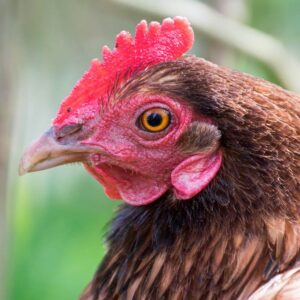
Chicken eyes have similarities and differences to human eyes, and what chickens see is different from what we see, it’s also different from what dogs see. Evolution is the driving force behind how vision develops for different species. Placement of the eyes, the number of rods, cones, and other special eye structures, plus other factors all play a role in how a species sees the world. It’s fascinating!
Monocular And Binocular Vision
Humans have forward-facing eyes that work together to see mostly with binocular vision, while chickens have eyes on either side of their head that work almost independently to see mostly with monocular vision. This means that human eyes see an overlapping field of vision that improves depth perception. However, it also means that the field of vision is reduced. Humans have about a 180-degree field of vision, with 120 of that being overlap between the two eyes. Chickens enjoy a whopping 300-degree field of vision because of the side placement of their eyes, but only about 30 degrees of that is overlap.
What does all this mean for backyard chickens? Chickens developed a greater field of vision because they are prey animals that need the best chance to see a predator before it attacks. They only have 60 degrees of blind spot behind them, and by moving their head they can easily get a full view of their surroundings. Although the lack of depth perception prevents them from knowing exactly how far away a predator is, seeing it earlier is more important.
Seeing The World In Color
Color perception is all about cones in the eyes. These light-sensing cells detect color. Chickens are tetrachromatic, meaning they see four colors: red, green, blue, and violet (including some ultraviolet). Humans are trichromatic, seeing three colors: red, green, blue. So, chickens see more colors than we do.
Because they can see violet and some ultraviolet, it’s said that chickens can look at the sky and see which way is north by the gradient of ultraviolet. It’s also said that young chicks have an ultraviolet “glow,” so the mother hen can see which are healthy and glow, and which might be ailing.
Besides these single cones for color sensing and day vision, chickens also possess double cones that provide an enhanced ability to detect motion. Yet another valuable trait for a prey animal.
Low Light And Bright Light
In bright light, chickens have a better ability to see shapes and details (acuity), but overall their acuity is only about 25% of human visual acuity. Chickens can see light as high as 105 Hz while humans top out at 60 Hz. This means that a light that looks continuous to us at 80 Hz will be flickering for a chicken. A light source must exceed the maximum Hz of a species in order to appear continuous. The Hz range can vary by individual and also by other environmental conditions.
One area where human vision excels beyond chicken vision is low-light situations. While cones are the cells that sense color and used for daytime vision, rods are used for night vision. And chickens don’t have a lot of rods in their eyes. Humans have more rods so we have better night vision than chickens, but not as many rods as nocturnal animals like cats.
Fun Chicken Eye Facts
Just a few fun facts about chicken eyes to ponder:
- Chickens can’t move their eyes much, so instead they move their head.
- Chickens’ bottom eyelid closes upward to close the eye, the reverse of how humans close their eyes.
- Chickens have a third eyelid, the nictitating membrane, which sweeps across the eye quickly from the side to keep it clear and moist. Many birds, reptiles, amphibians, fish, and mammals have a nictitating membrane, including cats and dogs. Primates don’t have it.
- Chicken eyes take up about 10% of the mass of their head, while human eyes take up about 1% of the mass of our head. Proportionally, chickens have big eyes!