

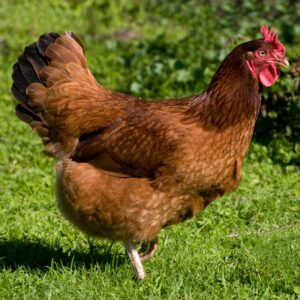
The Rhode Island Red might win the chicken popularity contest, if such a thing existed. The Livestock Conservancy website states: “The Rhode Island Red is not only America’s best known breed, but is perhaps the world’s best known fowl.” This popularity is likely due to its success as a dual-purpose breed, with excellent egg-laying capabilities. The Rhode Island Red is calm and usually friendly. The standard calls for it to have a long flat back and deep breast to create a bricklike silhouette that’s distinctive to the breed. It’s classified as a heavy breed. It can have either a single comb or rose comb, but the single comb is much more prevalent.
- ColorRed
- Skin ColorYellow
- LifespanAbout 5 to 8 years
- Weight6.5 to 8.5 pounds


Origin
The Rhode Island Red was developed in the late 1800s in Rhode Island and southern Massachusetts. The goal of breeding was to create a great dual purpose bird that laid well and put on weight.
Housing And Care
Housing for the Rhode Island Red is the same as all chickens need. A chicken coop or shed must provide safety, perches, nest boxes, room to move, be dry, and be ventilated but not drafty. It must contain accessories, such as water and food dispensers. Chickens also require an area for dust bathing, which could be in a run that is part of the coop, attached to the coop, or a fenced area adjacent to the coop.
Food is another basic necessity. Nutritious food is a must. Some chicken breeds also forage when given access to safe, fenced-in areas. Foraging is enjoyable and a fun activity for some breeds, but foraging can never take the place of nutritious chicken food. Supplements also help for different needs. We humbly suggest Booster Berries Enrich for egg laying support, Booster Berries Radiate for feather health, and Booster Berries Senior for older chickens.
Showing And Personality
The first Rhode Island Red was recognized by the American Poultry Association in 1904. It is available in both bantam and large fowl sizes. In 2023, the Rhode Island Red graduated from the Conservation Priority List published by The Livestock Conservancy because its population numbers had improved significantly.
All chickens are individuals. Temperament, noise level, egg production, size, and other characteristics can vary. Chickens typically live 7 to 9 years. The information below is for the large fowl Rhode Island Red, not the smaller bantam.
Rhode Island Red Chicken Overview
Purpose: Egg laying and meat
Egg Production: Very good (250+ eggs per year)
Egg Size & Color: Large, brown
Skin Color: Yellow
Size: Classified as Large Fowl by the American Poultry Association; Listed as 6.5 to 8.5 pounds by Livestock Conservancy
Temperament: Generally hardy and friendly
Noise Level: Moderate
Climate Needs: Adaptable to hot or cold
Origin: United States (American class)
Recognized Varieties: Rose Comb, Single Comb