

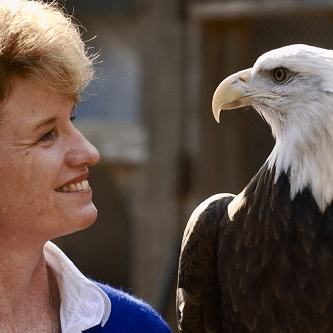
Dr. Julia Ponder
Julia Ponder, DVM, MPH served as Executive Director of The Raptor Center from 2007-2021 and Associate Dean for External Partnerships and Engagement at the University of Minnesota (UMN) College of Veterinary Medicine from 2021 until she retired in 2024.
Julia earned both a bachelor’s degree in biomedical science in 1982 and a doctorate in veterinary medicine in 1984 from Texas A&M University. She had 17 years of experience as a small animal practitioner before joining UMN in 2002 as a Staff Veterinarian at The Raptor Center (TRC), one of the leading programs in the world for raptor medicine. Dr. Ponder was named interim director of TRC in 2005.
“While I …have a lifetime passion for birds, my first true bird job was staff veterinarian at The Raptor Center.”—Juli Ponder, 2015 AAV Member Spotlight
Wild birds or raptors made up virtually all of Dr. Ponder’s clinical practice at TRC, from rare species, like the California condor, to commonplace birds, like the red-tailed hawk.
Clinical excellence
Dr. Ponder’s career has advanced the knowledge and practice of avian medicine, with special focus on wild birds and conservation. She is internationally recognized as one of the foremost experts in raptor medicine and avian orthopedics and has lectured on these topics across the globe. Of the more than 100 presentations she has delivered at conferences, over one-third focused specifically on avian orthopedics. Dr. Ponder has also been regularly asked to present on best practices in avian anesthesia, emergency medicine, as well as general raptor medicine at major veterinary and specialty conferences.
Dr. Ponder has shared her knowledge through direct consultation with veterinarians around the world, providing advice on challenging cases and advancing clinical outcomes for birds of prey. She has also consulted on a variety of ecosystem health issues globally. In 2009, she was part of a team working with the Galápagos National Park, the Charles Darwin Foundation, and Island Conservation. Dr. Ponder’s role was to develop and implement plans to safeguard endemic species, with particular focus on the Galápagos hawk, during invasive species eradication programs. Her work in the Galápagos Islands continued until retirement. Julia has also assisted programs closer to home, providing consultation and medical support for the Midwest Avian Adoption and Rescue Services (MAARS) from 2004-2024.
Local bird clubs, the Minnesota Ornithologists’ Union, and Audubon Societies have also reaped the benefit of presentations and consultations by Dr. Ponder.
Educator
Perhaps Dr. Ponder’s most impactful efforts have been in teaching, mentoring, and training current and future professionals in avian medicine and clinical wildlife medicine. She wrote, “I have delivered countless workshops, lectures, wet labs, and training opportunities to veterinary medical students, graduate and undergraduate students, practicing veterinarians, wildlife rehabilitators, and agency personnel in the pursuit of advancing avian medicine”. Additionally, throughout her years as a faculty member at UMN (2008-retirement), she consistently taught didactic courses in avian medicine and surgery, preventative medicine, avian behavior, and non-domestic veterinary medicine. She also led clinical training through avian/exotics rotations, raptor rotations, and captive managed wildlife work.
Researcher
Over her academic career, Dr. Ponder has secured 35 grants totaling more than $14 million to support research projects as well as the development and implementation of education, outreach, and training programs, primarily focused on wildlife.
A major focus of her research has been the ecological consequences of rodenticide use for invasive species eradication, particularly their effects on non-target species in sensitive island ecosystems. Drawing on her extensive experience with anticoagulant rodenticides, Dr. Ponder has also led multiple studies evaluating coagulation in raptors. Her research has further investigated the impacts of environmental contaminants on raptors, including heavy metals, rodenticides, pesticides, per- and polyfluoroalkyl substances (PFAS), and diclofenac—agents that threaten both animal and human health.
Dr. Ponder’s research has also emphasized the wildlife health component of One Health, exploring the role of raptors as sentinels for infectious disease and environmental contaminants and identifying emerging issues related to raptor health and populations.
Through her mentorship of graduate students, she has guided investigations across diverse topics, including antimicrobial resistance in wild raptors, the microbiome of raptors treated in wildlife rehabilitation, and mapping the eagle auditory system. This body of work has expanded our understanding of avian sensory biology, with important implications for both clinical care and conservation.
Author
As a leading authority in the field of avian orthopedics, Dr. Ponder has authored five book chapters and 15 peer-reviewed conference proceedings on this topic. She has also co-authored and published numerous papers.
Furthermore, Dr. Ponder has written white papers on the role of veterinarians in wildlife rehabilitation and conservation that have elevated the visibility and credibility of the profession, and inspired colleagues worldwide. In 2024, she coauthored a report commissioned by the U.S. Fish and Wildlife Service (USFWS) that serves as a comprehensive assessment of the true impact of avian wildlife rehabilitation on conservation, identifying knowledge gaps and potential tools for improved data collection.
Wildlife medicine
As if her work at TRC was not enough, Dr. Ponder has also had an impact on the UMN campus at large. She envisioned UMN’s Partners for Wildlife (P4W) program and secured funding to build the P4W team in 2018. The objective of P4W is to prioritize animal welfare alongside conservation and clinical medicine in wildlife rehabilitation. They work to achieve this objective through mentorship, clinical wildlife medicine internships for veterinarians, professional development fellowships for rehabilitators, and grant support for rehabilitation organizations. Dr. Ponder worked as a Principal Investigator for P4W and as an Associate Professor in Veterinary Population Medicine, with an emphasis in public health and conservation medicine. Dr. Ponder was also a co-creator of the UMN undergraduate minor in wildlife care and handling. This program of undergraduate coursework was introduced in 2007.
Additionally, Dr. Ponder has worked on an organizing committee proposing the formation of a recognized veterinary specialty certification in Clinical Wildlife Practice.
Public health
Dr. Ponder earned a master’s degree in public health from UMN in 2015, training that further expanded the reach and impact of her work. She served as a co-principle investigator in developing the UMN One Health Clinic, a collaboration between the College of Veterinary Medicine, Medical School, and other partners that provides care for companion animals and their families in a single setting. She also led the College’s Community Medicine Initiative, dedicated to improving access to veterinary care for underserved populations.
Professional organizations
Julia currently serves as the Secretary/Treasurer of the Midwest Peregrine Society, a role she has held since its inception in 2007. She is also a member of the Board of Directors for Voyageurs Conservancy, the official nonprofit partner of Voyageurs National Park. Additionally, she was a member of the Raptor Research Foundation and the Minnesota Veterinary Medical Association until retirement.
In 2023, Dr. Ponder was inducted into the Veterinary Medicine Academy of the National Academies of Practice, an interdisciplinary organization of health care practitioners and scholars.
Dr. Ponder has been a member of the Association of Avian Veterinarians (AAV) since 1999, serving on the AAV Research, Conservation, and Student Committees. She received the Outstanding Service Award in 2010, 2014, 2016, 2017, 2018, 2019, and 2020.