
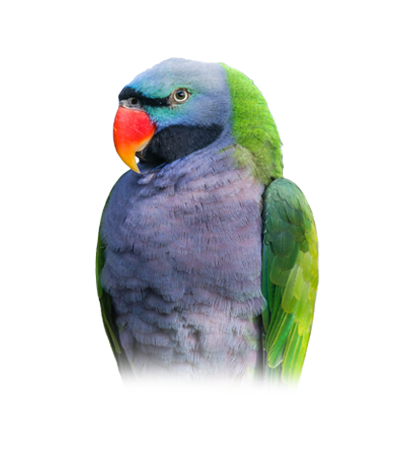


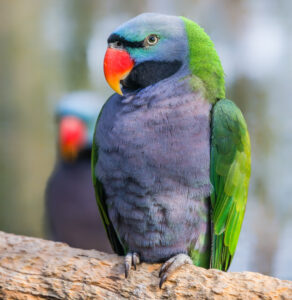
The vibrant Derbyan parakeet, garbed in jewel tones with inky mustache feathering, inhabits Asia’s highland forests. These medium-sized birds boast high intelligence and emotional sensitivities to match. As companions, these curious energetic birds needs plenty of healthy stimulation!
Photo by Henner Damke/Shutterstock

- Color
Multi Colored - Size
medium - Lifespan
30 + years - Sounds
Vocal communicator - Interaction
Social

- The Derbyan parakeet is also known as the Lord Derby’s Parakeet, after the 13th of Earl Derby.
- The Derbyan’s big beak helps it rip pine cones apart to eat the pine nuts.
- Derbyan parakeets resemble another member of the Psittacula genus, the Moustache parakeet, as both have a distinctive row of black feathers on their faces that look like a mustache. Derbyan parakeets are the larger of the two.

Want to stay up-to-date on Derbyan Parakeets?


What Is A Derbyan Parakeet?
Derbyan parakeets are eye-catching with a palette of colors. Their backside, wings, neck, and leg feathers are green, and their chest, abdomen, and throats are a purple to gray color. The facial feathers are gray with bluish-green iridescent coloring. A distinguishing feature is the black-colored, mustache-shaped feathering on their lower cheeks/neck, and a narrower black line that runs along the nares across their eyes.
Male and female Deryban parakeets can be visually distinguished by their beak coloring. The upper mandible of males is red with a yellow tip, and their lower mandible is black. The female’s beak is all black. Young Derbyan parakeets don’t get their fully vibrant colors until around 2 or 3 years of age.
These “block-head looking” parrots have a reputation as being extremely intelligent and inquisitive companions. With positive and respectful interactions, they can be friendly and docile.
Native Region / Natural Habitat
In the wild, the Deryban parakeet range spans from India to southern China, including southeastern Tibet, western Szechwan, and western Yunnan. They live in flocks of up to 50 birds and communicate loudly to their flockmates. It has been noted that they sometimes nest in tree cavities previously occupied and excavated by woodpeckers.
Care & Feeding
In the wild, Derbyan parakeets forage for seeds of Pinus tabulaeformis, catkins of Populus ciliata, pine cones, well as cultivated fruits and grain. They are considered an agricultural pest in some areas of their native range.
As a companion, Derbyan parrots should be offered a varied diet such as a formulated base diet that is supplemented with fresh fruit like apples, bananas, pomegranates, and green leafy vegetables, as well as spray millet, quality nuts, and high-quality seed mix.
These are active birds with long tail feathers and should be housed in a spacious cage or aviary-style enclosure. Curious and active, Derbyan parakeets need an assortment of toys and enrichment opportunities to keep them happily engaged.
Personality & Behavior
Derbyan parakeets thrive with devoted care tailored to their active minds and social nature. Overall a hardy highland species, these brainy birds remain healthy when their basic needs are met and flourish when provided a quality diet and positive interaction. Plenty of enriching toys, nourishing food, room for flying, and consistent loving interaction with help a Derbyan stay happy and healthy.
Speech & Sound
Like other parrots in their Psittcula genus, especially the popular Indian-ringneck parakeet, Derbyan parakeets are capable of imitating sounds and speech and are described as having “metallic-sounding voices.” They have the potential to have large vocabularies. Their contact calls can be loud and shrill.
Health & Common Conditions
Deryban parakeets are generally a hardy species. They are natural ground foragers so might be inclined to forage on the ground of their cage or aviary, which some aviculturists say might make them more prone to intestinal worms and fungal infections. A clean, well-maintained aviary helps reduce the chance of an intestinal or fungal infection.
Derbyan Parakeet Populations In The Wild
The Derbyan parakeet’s wild population is said to be declining due to extensive capture for the pet trade. While they tend to nest in remote areas, they do face threats such as deforestation and poaching for illegal trade.
Have Questions? Contact Us!
Lafeber is a family company dedicated to its customers and the health of all animals. We really value feedback, and if you have any questions or concerns, please do not hesitate to contact us.
Please email: [email protected] Or call us and a real person will pick up the phone: (815) 888-4040