



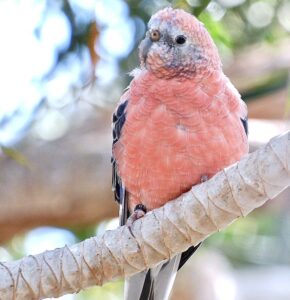
Bourke’s parrots have a reputation for being one of the mellower of the parrot bunch in terms of vocalizations and attitude. They tend to be most quiet during the day and active at sunset and dawn. They are often referred to as the “pink parakeet” because of their small size and popular pink color mutation.

- Color
Pink - Size
small - Lifespan
Up to 20 years - Sounds
Chatterer, Relatively Quiet - Interaction
Social, Somewhat social

- Bourke’s parrots were named by Sir Thomas L. Mitchell, who spotted the bird in New South Wales in 1835. Mitchell named the bird after Sir Richard Bourke, who was a governor of New South Wales at the time.
- Bourke’s parrots are also referred to as the sundown parrot because of their increased activity at sunset
- Bourke’s are one of a few parrot species that are crepuscular. Instead of settling in their roosts once the sun sets, Bourke’s become more active during dusk and at dawn.


Want to stay up-to-date on Bourke’s Parrots?


What Is A Bourke’s Parrot?
 Initially, the Bourke’s parrot was classified under the genus Neophema, which is made up entirely of grass parakeets. However, in the 1990s, the Bourke’s parrot was given its very own genus and reclassified as Neopsephotus bourkii. It is also referred to as the Bourke’s parakeet.
The nominate bird (the color most found in the wild) is a combination of shades of blues and shimmering pinks and violets. Bourke’s parrots are dimorphic, meaning that there’s a visible difference between the sexes. The male has a blue band above his eyes and the female either does not have this band, or has a band that’s much duller in hue. The female’s plumage is duller in general. Juveniles look like females and come into mature coloring at about nine months.
Popular color mutations available for the Bourke’s parrot include the rosy Bourke’s, pink, cream, blue, pied, and cinnamon. The Rosy is a favorite among fanciers because of its unusual shade of bright pink. Males and females in the Rosy mutation look identical, unlike their nominate cousins, though some female Rosies can have more gray feathering than the Rosy males.
Native Region / Natural Habitat
Bourke’s parrots are native to Australia’s vast arid interior, including parts of Queensland, New South Wales, and Central Australia as well as South Australia and Western Australia. While they can be found in urban areas, they mostly congregate in less-populated areas.
Bourke’s parrots perch and nest in trees, however, their feathering affords them a degree of camouflage to blend in with the ground and foliage, where they forage on grass and seeds. They are swift flyers that flit from tree to tree or bush to bush. They are said to fly through the tree canopy rather than over it. In the wild, they are usually seen in small groups, and pairs mate for life.
Care & Feeding
Since Bourke’s are closely related to grass keets, they thrive on seed, unlike many other parrots. In addition to seed and grasses, wild Bourke’s may feed on seed sprouts, other vegetation, and even insects. However, adequate nutrition for captive Bourke’s and grass keets requires more than just seed. Many of Lafeber’s foods — like Lafeber’s Premium Daily Pellets, Nutri-Berries and Avi-Cakes — incorporate seeds with healthy pellets, fruits, and vegetables, as well as Omega 3 and 6 fatty acids and chelated minerals.
Housing for the Bourke’s should be as large as possible, preferably an aviary or large flight cage. These birds don’t thrive in small quarters. The aviary or flight cage can be lushly planted because the Bourke’s isn’t generally a destructive bird. Bourke’s can also be housed outside in pairs or in a small group and acclimated to colder weather conditions, though the aviary should be protected from harsh weather in the deep winter, especially if other species of birds are present.
This bird makes an amiable aviary companion, able to get along with other grass keets, budgies, cockatiels, canaries, and sociable finches. However, the Bourke’s activity past dusk can disturb other aviary birds, even going so far as knocking them off of their perches.
Personality & Behavior
The Bourke’s hasn’t received much attention among novice bird fanciers because of its notoriety as having less character than other birds of its size and price. It is true that the Bourke’s spends much of the day in what seems like a prolonged coffee break, but dawn and twilight bring about a change in personality. These birds take flight early in the morning and at dusk, chirping and interacting with their environment and each other. They are not truly nocturnal, but they are known to be active well past sunset, unlike most parrots.
Compared to other parrots, Bourke’s are said to be a bit mellower and quieter, which makes them especially good for those living in apartments or similar abodes with shared walls. And although they might not be known for their ability to mimic human speech, that’s not to say that these birds aren’t intelligent.
Bourke’s parrots are also noted as being very social and are an exception where they will remain tame with regular handling even if they are kept in pairs.
Speech & Sound
Bourke’s parrots are generally on the quieter side, but they have been described as having a very melodic call, a “chir-rup” type sound. They are most vocal at sunrise and sunset and can be quite chirpy during these times.
Health & Common Conditions
Bourke’s parrots are said to be a relatively hardy species, with no increased susceptibility to avian diseases and conditions. Like any companion parrot, however, they should receive annual health checkups with an avian veterinarian. A balanced diet, enrichment, daily exercise, and a well-maintained environment are key to maintaining good health in Bourke’s parrots.
Bourke’s Parrot Populations In The Wild
Bourke’s parrots are not considered endangered by the International Union for Conservation of Nature (IUCN). The main threats to Bourke’s parrots in the wild include feral cats and red foxes, and periods of extreme drought can affect wild population numbers. However, compared to other parakeet species, their numbers are said to be increasing due to their vast habitat range.
Have Questions? Contact Us!
Lafeber is a family company dedicated to its customers and the health of all animals. We really value feedback, and if you have any questions or concerns, please do not hesitate to contact us.
Please email: [email protected] Or call us and a real person will pick up the phone: (815) 888-4040