



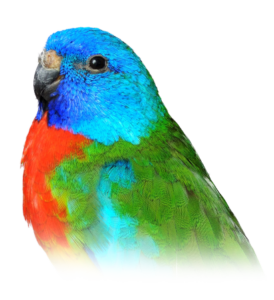
With brilliant rainbow plumage, the scarlet-chested parakeet captivates bird enthusiasts as an exquisite Aussie species. But behind the male’s dazzling blue, red, and green hues lies an introverted yet gentle personality. Females charm with more subtle earthy tones of green and yellow rather than scarlet chests.
- Color
Multi Colored - Size
small - Lifespan
Up to 20 years - Sounds
Relatively Quiet - Interaction
Somewhat social

- In the wild, scarlet-chested parakeets are nomadic and use succulent plants for hydration when they don’t have access to water
- They are s sexually dimorphic, will males having a scarlet chest, a cobalt-blue face, and bright green upperparts. The lower breast and underparts are yellow, the wing coverts are pale blue, and the tail green. Females’ coloration is duller, with green upperparts and green breast, with yellow underparts
- According to World Parrot Trust, the female scarlet-chested parrot carries green leaves to the nest tucked in her rump feathers


Want to stay up-to-date on Scarlet-Chested Parakeets?


What Is A Scarlet-Chested Parakeet?
The scarlet-chested parakeet, also referred to as the scarlet-breasted parakeet and the splendid parrot, is part of the Neophema family of parrots, along with the Bourke’s parakeet and turquoise parakeet. Scarlet-chested parrot feature a rainbow of brilliant colors in their plumage. It is a sexually dimorphic species, so males and females are colored differently.
Native Region / Natural Habitat
The scarlet scarlet-chested parakeet is native to central South Australia and inland southern Western Australia, with populations across the arid parts of Australia. They are mostly nomadic and also travel to adjacent areas. They are noted as being able to survive with limited access to water by utilizing succulent plants such as Calandrinia to stay hydrated.
Care & Feeding
In the wild, scarlet-chested parakeets’ main diet consists of grass seeds, flowers, fruits, and insects. A healthy diet for a companion scarlet-chested parakeet includes pellets, a quality seed mix, millet spray, sprouted seeds, fresh fruits, and vegetables.
According to those familiar with scarlet-chested parakeets as pet companions, they prefer taking a bath in shallow dishes, even their water dishes, or on wet foliage. Make sure to keep their water bowl inside the cage clean. Some note that their scarlet-chested parakeet companions might be inclined to spread out their feathers to catch rays of sunlight.
Housing for the scarlet-chested parakeet is preferably in a spacious flight cage or aviary-type setup, taking care to protect them from the cold and excessive humidity.
Personality & Behavior
Bird enthusiasts might be initially drawn to scarlet-chested parakeets because of their colorful plumage, and some might be inclined to consider them as more “hands-off aviary birds.” However, they can make good companions, especially if interacted with in a gentle way, with plenty of patience and positive interactions. Their temperament has been described as being gentle and docile.
Speech & Sound
The scarlet-chested parakeet’s vocalizations are described as chattering quietly among themselves with melodious notes, as opposed to loud contact calls. They are said to be among the quieter parrots of the genus Neophema, which, as a group, are comparably quieter than parrots of similar size. When they do call out, it is said to be more akin to a repetitive chirping sound. However, when alarmed they can produce a much higher-pitched call.
Health & Common Conditions
Healthwise, scarlet-chested parakeets are thought to be more vulnerable to Candida infections in aviculture when exposed to excessive cold or humidity, which is attributed to the fact that these birds originate from arid habitats. For this reason, some aviculturists recommend refraining from feeding them foods that promote fungal growth, such as high-sugar fruits like bananas and grapes.
Scarlet-Chested Parakeet Populations In The Wild
According to BirdLife International, the scarlet-chested parakeet, which has a very large range, appears to have a fluctuating population, therefore, it does not meet the threshold for being a vulnerable species in the wild. It’s population trend is categorized as stable.
Have Questions? Contact Us!
Lafeber is a family company dedicated to its customers and the health of all animals. We really value feedback, and if you have any questions or concerns, please do not hesitate to contact us.
Please email: [email protected] Or call us and a real person will pick up the phone: (815) 888-4040