



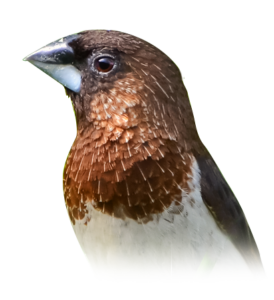
Society finches make wonderful pets for bird lovers who appreciate their social nature, gentle disposition, and entertaining antics. Society finches are generally non-aggressive and can coexist peacefully with other small, friendly bird species. They are not known to be territorial or prone to fighting, making them ideal for mixed-species aviaries.
Photo by Wei Ming Hung/Shutterstock

- Color
Brown, Multi Colored, White - Size
small - Lifespan
Up to 10 years - Sounds
Chatterer, Relatively Quiet - Interaction
Hands off, Highly social


- Society finches are known for their friendly, peaceful temperament and can coexist harmoniously with other small, non-aggressive bird species.
- Society finches are excellent foster parents and will readily care for the eggs and chicks of other finch species.
- Society finches are not actually a true finch species, but rather a domesticated form of the White-rumped Munia, a type of mannikin native to tropical Asia.
- The society finch is also referred to as the Bengali finch or Bengalese finch, especially outside the United States.
Want to stay up-to-date on Society Finches?

What Is A Society Finch?
While not as flashy as some finches, society finches captivate through their enchanting personalities and readiness to socialize with all who share their space – traits that truly live up to their kindly common name.
Society finches epitomize these gregarious instincts through their pleasant interactions with fellow finches and other peaceful species such as canaries or budgies when housed together in an aviary setting. They are known for serving as foster parents to other finches’ young, a benevolent tendency that endears them to breeders and makes them ideal aviary companions.
Society finches come in a wide range of colors and patterns, including white, fawn, chocolate, and pied variations due to selective breeding over centuries.
Also known as Bengalese finches, this domesticated species descends from the wild White-rumped Munia native to tropical Asia. Nearly 250 years ago, these highly social birds entered the pet trade in China and Japan, leading to the cultivation of distinct “society” temperaments and color variations not found in their munia ancestors.
Native Region / Natural Habitat
Society finches are not actually a true finch species, but rather a domesticated form of the White-rumped Munia, a type of mannikin native to tropical Asia. In the wild, White-rumped Munias are highly social, living in flocks of up to several hundred birds and prefer open grasslands with tall grasses and scattered shrubs. Munias are often found in rice paddies, sugarcane fields, and other grain crops, where they feed on the seeds of cultivated plants.
Care & Feeding
Finches need spacious housing, especially since they spend most, if not all, of their time inside their enclosure. These birds should remain fully flighted instead of having trimmed wing feathers. A horizontal cage is a must (as opposed to a vertical cage).
Society finches are known for getting along with other similar-sized bird species and their extreme socialness—they should not be housed alone. If you house pairs of finches together, be prepared for possible offspring, especially if the finches are provided a nest (small wicker-basket) and nesting material. Society finches are active and curious birds that enjoy exploring their surroundings and interacting with toys and perches.
A finch will thrive on a pelleted base diet, such as Lafeber’s Premium Daily Diet specifically designed for finches, supplemented with fresh greens and other vegetables, grubs, eggfood and some seed.
Personality & Behavior
Society finches are generally non-aggressive and can coexist peacefully with other small, friendly bird species. They are not known to be territorial or prone to fighting, making them ideal for mixed-species aviaries.
Highly social, society finches thrive when living in pairs or small groups and can become stressed or depressed if housed alone. While society finches are not commonly hand-tamed, they can bond with their owners and become quite friendly if raised by hand from a young age.
Speech & Sound
Male society finches are the primary singers and use their songs to attract mates and establish their place within the social hierarchy. Their songs consist of a series of chirps, trills, and whistles that can vary in pitch, tempo, and complexity. Females also vocalize but typically have quieter and simpler calls compared to males. Society finches are not particularly loud birds, and their vocalizations are generally considered to be pleasant and soothing. Like many finch species, however, society finches do tend to chirp and sing throughout the day.
Health & Common Conditions
Finches can be prone to air-sac mite infection, especially when overly stressed. This is a serious medical condition that warrants immediately veterinary care. Finches can also be susceptible to scaly face (a condition caused by a mite that presents as white, scaly areas around the beak/eyes, as well as the legs), which also warrants a call to the vet. Finches can also have overgrown nails or beaks, which should be addressed by an experienced bird groomer or vet.
Society Finch Populations In The Wild
Society finches are a domesticated form of the White-rumped Munia, a type of mannikin native to tropical Asia, White-rumped Munia’s native habitat is characterized by a combination of open grasslands, agricultural areas, and wetlands in tropical regions of Asia, where they live in highly social flocks and adapt to a variety of environmental conditions.
Finches such as society finches, Gouldian finches, and zebra finches are widely available in large pet stores, from avian specialty stores and from bird breeders.
Have Questions? Contact Us!
Lafeber is a family company dedicated to its customers and the health of all animals. We really value feedback, and if you have any questions or concerns, please do not hesitate to contact us.
Please email: [email protected] Or call us and a real person will pick up the phone: (815) 888-4040