



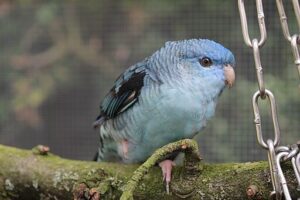
With their gentle nature and comparably quieter vocalizations, lineolated parakeets have earned a reputation as one of the more easygoing small parrots. At rest, they strike a distinctive horizontal stance, heads aligned with tails – a mellow match to their calm temperament. Under those horizontal bodies and stripes lies an intelligent, engaging small parrot.

- Color
Blue, Gray, Green, Multi Colored - Size
small - Lifespan
Up to 20 years - Sounds
Relatively Quiet - Interaction
Social

- The lineolated parakeet gets its name from the black and dark green stripes on its green plumage
- Males and females have similar appearances, though some say males may have darker stripes
- Juveniles are less prominently striped than adult birds
- Lineolated parakeets tend to love spray baths


Want to stay up-to-date on Lineolated Parakeets?


What Is A Lineolated Parakeet?
The lineolated parakeet (Bolborhynchus lineola) is also referred to as the linnie and barred parakeet. Similar in size to budgies, lineolated parakeets have a stockier build and black and dark green stripes on their backs, wings, and sides. Unlike budgies, the lineolated parakeet’s barring increases with age. There are various color lineolated color mutations, including turquoise and olive.
Compared to other parrots, lineolated parakeets are among the quieter parrot companions, with a soft chatter—a dialed-down version of a budgie’s chatter. They are also capable of mimicking speech and sounds.
Native Region / Natural Habitat
The lineolated parakeet makes its home in the mountain forests of Central and South America. Ranging from southern Mexico down through the Andes into Peru and Bolivia, two subspecies of this diminutive parrot exist, each exhibiting variations in the prominence of the signature dark bars lending the bird its common moniker. Ornithologists recognize Bolborhynchus lineola lineola, found in Mexico and Central America, and B. l. tigrinus, occupying the northern Andean range, by subtle differences in barring patterns.
In the wild, lineolated parakeets are found in groups of between six and 30 individuals, although bigger groups are not uncommon.
Care & Feeding
Lineolated parakeets are known for their love of shower time; it’s not unusual for them to hang upside down and open their wings to catch drops of water while enjoying a mist bath. Some say they can be perch potatoes if not given opportunities for exercise.
They like to navigate their environment and natural branches are great for them to move about on. Since they like to walk around, take care to ensure your linnie’s safety if they climb down from a play stand — watch where you walk!
The lineolated parakeet’s wild diet includes fruit, dried and germinated seeds, and insect larvae. As pets, lineolated parakeet breeders generally recommend a varied diet consisting of pellets and seed, supplemented with fresh fruit and vegetables.
According to the Lineolated Parakeet Society, lineolated parakeets eat throughout the day, and they also tend to have larger, looser stools than other parrots, even more so after eating fruit or vegetables. They also are more inclined than other small parrots to pick up food with their feet, much like bigger parrots do.
Some of those familiar with lineolated parakeets point out that they have strong flock instincts, and especially enjoy being kept in groups. Consistent positive interactions are key to keeping linoelated parakeets from becoming hand-shy.
Personality & Behavior
At rest, the lineolated parakeet strikes a distinctive near-horizontal pose, with its heads aligned to its tail, a posture seldom seen in other parrot species. Matching their laidback stance, lineolated parakeets display remarkably calm temperaments. Lineolated parakeets’ vocalizations are comparably milder than that of other parrots, with mumbles and murmurs rather than ear-piercing screeches. Their mellow disposition and manners, paired with a singular style of repose, set lineolated parakeets apart as delightful companions.
The lineolated parakeet is more inclined to walk, foot over foot, to change perch spots vs. flying to them. This “walk to get where they want to go” instinct comes in handy when teaching a lineolated parakeet to step up onto your hand, which they are said to learn rather quickly.
Speech & Sound
Lineolated parakeets’ vocalizations are comparably milder than that of other parrots, with mumbles and murmurs rather than ear-piercing calls. It is often described as a low, soft chattering sound. As companion pets, lineolated parakeets are capable of mimicking human speech and can be good talkers, with a voice described as cute and squeaky. When they are in full contact-call mode, they have been described as sounding like a monkey.
Health & Common Conditions
Like many small parrots, lineolated parakeets can be prone to developing fatty tumors, which is often tied to being offered a mostly seed diet and not much else. Seed-based diets tend to be higher in fat. While seed can be a healthy part of a lineolated parakeet’s diet, it should not be the only offering. Pellets, as well as healthy grains, fruit, and vegetables, offer variety as well as well-rounded nutrition.
Lineolated Parakeet Populations In The Wild
Lineolated parakeet populations in the wild are thought to be stable. They spend time foraging on the ground and sleep high in the trees.
Have Questions? Contact Us!
Lafeber is a family company dedicated to its customers and the health of all animals. We really value feedback, and if you have any questions or concerns, please do not hesitate to contact us.
Please email: [email protected] Or call us and a real person will pick up the phone: (815) 888-4040