

Color: Blue

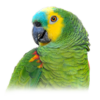
head and shoulders of a blue-fronted Amazon parrot

Blue-Fronted Amazon

Blue-fronted Amazon parrots can make wonderful pets for those who can provide the time, attention, and care they require. With their engaging personalities and vocal talents, they are a joy to have in the right environment.
Photo by aaltair/Shutterstock
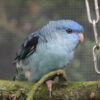
blue lineolated parakeet sitting on branch perch

Lineolated Parakeet

With their gentle nature and comparably quieter vocalizations, lineolated parakeets have earned a reputation as one of the more easygoing small parrots. At rest, they strike a distinctive horizontal stance, heads aligned with tails — a mellow match to their calm temperament. Under those horizontal bodies and stripes lies an intelligent, engaging small parrot.
Photo by Kathinetzwerk, CC BY-SA 4.0, via Wikimedia Commons

portrait of cockatiel, African grey parrot and conure

Parrot

You might think you know what a parrot is, but do you? Learn about parrot characteristics, behavior, care needs, and more. These feathered companions have more to offer than you might guess!

White-Capped Pionus

White-Capped Pionus

Don’t overlook the white-capped Pionus parrot as an companion. While it might not demand your attention as other parrots do, a well-socialized white-capped Pionus can certainly be an outgoing and social family pet.
Photo by nakashi, CC BY-SA 2.0, via Wikimedia Commons

Blue-Headed Pionus

Pionus Parrot

The Pionus parrot is the best kept secret of the bird world. It’s got all of the good qualities of the popular companion species, with few of the negative aspects that often occur with parrots.
Photo by Paul B from London, London, CC BY 2.0, via Wikimedia Commons

Pacific Parrotlet

Pacific Parrotlet

Pacific parrotlets are very spirited, and can become aggressive if left for too long without handling. Even though it is tiny, do not underestimate the strong beak – its bite is much stronger than a budgie. These pint-sized parrots don’t seem to realize that they are small because they have a large bird personality — outgoing, curious and, at times, downright feisty.
Photo by Susan C. Griffin, CC BY-SA 3.0, via Wikimedia Commons

Pacific Parrotlet

Parrotlet

The parrotlet parrot might be small in size but it is big in personality. These pint-size parrots are bold and assertive, and they can learn to talk, too.
Photo by Susan C. Griffin, CC BY-SA 3.0, via Wikimedia Commons

ring-necked Dove

Dove

Doves are ideal for someone who wants a bird, but cannot accommodate the needs of a parrot (noise, one-on-one social interaction). Their interactions are fun to watch and some consider their cooing pleasant.
Photo by Charles J. Sharp, CC BY-SA 4.0, via Wikimedia Commons

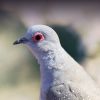
Diamond Dove

Diamond Dove

For a dove species, the diamond dove is surprisingly small, but eye catching nevertheless, especially with its prominent red eye ring. Many find its soft cooing a pleasant alternative to a boisterous parrot.
Photo by Jim Bendon from Karratha, Australia, CC BY-SA 2.0, via Wikimedia Commons

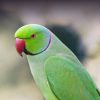
Indian ring-necked parakeet

Indian Ring-Necked Parakeet

The Indian ring-necked parakeet is not a shy bird, and does best with an owner who appreciates an outgoing companion that is not afraid to demand what it wants! Indian ring-necks can also be quite talkative.
Photo by Dick Daniels of World Birds, CC BY-SA 3.0, via Wikimedia Commons

parakeet budgie

Budgie (Parakeet)

The budgie (parakeet) is often thought of as a “beginner bird,” however, this social, outgoing little bird deserves just as much care and attention as larger parrots. Budgies are playful, love food and they can rival any parrot in terms of talking ability.
Photo by NoName_13/Pixabay

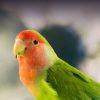
Fischer's lovebird

Lovebird

A lovebird might be one of the smaller parrot species available as a companion pet, but this bird is inquisitive and seemingly always on the go. As their name suggests, lovebirds are known for the loving, attentive bond they tend to form with their mates.

hyacinth macaw

Hyacinth Macaw

The hyacinth macaw stunning cobalt-blue coloring and massive size will cause anyone to pause and take notice. Bright yellow around the eyes and at the base and the corners of the beak makes the largest of the macaw species appear to be in a perpetual smile. This is a parrot for someone who afford a hefty price tag and who has space to spare.
Photo by Hank Gillette, CC BY-SA 3.0, via Wikimedia Commons

blue-crowned conure

Blue-Crowned Conure

The blue-crowned conure has a large vocabulary and high intelligence to match. This species is known as one of the better talkers in the conure family, though it can be a little difficult to understand.
Photo by John Graziano, CC BY-SA 3.0, via Wikimedia Commons

green-cheeked conure

Conure

Conures, which vary in size from small to medium, often charm people with their playfulness and inquisitive personalities. They generally like to be where the household activity is, which can include mealtime and hanging out with their favored people.

blue-and-gold macaw

Blue-and-Gold Macaw

The blue-and-gold macaw is aptly named, with a gorgeous blue body and dark lemon-yellow chest, this is a bird that’s hard to miss. It also referred to as the blue-and-yellow macaw.
Photo by Ralph Daily, CC BY 2.0, via Wikimedia Commons

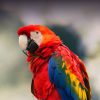
green-winged macaw

Macaw

Macaws’ big size and vibrant colors make them hard to overlook. These social birds can create a racket when they feel so inclined, and their clownish ways are sure to draw attention. Although their large beaks can be intimidating, a well-socialized macaw can be a friendly and affectionate companion.
Photo by Ralph Daily, CC BY 2.0, via Wikimedia Commons

Subscribe to our newsletter

Click here to subscribe to our newsletter

×

Join our Lafeber Flock

Enjoy our Pet Birds' weekly newsletter, featuring captivating stories, care tips, and more.
Opt for Small Mammals' monthly edition for delightful facts about rabbits, guinea pigs, and more.
Choose our monthly Backyard Chickens newsletter for insightful information to keep your flock happy.
*