

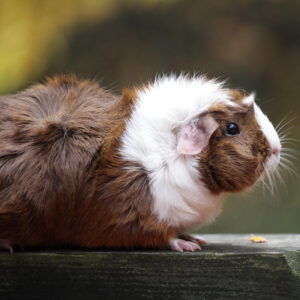
Guinea pigs are a popular small mammal pet in the United States. They likely first arrived in North America in the 1800s and gained popularity in the 1900s. The species is docile and adorable, with several breeds to choose from. Abyssinian guinea pigs are one of the most distinct of the 13 breeds recognized by the American Cavy Breeders Association. And that’s because of their “wild and crazy” fur. They often have eight to 10 rosettes or more of fur across their body that send the fur growing in all directions.
Colors: ARBA recognizes six variety groups that include many colors
• Abyssinians have a mustache where the fur from the jaw meets fur from the nose.
• Some people nickname them Abys.
• Guinea pigs were domesticated thousands of years ago at elevations around 14,000 feet in the Andes Mountains.
• American Cavy Breeders Association
Related Breeds All guinea pig breeds
Description
You can’t describe the Abyssinian without discussing their amazing fur. They have short hair, and it grows in a mix of rosettes and ridges. The rosettes appear as circles of fur that grow out from a pinpoint center. Where the edges of these circles meet form ridges of fur, so the Abyssinian’s fur is a mix of rosettes and ridges.
Most often there are 10 rosettes: a rosette on each shoulder, a rosette on each hip, two rosettes on the rump, and four rosettes spanning the saddle and sides. Show-quality Abyssinians have eight to 10 well-defined, deep, symmetrical rosettes with crisp ridges that make straight lines.
For the best looking rosettes and ridges, the body of the Abyssinian guinea pig should not be too short or cobby nor should it be too long. It needs to be a medium length and a bit broad.
Abyssinian guinea pigs are classified as rough-coated (breed coats can be classified as smooth, rough, or long). The texture and look of the coat can change with age. Very young Abyssinian guinea pigs may have more of a fluffy look. Young adult and adult guinea pigs have more of a crisp look to their coat. Senior Abyssinian guinea pigs may go back to looking more fluffy.
Eye color for Abyssinians varies. They can be black, brown, blue, or shades of red, and this seems to vary with the coat color. Lighter coat color can mean a lighter eye color.
Like most other guinea pigs, the Abyssinian has a rounded body, large ear pinnae, a rounded nose, short legs, four digits on their front paws and three digits on the back paws, no tail, and they usually weigh 2 to 3 pounds.
Colors
The American Cavy Breeders Association traces its origins to the National Pet Stock Association of America that was founded in 1910. From that arose the American Rabbit Breeders Association and the American Cavy Breeders Association. The ACBA is an affiliate National Specialty Club of the ARBA.
More than 20 colors are recognized across six groups in ACBA guinea pig shows. These include:
Self group: Beige; Black; Chocolate; Cream; Lilac; Red; Red-Eyed Orange; White
Brindle
Roan
Any Other Solid: Dilute Solid; Golden Solid; Silver Solid
Agouti group: Dilute Agouti; Golden Agouti; Silver Agouti
Marked group: Broken Color; Tortoise Shell; Dalmatian; Dutch; Himalayan; Tortoise Shell and White
Brindle and roan colors are among the most common. Brindle coats are a mix across the body of dark hairs with red hairs, and other colors can be present. Roan coats have white hairs intermingled across the body with the dominant color or colors.
History
The pet guinea pig we know today has come a long way. A study from 2020 that analyzed ancient guinea pig DNA indicates that Cavia tschudii was likely the wild cavy species ancestor to the domesticated C. porcellus. Guinea pigs were domesticated about 4,000 to 8,000 years ago (6000 to 2000 BC) in the Andes Mountains of South America in what is present-day Peru and Chile. It also mentions that a different wild species was domesticated in Colombia and suggests that C. anolaimae might possibly be that species. Regardless of the two separate species, C. porcellus, today’s guinea pig, originated from C. tschudii.
Over thousands of years, guinea pigs were mostly kept as livestock and sometimes pets or used in ceremonies in South America. When European explorers brought them back to Europe in the late 1500s, they were a novelty pet for the well-to-do. After a few hundred years, they were available as pets to many. By the 1900s, they were also readily found in the United States, where they were kept as pets, and by that time were also used in some laboratory experiments.
Guinea pig clubs and associations promoting the breed began to form. The Abyssinian is one of three founding breeds of what became the American Cavy Breeders Association.
Personality
Abyssinian guinea pigs distinguish themselves from other breeds not only in looks but in behavior. All guinea pigs are individuals, so generalizations don’t always apply, but Abyssinians are known to be active, curious, and perhaps a bit mischievous. Some owners describe these piggies as having “Abytude.” That’s right, they let you know how they’re feeling about things. Some people even believe they’re a more vocal breed.
Socialization when they’re young can affect how they react to the world. Usually, Abyssinians aren’t big fans of being touched. This could be because with their fur growing in so many directions, touching it inevitably pushes against the direction of fur growth for some of the fur, and that can feel odd to them.
Some guinea pig might prefer to live alone, but it’s generally believed that guinea pigs are social animals who appreciate the company of another one or two guinea pigs. Best results usually occur with female-only groups or one male (neutered) and one or two females. Be sure the habitat you provide is large enough for the number of guinea pigs.
If you find an Abyssinian you might want to adopt, talk to the rescue operator, breeder, or person you’re considering adopting from about the guinea pig’s temperament or personality. Are they outgoing, boisterous, shy, lazy? Learning more about any guinea pig you want to adopt can help you with your decision.
You might find some insights about guinea pig personalities at online forums where owners discuss their experiences, including GuineaLynx, Guinea Pig Cages, and The Guinea Pig Forum.
Care
Your care routine is critical for your guinea pigs’ health and happiness. This includes providing proper housing and food, keeping their environment clean, enrichment, and veterinary care.
Provide a habitat that’s well-ventilated, large enough for the guinea pig or guinea pigs who live there, and allows plenty of room for them to exercise after necessary accessories are added. Horizontal space is preferred over vertical space. Must-have accessories include bedding, hay racks, food bowls, water bowls/bottles, hideaways, toys, litter boxes, and litter. We have more details, including tips on placement, in our guinea pig home article. Guinea pigs need hay. It’s the main food guinea pigs eat. They eat often, and the low-calorie, high-fiber of grass hay meets most of their nutritional needs. It also helps to wear down their constantly growing teeth to minimize the risk of dental problems. Nutri-Hay or Berrie-Bales are great choices for hay.
After clean, fresh hay, which is about 80% of their diet, they also need other nutrients and vitamin C. Those come from vitamin-c fortified guinea pig food pellets. Only use food specifically made for guinea pigs and follow directions or consult your veterinarian on portions to feed.
You can also offer your furry pal guinea-pig safe vegetables in small quantities. These provide variety, enrichment, and other added nutrients. Guinea-pig safe fruit can be offered as super special treats. Fruit should be a rare treat because of its high sugar content. Some treats made for guinea pigs, such as Hey!Berries, are another option to add variety to your guinea pigs’ food bowl. Keep in mind that all treats should make up no more than 5 to 10% of your guinea pigs’ daily calories.
Clean, fresh water is also vital to guinea pigs. Offer this in water bottles, with at least two water bottles in the habitat. This ensures that if one bottle gets plugged or stops working, the second is there to keep them hydrated. Guinea pigs are known to be messy and get food particles into spouts. A shallow water bowl can also be offered, but this will likely be full of bedding or other debris quickly.
Keep the habitat and accessories clean. This means daily cleaning of all food bowls and water bottles, and spot-cleaning of bedding and litter boxes. A complete cleaning should be done weekly.
Enrichment is important to guinea pigs. This includes things or activities that engage their brains and stimulate them mentally. Toys, exercise, companionship, or anything that affects guinea pigs in a positive way is enrichment.
Find a guinea pig-savvy vet in your area soon after you get your guinea pig. Taking your guinea pig in for an annual checkup might help find a health problem before it becomes an emergency.
Grooming needs for healthy Abyssinian guinea pigs involves more observation than action. They usually take pretty good care of themselves. But they do need you to keep an eye out for possible problems. So, look at your guinea pigs every day. You’re basically checking for anything abnormal. Is there discharge from the eyes, nose, mouth, or rear? Does the fur or anything else look “off”? Are the eyes bright and clear? Is the nail length OK? Are the teeth lining up and not overgrown? Are your guinea pigs acting normally? Are they eating, drinking, and defecating normally? If you notice anything concerning, contact your guinea pig-savvy veterinarian.
Health
Abyssinian guinea pigs are subject to the same health issues usually seen in any guinea pig breed. Some common problems that land a guinea pig at the veterinarian include dental problems, heatstroke, vitamin C deficiency, respiratory problems, abscesses, trauma, and more.
Follow these tips to help minimize the risk of health issues for your Abyssinian guinea pig:
• Feed plenty of clean, fresh hay
• Don’t overfeed treats
• Keep your guinea pig’s environment clean (urine buildup causes respiratory problems)
• Be sure your guinea pig is getting adequate vitamin C
• Prevent or minimize contact with rabbits, dogs, or other pet species
• Keep nails trimmed
• Provide plenty of soft, flat surfaces for your guinea pig to rest on
• Keep ambient temperature between 65 and 79 degrees Fahrenheit (or cooler during high humidity)
• Guinea pig-proof any areas your guinea pig roams
• Watch for anything abnormal physically or in behavior
If you suspect your guinea pig is ill, contact your guinea pig-savvy veterinarian immediately.