

Contents
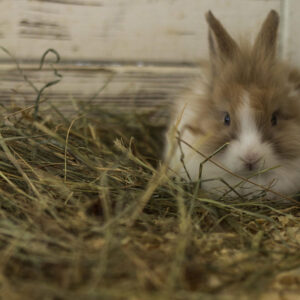
Our rabbits’ wild counterparts spend their day foraging for fiber-rich grasses, leafy plants, flowers, and other vegetation. And domesticated rabbits retain many of the instincts and dietary needs of these wild cousins.
In our homes, fresh hay caters to our rabbits’ foraging instincts, and hay is the best way to meet their high-fiber needs.
Hay Is Rabbit Fuel
Hay is an important part of a companion rabbit’s health. In fact, if you were to build a food pyramid for your pet rabbit, you would need a wheelbarrow to haul in bales of hay to stack the bottom and continue up, leaving just 20% at the top for green leafy vegetables, followed by high-fiber pellets, and then a tiny part at the tippy top for fruit as a special treat.
That 80% means rabbits are built to eat hay. Their long gastrointestinal tract requires the high-fiber diet hay provides to keep nutrients moving. Their teeth grow continuously, and the constant chewing of hay provides the wear and tear to keep teeth at a healthy length. Nutri-Hay and Berrie-Bale from Lafeber are both timothy hay grown in the Northwest U.S., with the Berrie-Bale featuring hidden mint Hey!Berries treats to encourage eating and foraging.
Know Your Hay
But hay is hay, right? Not quite. There are different varieties of hay, and before we get to hay, let’s talk about how we get hay.
Hay is grass that is dried, preserved, and then shaped into bales. People sometimes mistake straw for hay and hay for straw, but there are notable nutritional differences. Straw is an agricultural byproduct that, while fibrous like hay, offers little nutrition compared to fresh hay. Straw is better suited as bedding for your rabbit than part of your bunny’s menu. Your rabbit might nibble on their straw bedding, and that’s perfectly fine. Clean straw won’t make your rabbit sick, but it also won’t give your rabbit the nutrition they need.
Now that we know that “hay is the way,” here are some of the most common types of hay available for rabbits.
Timothy Hay
Timothy hay is a go-to choice for people with adult rabbits, and it’s named after a real person. A perennial grass, timothy hay originated in Europe and Asia. In the early 1700s in North America, agriculturist Timothy Hanson recognized its superior quality as feed for cattle and horses. He introduced the hay from Maryland to other states.
This highly palatable and high-in-fiber hay is the most recommended hay type for adult rabbits. Timothy hay like Nutri-Hay from Lafeber should be offered freely every day for your rabbit to munch on.
A potential downside to timothy hay is that timothy grass is one of the leading causes of seasonal allergies for those with allergy sensitivities. If you are allergic to timothy hay/grass, you might experience itchiness in your throat, mouth, eyes, nose; coughing; and/or nasal congestion. If this occurs, consider other hay alternatives, such as orchard hay.
Orchard Hay
Orchard hay is another grass hay commonly available for our rabbit companions. Also referred to as orchardgrass, it is a good option for adult rabbits. It is high in fiber, low in protein, and low in calcium.
Like timothy hay, it can be offered in unlimited amounts. Some rabbits prefer its sweeter taste. Another bonus is that rabbit parents who are allergic or sensitive to timothy hay can serve orchard hay as a substitute.
Oat Hay
Oat hay is harvested from oat plants. Like timothy hay, it offers high-fiber nutrition that supports healthy digestion and healthy teeth in rabbits.
Oat hay is higher in protein and fat than timothy hay, which can potentially cause weight gain if offered exclusively. For this reason, oat hay is more often fed as a complement to grass hays. It is also a way to offer some taste variety, as some rabbits can be picky eaters.
Alfalfa Hay
Alfalfa hay is packed with nutrients that young rabbits need to grow up strong and healthy. This legume has high levels of protein and calcium, which growing rabbits need. Alfalfa hay also supports milk production and development for pregnant/nursing rabbits.
It’s best to think of alfalfa hay as a specialty diet for the above life stages rather than a maintenance diet for adult rabbits. Alfalfa hay’s high protein load can lead to obesity, and its high calcium levels can lead to urinary issues in adult rabbits. Alfalfa hay, however, can be served as a treat or as a supplement offered in much smaller amounts than other hays.
Keep Your Rabbit’s Hay Safe
Wet or soiled hay must be discarded and replaced with new hay. Hay that becomes wet or moist can become moldy, which can make your rabbit very sick.
Some rabbit experts caution that hay must be stored in a way that allows airflow, such as in a plastic bin with the lid placed loosely on it, as opposed to completely closed, or in an open box. Likewise, if your hay comes in a plastic bag, instead of sealing it shut, some rabbit experts recommend leaving the bag open to reduce the chance of sealing in moisture.
Check your rabbit’s hay for signs of mold, which can include fuzzy spots, discoloration, and/or a musty or sour odor. The rule of thumb with hay is that it’s always best served fresh!