Almost exactly four years ago, I wrote a blog entitled “The Work Ethic,” which describes how many individuals, be they human or nonhuman, might—surprisingly—actually prefer to work for rewards rather than receive them for free. The formal term for this behavior is called “contrafreeloading,” and I described a study by some of my colleagues that was presented at a conference. They found that African grey parrots, in particular, would prefer to interact with an experimenter, trading a token for food rather than just taking the food itself.
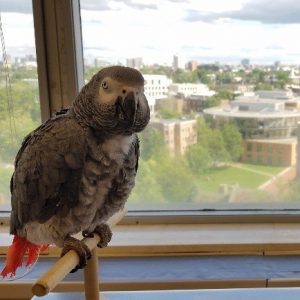
The work has since been published (Krasheninnikova et al., 2018). It seemed that the parrots viewed the interaction with the experimenter not as “work” but as an added bonus. The study intrigued me because I noted that many Africna greys, my own Athena included, often engaged in a related behavior—that is, they seem to enjoy engaging with various foraging toys, figuring out how the gizmos worked even though they could often obtain the same foods in their dishes without doing anything extra. In the wild, of course, they have to “work” for all their food—crack nuts, eviscerate fruits, and juice bark (May 2004).
Designing The Experiment
These data from the Krasheninnikova et al. paper really intrigued one of my students, and she decided to investigate the behavior for her MA thesis. The student, Gabriella Smith, thought that the key to deciding whether to engage in contrafreeloading was if the activity involved would be considered work or play—that is, something onerous versus something fun to do en route to getting a treat.
After talking over how we would design the experiment, we decided to see if the quality of the treat might also affect the decision to go for free food or engage in the action leading to the food. We hypothesized that if the activity was considered “fun,” our birds would do it whatever the reward, but if it was “work,” they would do it only to get their most favored treats.
Moreover, we wanted to see if they found the activity itself rewarding enough that they would choose it by itself more than a free treat. And, finally, we wanted to test at least two different activities—one “artificial” (something like a foraging toy) and something more “ecological” (something more natural) to see if a difference existed in what they chose to do—i.e., might “work” be innately triggered in some way?
We also recruited a few companion African greys to see how generalizable the behavior might be. So we included Pepper and Franco, who have taken part in several experiments over the years, and Lucci, who belonged to one of my research assistants and who was naïve to any research activities.
Different Birds, Different Preferences
We first had to choose, and then test, for each parrot, a set of three different foods that could be ranked in order of preference. Each bird might have a different set or, within that set, a different order. Once we had the information on food rankings, we could then start the experiments.
The first experiment involved a small container that could have a loosely attached lid that the parrot could flip off to receive a reward. Treats would be placed in covered or uncovered cups; the latter were ‘”free.” The second experiment involved a choice between a nut still in its shell (i.e., one that required some work to obtain) and an already shelled, “free” nut.
In Experiment 1, each bird received 270 trials of container pairs holding more- or less-preferred free or enclosed food items, using each of the different food items. We also tested containers with and without covers to see if lid-flipping was a favored action. And we continued to test their food preferences, to ensure that no change had occurred over the course of the experiment. This last information was important, because we were looking at different degrees of contrafreeloading, which we classified as follows: calculated contrafreeloading (working to access preferred food over less-preferred, freely available food); classic contrafreeloading (working to access food equal in value to freely available food); and super contrafreeloading (working to access a less-preferred food over preferred, freely available food).
In Experiment 2, we put a shelled or unshelled nut in each uncovered container and let the bird choose. They could spend a significant amount of time cracking the shell with their beak, or they could just eat the shelled nut. All we did was mark down their choice.
The results were quite interesting, and although each bird kept their food preferences throughout Experiment 1, in every other way they were quite different (Smith et al., 2021). In Experiment 1, Griffin significantly preferred classic and calculated contrafreeloading and even did some super contrafreeloading; Athena, Pepper, and Franco significantly preferred calculated contrafreeloading; Lucci didn’t participate as he had no interest in the cups at all. In Experiment 2, Athena and Franco surprised us by significantly preferring to crack the shell to obtain the nut (contrafreeloading); Griffin and Lucci did not; Pepper chose at chance.
What was clear was that for Griffin, lid-popping was fun and cracking nutshells was work, but the opposite was true for Athena and Franco. Lucci also thought nutshell cracking was work. Griffin would even pop a lid on an empty container in preference to eating a less favored treat (see Figure)!
It was clear that all four birds in Experiment 1 were willing to work a bit if it meant getting a better reward than the one they could have for free (calculated contrafreeloading). Their behavior wasn’t a matter of age—Griffin, Lucci, and Pepper are about the same age; Franco isn’t very much younger. And Franco is significantly older than Athena. It isn’t a matter of gender, either—Pepper and Athena are both female, whereas Griffin, Franco, and Lucci are male.
The take-home message here is that the kind of task we give our companion animals for enrichment really matters! What one bird might enjoy, another may simply ignore. Each bird will have its own preferences. The point is to keep introducing various types of enrichment—we can’t give up just because our birds might not like what we think would be fun—it has to be fun for them!
References
Krasheninnikova, A., Höner, F., O’Neill, L., Penna, E., & von Bayern, A. M. P. (2018). Economic decision-making in parrots. Scientific Reports, 8(1), Article 12537. https://doi.org/10.1038/s41598-018-30933-5
May, D.L. (2004). The vocal repertoire of Grey Parrots (Psittacus erithacus) living in the Congo Basin (Central African Republic, Cameroon). PhD Thesis, University of Arizona, Tucson.
Smith, G.E., Greene, D., Hartsfield, L.A., & Pepperberg, I.M. (2021). Initial evidence for contrafreeloading in Grey parrots via the opportunity for playful foraging. J. Comp. Psychol. doi: 10.1037/com0000295.


 Join us for a FREE, live, interactive webinar hosted by Laura Doering, former editor of Bird Talk magazine and Birds USA magazine. Our special guest, Dr. Stephanie Lamb, DVM, DABVP (Avian Practice), will discuss keeping backyard chickens as pets. She will talk about the common problems that Veterinarians see in chickens including neurological issues and reproductive diseases & disorders. Dr. Lamb will also talk about infections and diseases that could be shared between chickens and parrots. Learn how to safely keep chickens and parrots in this insider’s view of the daily happenings at your Avian Vet’s clinic.
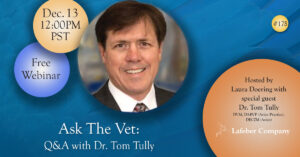 Join us for a FREE, live, interactive webinar hosted by Laura Doering, former editor of Bird Talk magazine and Birds USA magazine. Our special guest Tom Tully, DVM, DABVP (Avian Practice), DECZM (Avian), will answer your questions about pet bird health, nutrition, & care. Dr. Tully, a decorated Professor & practicing Vet at Louisiana State University School of Veterinary Medicine, is an internationally known Veterinarian who has earned specialties in Avian medicine in the United States as well as in Europe. Having this type access to a Veterinarian of his status is rare, but Dr. Tully believes in the educated bird owner as being the best bird steward. Dr. Tully answers each question in detail and shares his vast knowledge of birds, particularly parrots. Is your bird’s problem health-related or behavioral? Are you offering the right foods to your pet bird? Ask the Vet!
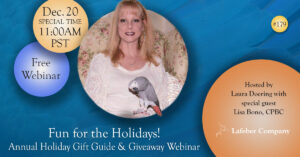 Join us for a FREE, live, interactive webinar hosted by Laura Doering, former editor of Bird Talk magazine and Birds USA magazine. Our special guest, Lisa Bono, CPBC, owner and operator of The Platinum Parrot and a certified parrot behavior consultant specializing in African grey parrots, has once again secured many wonderful donations for us to give away to some lucky viewers! In this fun holiday episode, Lisa will discuss each prize, an assortment of toys and supplies that are safe for our feathered companions as well as some parrot-themed items for bird lovers. We encourage you to shop with our generous donors when doing your holiday shopping for yourself or your own flock or for your bird friends or their flocks. This very special Holiday Webinar is generously sponsored by Lafeber Company, The Platinum Parrot & Grey Parrot Consulting.










 Join us for a FREE, live, interactive webinar hosted by Laura Doering, former editor of Bird Talk magazine and Birds USA magazine. Our special guest, Stephanie Lamb, DVM, DABVP (Avian Practice), will continue the fun & informative series, Species Spotlight! The California Condor is a highly endangered avian species in North America and caring for them has been fraught with challenges throughout the years. However, the year 2023 brought the new challenge of Highly Pathogenic Avian Influenza (HPAI) to the Northern Arizona flock. Dr. Lamb will take us through the difficulties of this time but also tell us an uplifting story of one special bird.
 Join us for a FREE, live, interactive webinar hosted by Laura Doering, former editor of Bird Talk magazine and Birds USA magazine. Our special guest, Pamela Clark, is a well-known author, speaker, IAABC Certified Parrot Behavior Consultant & retired CVT. Pamela will present Episode 11 of Translating Parrot, a Lafeber Pet Birds Webinar Series focusing on Parrot Behavior & Wellness, based on Pamela’s years of experience with a wide range of parrot species. In this episode, Pamela will discuss some of the most common complaints from pet bird owners. Why does my bird hate me? Why is my bird so bad? Why does my bird bite me or scream for no reason? Are these behaviors bad or just undesirable? Pamela’s cutting-edge approach will help you translate why your pet bird does certain things that drive you crazy, and how you can resolve the “problem behavior” in this informative series!
 Join us for a FREE, live, interactive webinar hosted by Laura Doering, former editor of Bird Talk magazine and Birds USA magazine. Our special guest, Lisa Bono, CPBC, will share her first-hand experiences with a devastating hurricane. When Lisa presented her webinar in September on preparing for Winter, she included information on preparing for a disaster. She had no way of knowing that days later, she would have to put all of her plans and expertise to the test during Hurricane Helene. Lisa will discuss what she did to prepare, what she did during the hurricane to protect her flock, and the days following the disaster, without power, with her family & flock to care for. Lisa will share her thoughts, pictures and videos of the disaster & aftermath in this compelling and important webinar.
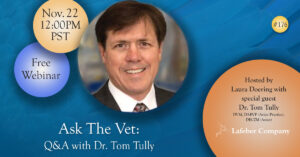 Join us for a FREE, live, interactive webinar hosted by Laura Doering, former editor of Bird Talk magazine and Birds USA magazine. Our special guest Tom Tully, DVM, DABVP (Avian Practice), DECZM (Avian), will answer your questions about pet bird health, nutrition, & care. Dr. Tully, a decorated Professor & practicing Vet at Louisiana State University School of Veterinary Medicine, is an internationally known Veterinarian who has earned specialties in Avian medicine in the United States and Europe. Having this type of access to a Veterinarian of his status is rare, but Dr. Tully believes in the educated bird owner as being the best bird steward. Dr. Tully answers each question in detail and shares his vast knowledge of birds, particularly parrots. Is your bird’s problem health-related or behavioral? Are you offering the right foods to your pet bird? Ask the Vet!



 Join us for a FREE, live, interactive webinar hosted by Laura Doering, former editor of Bird Talk magazine and Birds USA magazine. Our special guest, Pamela Clark, is a well-known author, speaker, IAABC Certified Parrot Behavior Consultant & retired CVT. Pamela will present Episode 10 of Translating Parrot, a Lafeber Pet Birds Webinar Series focusing on Parrot Behavior & Wellness, based on Pamela’s years of experience with a wide range of parrot species. In this episode, Pamela will discuss some of the most common complaints from pet bird owners. Why does my bird hate me? Why is my bird so bad? Why does my bird bite me or scream for no reason? Are these behaviors bad or just undesirable? Pamela’s cutting-edge approach will help you translate why your pet bird does certain things that drive you crazy, and how you can resolve the “problem behavior” in this informative series!
 Join us for a FREE, live, interactive webinar hosted by Laura Doering, former editor of Bird Talk magazine and Birds USA magazine. Our special guest, Stephanie Lamb, DVM, DABVP (Avian Practice), will discuss her recent experiences at the American Federation of Aviculture (AFA) conference as a Speaker & attendee. Educational conferences are so important to attend when you have the opportunity. You will learn from the speakers as well as share information with other bird owners. But there is so much more to attending a conference. Dr. Lamb will share her perspective from a Vet’s point of view along with input from our host, Laura, who was there for the entire conference.
 Join us for a FREE, live, interactive webinar hosted by Laura Doering, former editor of Bird Talk magazine and Birds USA magazine. Our special guest, Natalie Antinoff, DVM, DABVP (Avian Practice), will discuss the “silent” or “hidden” killer that can affect pet birds, particularly seniors. Now that our pet birds are living longer, veterinarians are diagnosing atherosclerosis more frequently. What exactly is atherosclerosis? Are there any warning signs? Can it be treated? Can I do anything to prevent it? Get the answers to these questions, as Dr. Antinoff takes us on a deep dive into this disease.
 Join us for a FREE, live, interactive webinar hosted by Laura Doering, former editor of Bird Talk magazine and Birds USA magazine. Our special guest Tom Tully, DVM, DABVP (Avian Practice), DECZM (Avian), will answer your questions about pet bird health, nutrition, & care. Dr. Tully, a decorated Professor & practicing Vet at Louisiana State University School of Veterinary Medicine, is an internationally known Veterinarian who has earned specialties in Avian medicine in the United States and Europe. Having this type of access to a Veterinarian of his status is rare, but Dr. Tully believes in the educated bird owner as being the best bird steward. Dr. Tully answers each question in detail and shares his vast knowledge of birds, particularly parrots. Is your bird’s problem health-related or behavioral? Are you offering the right foods to your pet bird? Will Dr. Tully wear a Halloween mask? Ask the Vet!



 Join us for a FREE, live, interactive webinar hosted by Laura Doering, former editor of Bird Talk magazine and Birds USA magazine. Our special guest, Dr. Stephanie Lamb, DVM, DABVP (Avian Practice), will take a unique and informative look at how your pet bird might perceive a visit to the Vet. Presented from the bird’s point of view, this webinar will help owners understand what their bird may be experiencing. A bird’s experience will be much different for a wellness visit than for a health issue or emergency trip. While we can’t know exactly what our birds are thinking, Dr. Lamb will explain why your bird may have certain reactions or stress levels. This can help an owner understand what might help put their bird more at ease or how the owner’s behavior and reactions could influence how the bird handles being at the Vet. Let’s take a look through our bird’s eyes in this insider’s view of the daily happenings at your Avian Vet’s clinic.
 Join us for a FREE, live, interactive webinar hosted by Laura Doering, former editor of Bird Talk magazine and Birds USA magazine. Our special guest, Lisa Bono, CPBC, owner and operator of The Platinum Parrot and a certified parrot behavior consultant specializing in African grey parrots, presents Episode 28 of The Grey Way, a Lafeber Pet Birds Webinar Series focusing on Congo & Timneh African grey parrots as pets. In this episode, Lisa will help you & your birds navigate the Holiday Season! Whether your holidays involve guests, parties, decorations & special foods or you prefer a quiet season with your birds and maybe a few loved ones, the holiday season has a different feel about it. Winter and the holidays can bring with it different weather, emotions, routines, & lifestyles. Even small changes can be felt by our pet birds. Lisa will discuss this special time of year and how you can make it special for your birds, keeping them feeling secure and happy. As always, Lisa may focus on some Grey-centric concerns, but her advice can be applied to any pet bird species.
 Join us for a FREE, live, interactive webinar hosted by Laura Doering, former editor of Bird Talk magazine and Birds USA magazine. Our special guest Tom Tully, DVM, DABVP (Avian Practice), DECZM (Avian), will answer your questions about pet bird health, nutrition, & care. Dr. Tully, a decorated Professor & practicing Vet at Louisiana State University School of Veterinary Medicine, is an internationally known Veterinarian who has earned specialties in Avian medicine in the United States and Europe. Having this type of access to a Veterinarian of his status is rare, but Dr. Tully believes in the educated bird owner as being the best bird steward. Dr. Tully answers each question in detail and shares his vast knowledge of birds, particularly parrots. Is your bird’s problem health-related or behavioral? Are you offering the right foods to your pet bird? Ask the Vet!






 Join us for a FREE, live, interactive webinar hosted by Laura Doering, former editor of Bird Talk magazine and Birds USA magazine. Our special guest, Jamie Whittaker, AFA Conference Chair & 2nd Vice President, will give us a sneak peek at the upcoming AFA Annual Conference, celebrating 50 years of the American Federation of Aviculture. This important conference will take place September 4-7 in Costa Mesa, California and will be 3 full days of “Everything Aviculture”! Featuring over 25 presentations by Avian Experts, including Veterinarians, breeders, authors & more! Attend sessions, shop with the vendors, participate in the raffles & auctions. Have fun with other bird enthusiasts at the social events including the Welcome Reception, a Blue’s Bash Party hosted by the Bird Endowment, and the annual AFA Banquet. There will also be a Free Family Fun Day sponsored by Lafeber Company, which will include a free-flight bird show! Come for the Conference, stay for the sights & sounds of Orange County, minutes away from Disneyland & California Adventure with easy access from the Orange County(SNA) Airport or the Los Angeles area airports.
 Join us for a FREE, live, interactive webinar hosted by Laura Doering, former editor of Bird Talk magazine and Birds USA magazine. Our special guest, Stephanie Lamb, DVM, DABVP (Avian Practice), will continue the fun & informative series, Species Spotlight! Dr. Lamb will show pictures & talk about the 14 parrot species she saw on a trip to Peru. Did you know that learning about species in their natural habitat is very relevant to providing the best life for your pet birds? Observations of wild parrots can give us clues to the behavior of our pet birds, what they would eat in the wild and how & when they would forage for food. Be sure to join us to learn about these 14 different species in their natural habitats!
 Join us for a FREE, live, interactive webinar hosted by Laura Doering, former editor of Bird Talk magazine and Birds USA magazine. Our special guest, Lisa Bono, CPBC, owner and operator of The Platinum Parrot and a certified parrot behavior consultant specializing in African grey parrots, presents Episode 27 of The Grey Way, a Lafeber Pet Birds Webinar Series focusing on Congo & Timneh African grey parrots as pets. In this episode, Lisa will discuss how to prepare your birds for a major move by applying behavior techniques. Lisa will draw on her own experience in moving to a new State with her own flock. This information will also be useful for short trips or travel in general. While Lisa will focus on Grey-centric concerns, her advice will apply to any parrot species.
 Join us for a FREE, live, interactive webinar hosted by Laura Doering, former editor of Bird Talk magazine and Birds USA magazine. Our special guest Tom Tully, DVM, DABVP (Avian Practice), DECZM (Avian), will answer your questions about pet bird health, nutrition, & care. Dr. Tully, a decorated Professor & practicing Vet at Louisiana State University School of Veterinary Medicine, is an internationally known Veterinarian who has earned specialties in Avian medicine in the United States and Europe. Having this type of access to a Veterinarian of his status is rare, but Dr. Tully believes in the educated bird owner as being the best bird steward. Dr. Tully answers each question in detail and shares his vast knowledge of birds, particularly parrots. Is your bird’s problem health-related or behavioral? Are you offering the right foods to your pet bird? Ask the Vet!


 Join us for a FREE, live, interactive webinar hosted by Laura Doering, former editor of Bird Talk magazine and Birds USA magazine. Our special guest, Dr. Stephanie Lamb, DVM, DABVP (Avian Practice), will discuss what your Avian Vet needs to know in order to provide the best veterinary care for your bird. When your pet bird is sick, it’s very stressful for the bird & the owner. The last thing you want to do is answer a lot of questions, and it can leave some owners feeling like they are being judged. But every little detail can give your vet clues to what might be going on. Some examples of things a vet might ask is cage size, room temperature, & diet. Be specific – “a big cage” is not as helpful as giving the general dimensions as well as the shape of the cage. Naming the brands of food you offer, and specifics about fresh foods & treats, can be valuable information for your Vet. Dr. Lamb will explain why certain information is needed and why it can help with a diagnosis in this insider’s view of the daily happenings at your Avian Vet’s clinic.
 Join us for a FREE, live, interactive webinar hosted by Laura Doering, former editor of Bird Talk magazine and Birds USA magazine. Our special guest, Anthony Pilny, DVM, DABVP (Avian), will discuss the illegal capturing of live wild birds for the pet trade, an escalating crisis of biodiversity loss and horrendous cruelty. This illegal trade deeply affects avian welfare and conservation and can cause serious repercussions in captive and pet bird populations. The fate of the confiscated birds after they are released as evidence, is rarely a topic of welfare discussion and is not well-known within the avian veterinary community or the general public. Dr. Pilny will talk about how avian veterinarians and the public can play a positive role in changing the outcomes for these birds.
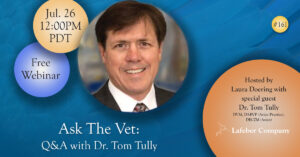 Join us for a FREE, live, interactive webinar hosted by Laura Doering, former editor of Bird Talk magazine and Birds USA magazine. Our special guest Tom Tully, DVM, DABVP (Avian Practice), DECZM (Avian), will answer your questions about pet bird health, nutrition, & care. Dr. Tully, a decorated Professor & practicing Vet at Louisiana State University School of Veterinary Medicine, is an internationally known Veterinarian who has earned specialties in Avian medicine in the United States as well as in Europe. Having this type access to a Veterinarian of his status is rare, but Dr. Tully believes in the educated bird owner as being the best bird steward. Dr. Tully answers each question in detail and shares his vast knowledge of birds, particularly parrots. Is your bird’s problem health related or behavioral? Are you offering the right foods to your pet bird? Ask the Vet!