


If a rat lover is asked to explain why rats make great pets, I guarantee intelligence will make the list, along with several examples that prove it. Is this because we’re biased, or are rats really as smart as we claim?
Exploring Rat Intelligence

No bias here, rats are indeed exceptionally intelligent! Not to mention that they’re advanced problem solvers. Don’t believe me? Research shows that rats are actually better at certain cognitive tasks than humans are. They form maps in their brains as they travel, which are similar to a GPS system. They have an episodic memory like humans. This means that rats not only form memories, but they also play them back in their mind. They are aware when they’ve forgotten something. Rats also dream when they sleep and actually dream about a better future.
Rats possess a high level of emotional intelligence as well. It’s been proven that they feel empathy and that they actually recognize pain and fear on another rat’s face. This can then motivate them to help a friend in trouble. I truly believe their empathy extends to their owners, too. My first heart rat, Rory, regularly exhibited behaviors that showed he was attuned to my moods, and he would come comfort me whenever I was sad or upset.
Scientists have proven that rats have self-awareness, emotions, relationships, and feel pain and pleasure, similarly to humans. After 30 years of living with them and intensely observing them, I personally believe rats to be sentient beings. Yet, some scientists refuse to internalize what these findings confirm about rats and their worth. To do so would mean acknowledging that testing on them amounts to torture, and that’s why rats bred for research are still not defined as “animals” under the Animal Welfare Act. If they were, it would require serious changes to how rats are used and treated in scientific experiments.
I can’t change the world’s opinion of these magnificent creatures, but that won’t stop me from trying. So, I’m going to share a few personal insights and stories about my own rats displaying just how smart and clever these animals are.
Yes, Rats Are Natural Learners
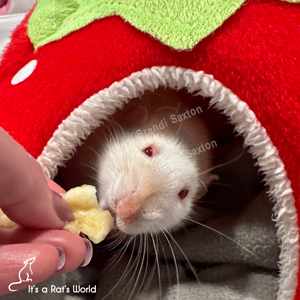
Rats are really adept at learning how to perform tricks. Just check out Shadow The Rat’s YouTube channel for some entertaining examples. But rats can learn more than just stunts.
Rats learn their names and can decipher when you’re talking to them, a cagemate, or even another pet. This is something they pick up over time just from you speaking to them regularly.
They can also learn special calls or phrases through repetition, tone, and observation of their cagemates. Mine was “Treats, Treats, Treats!” said rapidly in an ascending pitch. All my rats knew exactly what it meant. When they heard this word repeated three times, even if they were all dead asleep, they immediately woke and came running to see what wonderful delights I had waiting for them.
Try coming up with your own word or phrase. It’s really fun to watch newer rats learn a call just through observation of how the other rats react to it.
Rats also have visual recognition, despite their poor eyesight, and they remember who is nice to them. So, there’s no question that rats naturally learn to recognize their owners and desire a bond with them. I have lots more information and stories on these topics in my articles Do Rats Recognize Their People? and Forming A Bond With Your Rats.
Rats Reach Their Goal
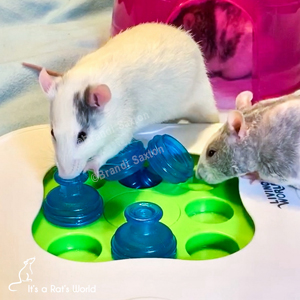
I regularly trained my dogs to do weird tricks when I was younger, like fetching the phone when it rang (back when landlines were still a thing) or fetching their own leash. Yet for some unknown reason I never spent time teaching tricks to my rats. But I was curious if they could master a treat puzzle.
I bought one called the Living World Teach N Treat Toy. It had a square base with eight spots to fill with your pets’ favorite snack. Depending on the level of difficulty you wanted, you covered the food with either individual lid toppers or a large, single flat disk.
For my first attempt I chose the individual lids and used a mixture of seeds, dried fruit, and cereal that my rats liked. Right away some of the rats were more curious than others. A couple of the older ones lost interest after inspecting the puzzle and discovering that the treats were not readily accessible. Having to work for the food was apparently asking far too much of them, so they chose to sit and observe from the sidelines.
Preacher was the only one of the older rats who stuck around, along with three of the younger boys. Camden was the first of them to realize that the compartment covers had to be removed or tipped to retrieve the reward. But it was his brother Regent who could do it the quickest. Preacher on the other hand, knew exactly where the treats were but, bizarrely, only stood over the covers trying to DEEPLY inhale the scent of food through them. He made zero attempt to actually move the covers. I found it strange because he was usually a pretty clever rat.
Then I began to notice a clear pattern emerge. After trying to “deep sniff” treats out from under several lids, Preacher then backed up and began purposefully watching Camden and Regent. At first I thought he was trying to learn how they were taking off the covers, but he had a better idea. He surmised that he didn’t need to be the one to remove the toppers, he just needed to be ready to pounce the second it was done for him! Every time Regent and Camden started pushing a topper over, Preacher rushed in to reap their reward.
As for the rest of the rats, they either went scrounging for whatever scraps were left or they tried stealing from a cagemate with a full mouth. Only two of the rats excelled at the puzzle, but they all figured out a way to get the treats.
The Rat Who Trained Me
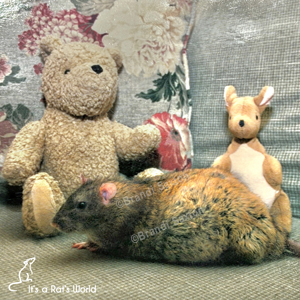
Rats are geniuses at figuring out obscure ways of getting what they want, even if that requires teaching their humans a few things. Back when I free-ranged rats I had a giant boy named Dover Cliffs. I kid you not, he was the size of a kitten. He spent most of his days roaming our apartment or napping in a favorite spot. When he wanted my attention, however, he became rather demanding and specific.
Dover wasn’t just a large rat, he was obese. And not because he lacked exercise or was given too much food. I was still learning about rats back then and was far from being a perfect owner, but I suspect he had a genetic issue that caused the weight.
His girth made it impossible for him to climb up my legs the way thinner rats could and he didn’t like jumping down from things when he wanted to run off. So, he set about teaching me to do things for him. When he wanted to be held or lifted to something he’d sit on one of my feet and not budge. Since his size required full body support to be lifted, he somehow taught me that if I put my hand out, palm side up, he could stretch his entire stomach across it and use it as an elevator. But his way of telling me he wanted to be back on the floor was much less amusing and was a bit rude if you ask me. That stinker would nip the side of my stomach if I ignored or missed his restless cues that he wanted down from the couch.
My Rat Mastermind
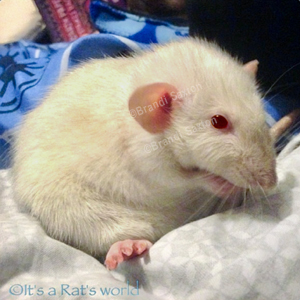
I’ve talked about Leeloo many times over the years and have briefly mentioned in a couple of articles the time she escaped outside, but her story is a great example of how smart rats are.
Leeloo was by far one of my most intelligent rats. When she set her mind to something, she did whatever it took to see it through. What Leeloo wanted most in life was to be free-range, but our living situation was no longer suited for that. This never stopped her, though, and she was extraordinarily talented at regularly escaping her cage. Thankfully, she loved her humans. Anytime she was missing, all we had to do was call her name and she came running. Leeloo demonstrated that she not only knew her name, but that she knew we were specifically addressing her, and calling her meant she needed to come back. None of us set out to teach her this, she just figured it out on her own. She was so consistently obedient about appearing when called, that the day she didn’t, I knew something was wrong.
What we finally pieced together when she disappeared was this: The night before she went missing, Leeloo must have slipped out of the cage when I gave the rats a late-night snack. Then around 1 a.m., my half-asleep husband got out of bed to let our very insistent dog outside to pee. Unaware that Leeloo was wandering around, he didn’t see that she too went out the door. And she never followed the dog back in. The next morning began a very frantic, three-day hunt for a Siamese rat with a list of health problems who had never been taught to endure the brutal, sun-scorched summers of Arizona.
By some miracle she found her way back home and, shockingly, thought to scratch on the back door! It was the very door she escaped from almost exactly 72 hours earlier. To this day, I have no idea where she went, how she found food or water, or how she survived three-digit temperatures, hungry feral cats, neighboring dogs, or the blazing sun with her sensitive red-eyes. Now, nearly 15 years later, this gut-wrenching experience still continues to blow my mind. I legitimately feared I’d never see my Leeloo again.
We were very lucky to get Leeloo back considering all the dangers that are outside. Please keep your rats safely indoors.
Happy Rats Show Their True Selves

I have more stories that I could share but I’ll wrap this up here. I understand that my experiences may be considered anecdotal. However, I feel like 30 years as a rat owner and my constant research into these animals gives me some insight into their behavior and talents. I believe that scientists will never have this insight, because they never bear witness to domesticated rats in the natural state of contentment that only exists when a rat feels safe and unharmed. They will never know if a rat is doing something because they want to, or because they’re being forced into performing.
It’s loving owners who experience the true nature of a rat’s intellect, because with us, they are given the freedom to use it whenever and however they choose.
So don’t be surprised if your rat seems dense at times, or too lazy to figure something out for themselves. It just means that they feel safe enough in their environment to let their guard down and not always think so hard.