



A common question from people considering rats as pets is, “Should I get males or females?” To which I would answer, “Either, they are both great!”
I absolutely love both, but if I’m honest, I secretly favor the boys. I mean, I’ve had 47 boys, but only 12 girls. Maybe it’s because my first heart rat was a boy.
So, does my love of boy rats mean that they are better than girls? Absolutely not!
Both male and female rats make fantastic pets and have wonderfully unique and fun personalities. You honestly can’t go wrong with either option. But if you’re curious what the differences are, let’s dive in.
See Physical Differences
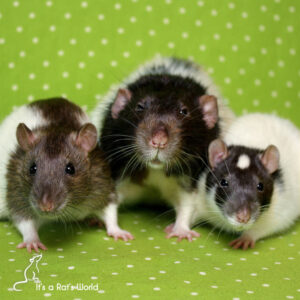
Male rats are generally larger than the females. The average size of a male is 10–12 inches, not including the tail, and weighing 450–650 grams (about 1–1.4 pounds). The average size of a female is 9–10 inches, not including the tail, with the average weight of 350–450 grams (about 12.3 ounces to 1 pound).
Of course, this can vary from rat to rat. My boys Wolfgang and Jing Jang (not related to one another and not dwarf rats) were as small or smaller than my female rats. My girl Cinder was a large female and was the same size as many of my males. But she was nowhere near as big as my huge boys. Dover Cliffs weighed a full 2 pounds (907 grams) and rat brothers Gatwick, Camdan, and Regent were all around 850 grams (about 1.8 pounds).
Another difference is that females ordinarily have softer fur than the adult males. This is because intact males produce more oil on their backs than females. This oil is called buck grease and is an orangish-yellow. Some males produce so much oil that they may need a bath if it’s causing their skin to itch. It’s common for buck grease to lessen or disappear when a male is neutered, which can soften up their fur.
Sniff Aromatic Differences

You might be surprised to learn that (intact) males and females also smell different. So much so that I could probably do a blind sniff test and tell you the gender. Remember those scented markers you used as a kid? What did the purple one smell like? Yep, grape soda — and so do the girls!
They have this absolutely lovely fragrant aroma that smells remarkably like grape soda and, in my opinion, fabric softener. Normally people just comment on the grape scent, but there is definitely a flowery, perfumy scent mixed in as well. And I love it!
The intact boys have a scent that you can almost feel, since they smell like warm corn tortillas or tortilla chips. It’s actually much more pleasant than it sounds. If a boy is neutered, they almost always end up smelling like flowery grapes, just like the girls.
It’s not uncommon for owners to “huff” their rats. Huffing is the act of deeply sniffing your rat’s fur, to the point of inhaling their scent. Yes, rat owners actually do this. When a rat smells good, you just don’t want to stop sniffing them! Unless they’ve been “marinating” that is. “Marinating” is the gross act of napping in a urine-soaked hammock or bed. Sometimes girls do this, but this is mostly a boy thing. Yeah, boys can be gross sometimes, too. Try not to hold it against them.
Too much buck grease can also make boys stinky. Wipe them down with unscented baby wipes or a damp paper towel to help with any stinky buildup.
Observe Energy Level Differences

When it comes to personality, the general thought is that boys are lazier and make better cuddlers, while girls are energetic, climb more, and are “less cuddly.” But this was not my personal experience.
OK, it is true that males become notoriously lazy as they age, especially if they are neutered. But boys are quite active when they are young. And laziness does not automatically equal being cuddly. Not all boys want to be held and may prefer to only lie in the vicinity of you and not on you.
If my girl Leeloo was my only example of females, then yes, girls can be quite energetic! But the rest of my girls became lazy potatoes just like my boys.
My experience with girls might have differed though, since every single one of them was spayed before I adopted them. I missed out on all the behavioral changes and angst that happens when a girl is in heat, such as restlessness, hyperactivity, agitation, and ear wiggling. And girls apparently go into heat every four or five days! I wish I had at least witnessed the ear wiggling, because that sounds cute.
Aside from Leeloo, who refused to settle down until health issues forced her to, I didn’t regularly observe a drastic difference in energy levels between my boys and girls. I also found girls could be just as cuddly as the boys, and I hate it when people say otherwise.
Experience Behavior Differences

Where I saw a major difference between male and female rats was in temperament, specifically after social maturity and with urine marking.
Social maturity behaviors and the introduction issue:
Puberty happens between 6–8 weeks of age in rats, but according to the National Institute of Health, males go into social maturity between 5–6 months. However, after 30 plus years spent with males, and talking to other owners, I’m going to totally disagree and say that it’s actually between 6–9 months old.
Not all, but some boys go through a personality change during the 6–9-month mark that can turn them into real buttheads. They suddenly become more agitated, more easily irritated, and can be more aggressive toward their cagemates — and sometimes even their owners. Thankfully, that’s rare. I only experienced it with one of my boys, who started nipping me. He was much worse to his cagemates, even his bestie.
If the aggression becomes dangerous for the other rats or doesn’t settle down after a couple of months, then you need to intervene. Your best option is likely castration. It made a huge difference with my hormonal boys.
Whether a male goes through this cranky change or not, all boys have the potential of being real brats when meeting new rats, particularly other males. Even the docile, lazy slugs are capable of summoning up enough energy to become territorial. It doesn’t mean that boys inherently can’t get along with each other or that all males are territorial, but when they are, it’s going to take extra patience to get these drama kings to chill out. If they don’t — and they become a danger to the other rats — then you need to keep your groups separate or consider a neuter.
I found introductions to be less stressful when bringing males and females together or females and females together, versus males and males. But even girls sometimes refuse to play nice with newbies. When middle-aged, my girls Echo and Tru absolutely refused to welcome new rats. Once they were old ladies though, they chilled out. Overall, though, my girls were much easier with intros than many of my boys were.
Urine marking happens:
Another behavioral difference between the two sexes involves urine. Intact males are much more likely to mark their owner and property they deem theirs. Many males stop frequent marking after they feel settled, but some feel the need to continue doing it throughout their lives. Girls are so much less likely to urine mark.
In my experience, the girls are also easier to litter box train. But neither my girls nor boys used the litter box a hundred percent of the time.
3 Differences From Spay And Neuter
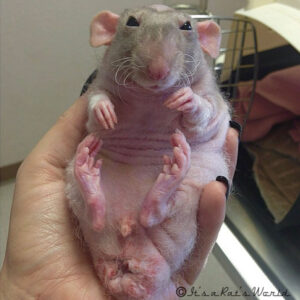
Since we’ve talked a lot about spays and neuters, I want to further explain the different impact these sterilization procedures have on females and males.
1. Prevent unplanned litters: The most obvious is pregnancy prevention. If you plan on having both sexes housed under the same roof, someone needs to be fixed, even if they aren’t caged together. Female rats in heat are masters at escaping their cage when intact males are nearby and can get pregnant through cage bars once they find the boys. Don’t risk an unwanted litter, especially since they can have anywhere from 8–18 babies.
2. Minimize health risks: Both male and female rats can get hormone-related diseases like mammary or pituitary tumors, but females are notoriously prone to mammary tumors. They are also at risk for ovarian and uterine disease. All of these health issues can shorten their already short lifespans. Getting females spayed around 3–4 months old, as opposed to later in life or not at all, can significantly reduce their chances of having these problems.
I should note that some websites mention that the spay needs to happen at 3–6 months old and even as late as 5–7 months to achieve medical benefits, but the people and resources I trust most when it comes to rat health all state the younger range as preferable.
Putting a rat through a spay is scary, as it is with any surgery. It’s also not cheap. It’s far more invasive than neuters are for the boys, but I do believe it’s beneficial. It’s why I went out of my way to always adopt girls who were already spayed or I paid to have the rescue spay them before I brought them home. Out of my girls, only Leeloo got mammary tumors. I believe that’s likely the result of being spayed after her first birthday.
3. Improve behavior and health: As I said before, some of the main benefits of a neuter are tamping down aggression, along with lessening urine marking and buck grease. But it also reduces the chance of a vesical proteinaceous plug, commonly known as a penis plug, in elderly or mobility-challenged males. It can even prevent the chances of testicular cancer, although that is much rarer.
Unfortunately, I’ve never been able to find good information on whether castrating males lessens their chances for mammary or pituitary tumors. So, strictly in medical terms, there seems to be more health benefits for the females to be spayed than for the males to be neutered. Regardless, it’s aways best to have a discussion with your veterinarian to determine if these surgeries are the right choice for your rats.
Mixing The Sexes

Once I finally adopted girls, I wondered why I waited so long. I especially loved having both boys and girls at the same time. Some of them even developed seriously strong “crushes” on one another. Remember the aggressive boy I mentioned above who became a raging jerk to me and his bestie? Well, that bestie was my girl Echo. After Sirius’ neuter he went back to being a sweetie, and those two continued on with their tight bond. They were inseparable, even when cuddling with me. And when Echo was old and sick, Sirius sat by her side, nuzzling his love until she was gone. It was both beautiful and heartbreaking to behold.
Whether you choose boys, girls, or both, you can’t go wrong, because they are equally delightful!
But again, please be responsible and ensure that one of the sexes is either neutered or spayed to prevent an “oops” litter.