


Contents

What makes being ratless so torturous is that I do not currently share a special bond with an animal. It’s honestly the first time in my entire life that this has been the case. We have two dogs in the house and a cat, but two of them aren’t mine. And well, they aren’t … rats.
Before I became a rat owner, I shared a closeness with an array of different animals, but once rats became a part of my identity, I discovered that no other animal really filled my heart quite the way they do. Ferrets were a close second though.
What I miss the most about having a special connection with rats are all the everyday moments we shared together. Moments like snuggling on the couch while watching movies, sweet rattie kisses and groom sessions on my hands, rats rushing to their cage door and dancing around in excitement when they saw me approach, jealousy of my attention that caused someone to push a brother out of the way so they could get the head scritches instead, or rats stretched out in my lap or next to me while I worked, and so much more. These simple, yet significant moments were mine and mine alone with these animals, and I never had to compete with another human for their affection; I was always their favorite human.
Struggling To Bond

If you’re new to rats or considering them as pets, I hope your goal is to achieve this level of closeness with yours as well. It’s the only way to truly experience these animals to their fullest.
But what if you find it isn’t happening? What if your rats are skittish or aloof, and show little interest in interacting with you? Does this mean that forming a bond with them is hopeless?
Definitely not! You just need a new approach.
New owners sometimes struggle to connect to their rats, especially when the rats are timid or jumpy. I think this behavior often triggers a fear of them biting. Most rats just need time acclimating to their new environment. And some, especially if they’ve experienced trauma, require extra work and patience to settle in. Not knowing how to help them adjust can lead to rats becoming more withdrawn and scared.
If you’re feeling in over your head with a nervous rat, or yours has experienced trauma, please check out my article “Helping A Scared Pet Rat.” It explains different ways rats express fear, provides insight into what might be causing it, and walks you through the process of earning their trust.
Understand Trust Vs. Bonding
Earning your rat’s trust is not quite the same thing as having a bond with them, but it is necessary to form one. For a rat, trusting you means they believe you aren’t out to kill them. Whereas, having a bond with them means you both have a mutual desire for companionship, and a deeper connection between the two of you develops.
A rat’s personality and life experiences will play a big part in that connection. When a rat feels unsettled or is in a state of self-preservation, their main focus is on staying safe. This makes it very difficult for them to form a loving attachment to you. Once they start feeling comfortable and at ease, however, that’s when they begin seeing the value in time spent with their humans.
Know Personality Types

Brave, extroverted rats are the easiest to bond with. That’s because they adapt quickly to new environments and humans, even when they’re babies. Whenever I had a large group of rats, I always had at least one extrovert that showed immediate faith in me. Usually within the first second of meeting them, they were demanding to be held and climbing all over me. It felt like they trusted me before I even gave them a reason to.
On the opposite end of the spectrum are rats that are so frightened or apprehensive that they view humans, even their owner, as a predator. With rats like this, you have to break through that barrier first, before anything else. Some may never feel entirely free from danger, but if you’re able to get them to recognize and accept you as their caregiver, then you’ve reached a monumental achievement in your relationship with them. How much deeper that relationship gets will be entirely up to that rat and the time you put into them.
The majority of rats fall somewhere between these two extremes. They might come off as nervous in the beginning, but it usually doesn’t take too long before they feel safe, especially if you’re spending time with them daily.
Provide Quality Time

The most vital part to building a relationship with your rat is consistently spending time with them — being a constant presence, talking to them, petting them, holding them, and playing with them. It’s absolutely necessary. It’s the only way to make a real connection with them. Plus, it’s the only way you’ll learn all your rat’s unique characteristics.
Keeping them in a room that you spend the bulk of your time in can be very beneficial. Just being able to hear your voice and smell you brings you into their daily life and routine.
You also need to get your rats out of the cage at least one to two hours every day. Besides needing exercise and a chance to move around, they also need quality time spent with you. This can be done on a couch, on a bed, or in a rat-proofed room. Try to get some concentrated cuddling time. Watch a movie, read a book, listen to music, whatever — just take the time to sit and love on your sweeties. Learn how they prefer to be held (or if they hate being held!) and pet, and see if there’s a particular spot they enjoy being pet the most.
Bonding pouches and rat-sized blankets are also very helpful, especially with rats that are skittish. All rats naturally love to burrow, so providing them with a place to hide while in your arms gives them a reason to snuggle up close to you.
Regularly talking to your rats while they are in their cage is also very helpful. It gets them used to your voice, while allowing them to stay safe in their beds. Not being yanked out of the cage constantly gives them reason to not be frightened every time you approach. And did you know that the very act of petting an animal has the power to bring out stress-relieving brain chemicals called endorphins, for both you and your rats? So, while they’re in their hammocks, make sure to gently scratch or stroke down their back, or on their head while you’re chatting with them. Those endorphins will be flowing in no time!
If interacting with one of your rats isn’t coming naturally to you or your rat is still resisting your attention, head on over to my article “Honoring Your Rat’s Personal Space.” Every rat is different, and some might have very specific boundaries. Ignoring those boundaries is the quickest way to sabotage your bonding efforts.
Use Glorious Food And Treats

Food is one of the best tools for trust training and bonding. Come to think of it, I’m not entirely sure the happy dance my rats did when I approached their cage was so much about me as it was the anticipation of receiving their tasty treats. Regardless, their excitement was always entertaining and amusing.
Make a big deal out of mealtimes so that your rats learn quickly that you’re the bringer-of-food. This status will earn their favor.
Also, pick a healthy snack that your rats love and always announce the arrival of it with a simple phrase or word in a distinct tone. Doing this every time is a way to train your rats into associating you with a feeling of happiness.
Mine was, “Treats, Treats, Treats!” said in an increasingly higher pitch with each “treats.” Every single one of my rats knew exactly what this call meant, and it had the power to pull even the deepest of sleepers out of their hammocks to rush to the cage door. They’d each push one another or step on and over a cagemate in an attempt to be the first in line. Even my standoffish rats, who hated being held, were happy to see me and gladly took what I had to offer. The minute I saw one of my nervous or introverted rats joining the stampede, that’s when I knew I was making real progress in my bonding efforts.
Extra Credit Bonding
If you have time and desire, take your rat friendship to the next step. One way to do this is by teaching your rats tricks or creating mazes. I personally have little experience with this, but there are plenty of examples online. It’s definitely a way to thoroughly engage with your rats and experience their personalities in a different way.
The same goes with traveling with your rats. Going into detail would require a separate article, but every time I took my rats on a road trip, we always came back home with a stronger bond. I often found them to be even more cuddly than before the trip, even my nervous ones. Something about them being out of their normal environment showed my rats how much they could trust me.
What To Expect
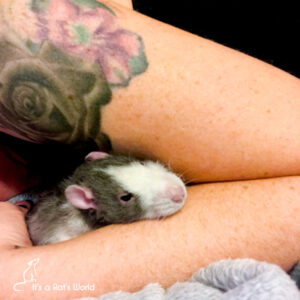
With each rat you have, you experience a distinctly different bond. Some bonds develop easily, while others might feel impossible at times. Regardless of your rat’s mindset, it takes continuous effort on your part to keep a connection thriving. Don’t compare your rats to the ones you see on social media, and don’t get discouraged if one of yours is less responsive to you; every rat is uniquely themselves.
The bonds I had with my own rats ranged from soulmate status, all the way to “you’re the human I dislike the least, so I’m willing to tolerate you” status. Even when a bond was built from only the toleration of me, it still felt quite special. That’s because I know how many hurdles I had to cross to achieve that, and it’s a great honor when a frightened rat finally lets their guard down around you and accepts your part in their life.
Each and every rat is worth the endeavor. Because, when they pass on and their life is only but a memory, it’s that bond you shared with them and the special moments that were born from it that will live on, forever in your heart.

Really enjoyed this article. The way you explain trust versus bonding made it click, and the “personality types” framing feels spot on. I also loved the practical tips like daily out of cage time, talking to them while they stay in their hammocks, and using a bonding pouch or blanket so they can burrow and feel safe. Quick question, for very timid rats, do you recommend starting with spoon fed soft treats, or letting them take a small solid treat from your fingers once they seem comfortable?