


Contents

One of the best qualities in pet rats is their wide range of personalities. They are generally friendly, outgoing creatures that love to play, eat, and sleep. But each rat also has their own unique characteristics and approach to the world. Some are fearless, ready to explore everything and everyone they come in contact with. Some are super mellow and love nothing more than sleeping their day away. But the ones I want to focus on are the shy or downright fearful rats. These poor sweeties need to be shown a little extra love and patience.
Basic behaviors of fear:
• Startling at new sounds or movement
• Staying at the back of the cage
• Hiding when a person approaches
• Slow to take treats being offered
• Not wanting to be held
• Fear pooping
• Tense body
• Bugged out eyes
Because these behaviors are seen in traumatized and aggressive rats, as well, it can be difficult to know if the fear you’re witnessing is temporary or will be a chronic issue. But taking the time to identify the difference gives you valuable insight about your rat.
First-Day Jitters
It’s common, even expected, for newly adopted rats to be nervous. In both the wild and captivity, they are prey animals. So, it’s only natural for them to be apprehensive in new situations, new surroundings, around new smells, new humans, and even new rats.
You may feel inclined to leave your new bashful friend alone because of this. Unfortunately, a lot of new owners take this approach, either from concern about overwhelming the rat more or fear that the scared rat will bite them. Contrary to how rats are depicted in books, TV, or film, however, they are not routinely known to bite. This is one reason they make great pets!
In reality, the best thing for your rat during this getting-to-know-you-phase is to have them out with you and socialize them. You can give them time to acclimate to their new cage that first day, but then over the next few days and weeks you need to work at earning their trust. The more you interact with them, the more confident and comfortable they will become. Most rats settle in pretty easily once they feel safe.
Sizing Up The Fear
So how do you know if your rat just needs time to adjust, or if fear is going to be an ongoing issue?
When nervousness is also accompanied by curiosity, the fear is either temporary or less extreme. Your rat may still startle, flinch, or even hide from subtle movements or sounds for a bit, but their desire to inspect you and their new environment eventually outweighs their fears. This is especially true if you play with them daily. This curiosity will continue to draw them out of their shell, and they will become more daring and relaxed.
Observe them inside their cage. Are they at ease? Do they play with cagemates? Do they move casually around their cage? Or do they stay hidden and cautiously dart out for food, followed by making a mad dash back to a dark corner? The latter indicates fear. Is the behavior improving over time?
Signs Of Scaredy-Rats

In addition to the behaviors mentioned above, a rat that is suffering intense fear will undoubtedly display one or more of the following:
• Screaming/screeching, especially when a person approaches or touches them
• Freezing in place
• Stiff/tense body movements
• Trembling
• Baring teeth
• Carefully watching their owner’s every move
• Ready to flee at a moment’s notice
• Always in hiding
• Unable to let their guard down, even in the cage
• Unwilling to play and interact with cagemates
• Aggression toward other rats or to people
• Trouble bonding with their owner
• Thrashing or constantly fleeing when picked up
• Cage Aggression
• Possible biting (Biting is not an automatic reaction to fear for all rats. Do not assume that your scared rat will attack you.)
Rats exhibiting behaviors this significant will potentially do so to some level throughout their life. Not all stay this anxious, but many never fully relax.
So where does fear like this stem from?
Experiencing Lived Trauma

The most consequential cause of fear is a lived trauma. Rats that have experienced the following require extra time and patience: abuse, neglect, abandonment, injury, or fending off a predator. How badly they are affected depends on the rat and what they endured.
I’ve taken in numerous rats over the years that were rescued from something terrible. They each expressed and conquered their trauma in different ways.
Pi and Cinder were by far the most damaged of my rescues. As babies, they were dumped outside with a group of rats and left to fend for themselves. Half of them had birth defects and were missing feet or limbs, Pi included. The result of this terror was lifelong anxiety and distrust of the world.
The girls were inseparable after I adopted them. They spent a lot of time hiding under blankets. Thanks to medication and patience, they learned that I could be trusted and that food was worth coming out of hiding for. They never directly sought out being held, but they loved having their backs rubbed when I offered it.

My boy Topher was neglected for more than a year of his life and forced to live in a tiny cat carrier alone. He literally screamed and panicked if you tried to touch him. After weeks of trust training, he finally climbed into my lap and took food from me. From then on, he was an extremely content and cuddly rat.
The rest of my traumatized rats were either rescued from hoarders or their backgrounds were unknown. Two such rats were Lurm Nurm and Jing Jang. They had been abandoned in an apartment with 60 other hairless rats by a habitual rat hoarder after she was evicted.
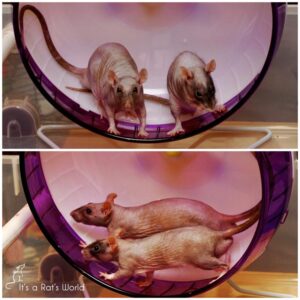
The boys didn’t take long to trust me, but they were very wary of other rats. Lurmers became territorial over Jing Jang and their wheel. He decided that no one but them were allowed near the wheel. He made an angry, pigletlike noise if anyone one even looked at it, or Jing Jang for that matter. This made him a nuisance to the other rats, but I thought he was pretty awesome.
You just never know how a rat will internalize their experiences.
Genetics And Lack Of Attention

Genetics can be another cause of fear — possibly from bad breeding. Anxious and fearful parents can pass these traits to their offspring. An inattentive mother that spends little time caring for her pups can also leave them with anxiety. Even a lack of handling by a human after the rat is born can induce these emotions as the rat grows.
Some of my rats were clearly born anxious. Despite having a safe environment and being handled from a very early age, these rats were always jumpy.
My boy Gatwick was only 3 ½ weeks old when I started fostering him, his mother, and his 11 siblings. Three of his brothers had eagerly, and without hesitation, declared that I would be their human. They craved attention and demanded to be held whenever I got near their cage. I couldn’t help but fall in love with them. Gatwick, on the other hand, was a timid boy who preferred to stay hiding behind his mother. He was shy, easily startled, and avoided being out in the open whenever possible. Nothing frightening ever happened to him, but his mother was found living in a barn the day she gave birth. She was still scared while I fostered her and wouldn’t let me touch her. I ended up keeping the four boys, and Gatwick stayed his anxious-but-friendly self his entire life.
How To Help

It’s important to reassure your scaredy-rat that they are safe. Their cage should be a secure environment, with plenty of dark hiding places. Definitely keep other pets away from it, too, as lurking cats or dogs will only add to their anxiety.
Most importantly, you need to spend time socializing with your rats, even if they protest being out of their cage. You do this by providing an area next to you on your bed or couch for them to retreat to. This way they have personal space while getting to know you. I suggest a small animal or cat hut, or an igloo. Even a box with a hole will do. It just needs to be a hiding spot that you can reach your hand inside to pet them. Add in scraps of fleece for additional “protection.”
Use the hut or blankets to carry the rat back and forth from the cage if they hate being held, as it helps them feel safer. Or another great option is a bonding pouch that your rat can hide in while you wear it.
If you rat is becoming more comfortable and curious, consider making a play area on your bed or couch so they can safely move around and play. Being able to explore helps their confidence.
And don’t forget to “bribe” them with healthy snacks. Food is always a good way to earn their trust.
Get them out every day! Leaving your rats in their cage and ignoring them only fuels their fear. For more on interacting with standoffish rats, check out my article “Honoring Your Rat’s Personal Space.”
Adopting already bonded pairs of rats is another way to help them adjust. Rats need rat friends and use each other for comfort.
Medical Intervention
If their fear is not waning, it might be time to talk to your vet.
A male rat may benefit from castration. This can be especially helpful or even imperative if the rat has become aggressive and is biting their cagemates, or even you.
Consider medication if anxiety is persistent and impacts their overall well-being. My girls Pi and Cinder were on Trazodone for at least the first year I had them. It helped take off the edge, which they desperately needed. They were still skittish, but they acted less feral. Plus, they were finally willing to take naps in my lap! But only if they could stay completely covered of course.
Rats As Individuals
As you can see, fear exists on a spectrum. One rat may function in a constant state of dread, or at the very least, a state of alertness and caution. While others are able to move past many of their fears. Then there’s those bizarrely fearless weirdos that regularly escape their cage in an attempt to hunt down that cat roaming the house. Or perhaps that was just my Leeloo?
No matter who they are or what they’ve been through, they are each fantastically special and deserve a peaceful life.