


Contents

If you’re like most rat owners, you probably find your rat’s teensy little hands, with only four fingers, and their chickenlike feet to be rather adorable. What is not adorable, however, is the feeling of them on your body when their nails are overgrown and piercing into your skin. It’s crazy how long and utterly sharp rat nails can get. There’s never a day that my hands don’t show signs of me handling rats, i.e., they are covered in scratches!
Rat Nail Facts

With the potential for pet rats to grow “dagger” nails, should owners regularly provide pedicures for their cute rodents? Not necessarily. But before we get into the ins and outs of nail care, let’s look at a few facts about rat nails.
• Rat nails are naturally arched
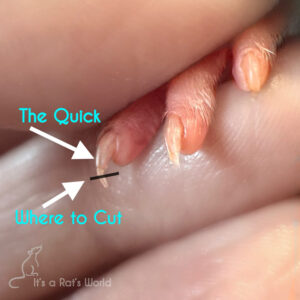
• In the center of the nail is the quick, which is where the nerves sit and the blood supply lies
• The quick is the pink, opaque area of the nail
• Cutting the quick can cause profuse bleeding and is very painful for the rat
• Only the clear tip of the nail should be trimmed
Following are my personal observations about rat nails. These are not hard science.
• Really young rats tend to have especially long nails. These aren’t necessarily more painful on people’s skin, however, due to the tips being quite thin.
• As a rat ages, the nails get thicker, which makes the tips more painful on human skin. Note that nails are less sharp with aging if the thick nails are caused by arthritis.
• Some rats’ nails stay relatively short and rarely need to be trimmed. That or the rat is biting their own nails and keeping them shorter.
• Sometimes only the “toenails” get long while the “fingernails” stay short, or vice versa.
• A senior rat’s nails sometimes grow quite thick and opaque, and curl inward. This is often seen in rats with hind limb issues and arthritis.
Three Reasons To Trim

Even with years of practice, I don’t look forward to trimming my rats’ nails. That’s because I’ve yet to meet a rat who enjoys it or tolerates it for very long. And, frankly, it’s nerve-racking considering just how tiny their paws are, and how easy it would be to accidentally cause your rat damage as they squirm around. For this reason, I usually leave the nails be. Sometimes, though, it’s absolutely necessary to make the effort.
If nails get too long, it’s not uncommon for one or more to start snagging on things, such as your clothes, material you line the cage with, or cloth hammocks. I find that it most often happens with a toenail versus a fingernail.
Too much snagging can lead to the entire nail being ripped off. This is painful and can result in a shocking amount of bleeding. If it’s only one nail getting caught, then you may not need to trim the others.
Keeping your rats’ nails trimmed can also lessen the frequency of yourself getting scratched. Or, at the very least, lessen the severity of any scratches. This is especially helpful if you’re allergic to rats and break out in hives when they touch you. I’m not allergic to them like my husband is, but I’m finding that after decades of enduring rat scratches, I’ve become more sensitive to them. While I don’t get hives, the cuts and scratches itch quite a bit.
If your rat is severely itchy from mites or lice and is continually scratching themselves, they are likely to become covered in scabs. A veterinarian can, and should, prescribe medication for the parasites. Additionally, you or the vet should trim the rat’s nails to prevent self-injury or an infection from spreading on their body.
Reasons Not To Trim Rat Nails

Even with experience, trimming rat nails shouldn’t be taken lightly. Rats move — a lot — and can be unpredictable. Don’t expect them to sit still for you while you use a sharp cutting tool on their delicate appendages.
And as I mentioned earlier, rats do not exactly enjoy getting pedicures, and it can cause them stress. If the nails aren’t posing any problem to you or your rat, I suggest leaving them alone.
Also, if your senior rat has developed long, thickened toenails, your rat may experience pain from even a normal trimming. I’m not sure specifically why some find it so uncomfortable, but I suspect that it either causes too much pressure on old, achy toes or the quick has grown out farther. It’s often more difficult to see precisely where the quick is with nails like this, because they also become more opaque. This makes cutting the quick much more likely.
Either way, my ailing seniors react as though I’m hurting them whenever I’ve tried trimming their toenails, so I avoid doing it unless absolutely necessary. Talk to your vet if you have any concerns or if the length of the nails hinders their movements or any of the nails are curving into the paw.
Nail Trimming Supplies

If you do need to trim your rat’s nails and have received proper, in-person instruction, gather all your supplies first.
Different clipping tools to choose from:
• Human baby nail clippers
• Tiny, human nail scissors
• Small pet nail clippers
• Soft emery board
Other optional supplies:
• A blanket or towel
• Kwik Stop or some other store-bought styptic agent, or cornstarch or flour
• Paper towels or tissues
• A second set of hands
You will also need lots of patience!
Tips For Trimming Rat Nails
Because of the risk of injuring a rat if you’re completely unfamiliar and uncomfortable with trimming a wiggly pet’s nails, always have a veterinarian do the cutting or have them teach you how to do it. Never attempt to trim your rats’ nails without first getting personalized instruction, in-person. You can spend some time watching online video demonstrations to prepare you. This video shows Dr. Anthony Pilny, a well-known veterinarian who treats rats, demonstrating rat nail trimming. Again, always consult with your own veterinarian before trimming your rats’ nails.
Different methods are used for holding a rat during a nail trim. Use the one with which you’re most comfortable. Some people even prefer to have a second person keep the rat still. If a helper is involved, it may be easiest for everyone if the rat is sitting on a tabletop. Setting a towel under the rat can help prevent slipping and/or be used to wrap around the rat for a more secure hold if needed.
I prefer to do the trimming by myself. I have my rat sit in my lap between my arm and my stomach, so that both hands free. I usually secure my rats in place by gently pressing their body against mine with my left arm and then using that hand to hold their paw in between my thumb and pointer finger. Then I use my right hand to hold the clippers or file. I hold the paw firmly, but not so firmly that I’m hurting my rat.
You only want to remove the transparent tip of the nail, leaving a tiny amount left in front of the quick. If you try to get too close to the quick, you risk cutting it, which will cause it to bleed.
If you’re struggling to keep your rat still enough to start cutting or are too nervous, use a soft emery board instead until you both feel more comfortable. Just swipe across the tip of the nail several times and avoid hitting their actual toe or finger.
You may need to take breaks and clip only one or two nails at a time. Pay attention to your rat’s comfort level and protests.
Use a calm voice with your rat during the process and reward them with a snack after.
Treating A Cut Quick Or Ripped Nail
You might be surprised at just how much a cut quick can bleed. If you do accidently cut it or you find the cage covered in blood after a toenail has been torn off, stay calm. As long as you can get the bleeding to stop fairly quickly, you both should be good. Thankfully rats are pretty fast healers.
Blot some of the blood with a paper towel first, and then use a styptic agent on the injured nail or dip the toe/finger into a tiny bowl of flour or cornstarch to help it clot. Use a reassuring voice to soothe your rat. If you can’t get the bleeding to stop, take your rat to your veterinarian.
Additional Tips About Rat Nail Care
To help your rats’ nails to wear down naturally, try placing safe objects with rough textures in areas of the cage your rat frequents the most. Bricks, a rock, or even a cinder block could work. You can also attach one or several Lava Ledges or other textured shelf/perch to the bars of the cage for your rats to climb on.
I find it ironic how much rats dislike getting a pedicure or manicure, because I have found that mine love trimming my nails with their teeth. At least I’m more professional about it and use proper clippers. I wish you good luck with your own rats’ nail care.