


Contents

Do you know what distinguishes rats, or all rodents for that matter, from other animals? Their teeth! Or more specifically, their continuously growing incisors (and for some rodent species, molars also). When front teeth are open-rooted, it means they continue to grow throughout the entirety of your rat’s life. This feature makes all rodents quite unique, but it can be problematic as well.
The majority of rats can go their whole life without any dental issues, but it’s crucial for owners to know how to spot a problem and what to do if one should arise. If problems are ignored, they could trigger all sorts of health concerns for your pet.
Before we dive into tooth care, however, I’d like to share a few facts about these frankly fascinating chompers.
Rat Teeth Facts
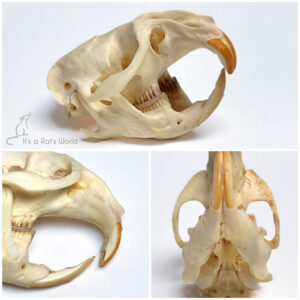
1. Unlike cats and dogs, who have four types of teeth, rats only have two types: incisors and molars. And they will only have one set of these teeth their entire lives. Meaning they don’t start with “baby” teeth that are later replaced by “adult” teeth.
2. Rats have 16 teeth in total. The four incisors, which are the front top and bottom teeth, are the first to erupt. They come in when the rat is around 8–9 days old, and their purpose is for gnawing. The molars are the 12 teeth found at the back of the mouth and the first set of them starts erupting on day 19. By day 35–40, the last set of molars start coming in. Their purpose is to grind up food before swallowing.
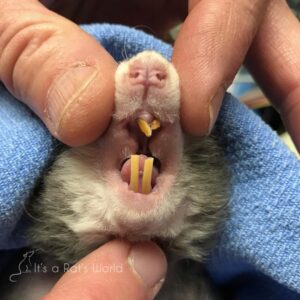
3. Rat incisors are not white. The healthy top incisors of an adult are a dark orangey-yellow color, with the bottom set being a bit lighter and only yellow. If you notice your rat’s teeth are suddenly getting lighter or are turning white, this is a sign of a health issue and it’s time to talk to a vet.
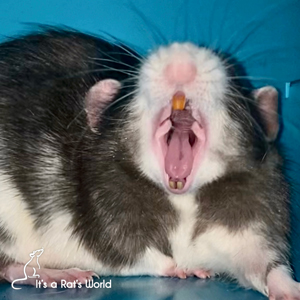
4. Positioned behind the incisors, in the gap between them and the molars, are flaps of cheek skin. These flaps close and can prevent unwanted items or debris from being swallowed. They also make it extremely difficult to see or examine the molars when a rat is not anesthetized.
5. Rats naturally keep their incisors worn down to a proper length and shape by grinding them. This is also known as bruxing. The combination of the hard enamel on the front of the incisors and the soft dentin on the back allow the rats to grind them into an almost razor-sharp, beveled angle. If these teeth were to grow without restraint, they would start curling and would even grow into the roof of the rat’s mouth.
6. Rat incisors don’t get cavities. This is in thanks to the fact that they never stop growing and the speed of growth. By the time a cavity would even have the chance to appear, a rat would have already worn that part of their incisors down.
7. Rats have two lower jaw bones that move independently from one another, with a flexible joint in between. This allows the rat to separate and move the bottom incisors at a slight angle. The top incisors cannot do this. This rotation helps with the sharpening of their teeth and gives them a major advantage when it comes to gnawing through food, hard materials, and keeping their teeth at an optimal length.

8. A rat’s powerful gnawing skills, along with the strong jaw muscle that runs through their eye socket, behind the eye muscle, is why rats can eye boggle. This jaw muscle moves so forcefully when they are gnawing or bruxing their teeth that it actually vibrates their eyes (i.e., boggling). Who would have thought that it was our rat’s teeth that we needed to thank for the cuteness of the eye boggling?!
For more even more in-depth facts on rat teeth, check out the teeth page on the Rat Behavior And Biology website.
Rat Teeth Myths

A couple decades-long myths about rat teeth seriously need to be dispelled.
Myth: Rats must be fed hard foods or given things to chew on to keep their teeth worn down.
I’m not sure when this myth first started but I’ve been hearing it since I got my very first rat back in the ’90s, and I unfortunately still continue to hear it today.
Fact: Rats instinctively wear down their own teeth and their jaws are specifically designed for this. As long as their teeth are healthy and properly aligned, rats do NOT need to be given anything special, nor do they need to be trimmed.
If they aren’t aligned, however, then intervention is needed, which we’ll discuss later in the article.
Myth: Rats can chew through anything, even steel.
Fact: The structure, strength, and sharpness of their teeth do allow a rat to chew through a number of seriously tough materials, such as bricks, aluminum, cement, and drywall. But a rat cannot chew through steel.
If they could, rats would be one of the few beings on Earth with the potential of defeating Superman. Come to think of it, I do like the idea of a rat comic book character. Well, as long as they are the superhero and not the villain, of course.
Malocclusion Dangers
Unfortunately, it is possible for a rat’s upper and lower teeth to become misaligned, which is called malocclusion. This condition can happen for a number of reasons and can quickly become quite dangerous for your rat if left untreated.
Some causes:
• Falls or accidents, such as being stepped on, not only cause a risk for jaw misalignment, but they can result in a broken tooth. If an incisor breaks, this can completely prevent the other three from grinding down evenly, thus causing them to continue growing at different lengths.
• A mouth abscess or cyst, or a tumor near the jaw can also affect alignment. And in turn, malocclusion can cause both a mouth abscess or cyst. The beginnings of malocclusion had caused the abscess in my girl Leeloo’s mouth from where a tooth was hitting her gums wrong.
• Some rats are genetically predisposed to malocclusion. In this case there is no way to prevent it, there’s only treatment.
One of the dangers of malocclusion is overgrown teeth. If the teeth are left as is, they will continue to grow until they eventually curl, puncture the roof of the mouth, or both. This can lead to infection, pain, starvation, and potentially death. As the problem continues, your rat will also find it more and more difficult to eat.
Overgrown teeth aren’t the only concern. Misaligned lower incisors can wear down the upper incisors until they are nothing but tiny, uneven stumps. This too can prevent your rat from eating, not to mention hindering the lower incisors from being worn down to an adequate length.
Minimizing The Risk Of Malocclusion
Malocclusion isn’t always preventable and can sometimes spring up, seemingly out of nowhere. But there are some steps you can take to lessen the chances of it happening. Or at the very least, catching it before it gets really bad.
• Avoid free-ranging your rats to lessen their chances of being stepped on or getting into areas where they could get physically hurt.
• Don’t leave your rats unattended on tables, beds, or other high-up areas that they could fall from.
• Monitor your rat’s eating habits. If you notice they are eating less or are refusing their favorite treats, it might be from mouth pain and/or dental problems. That’s how I learned my girl Leeloo had malocclusion. My vet found a mouth abscess when I brought Leeloo in for weight loss and lack of appetite.
• Look for other signs of mouth pain. If you find your rat rubbing the side of their face against things or drooling, this could be an indication that their mouth hurts.
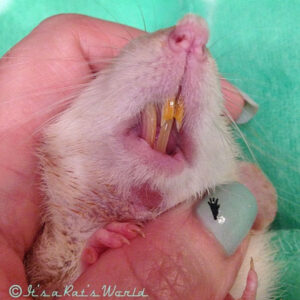
• Do weekly or biweekly visual exams on your rats’ mouth. Look for sores, signs of infection, gum irritation, or redness. Check that each set of incisors are even, and that there are no cracks, chips, or breaks in them. If one or more teeth are being worn into a point or at an angle, it means they aren’t aligning. Talk to your vet to see if your rat needs to have their teeth trimmed.
Teeth Trimming
Trimming can be done by a vet with a Dremel or clippers. And don’t be surprised if your squirmy, uncooperative rat needs to be put under light anesthesia for the process.
In some cases, a vet may even show you how to do it at home yourself. I warn you, though, this is not an easy task. Most rats will not tolerate it and will obsessively thrash about, making injury of the rat a lot more likely. I absolutely dreaded the experience on the occasions I had to do it, and I definitely required someone else’s help in holding my rats still.
Some rats may only need to have their teeth trimmed once or twice to get the teeth realigned and back to grinding them down evenly on their own. But in my experience, malocclusion is hard to correct, and most rats with it need continual trimming for the rest of their life.
If you find this to be the case, be prepared for the frequency of the trimming to increase over time. That’s because trimming the teeth actually speeds up the rate of growth.
When Leeloo first started getting her teeth trimmed, she needed it done once a month. After a while it was needed every two weeks, and then eventually weekly. Same with my boy Crowley.
Prepare For Rat Tooth Care
I never learned what caused the malocclusion for Leeloo or Crowley. I’ve speculated that Leeloo’s may have been from a fall after escaping her cage, that I just never witnessed. I don’t even have a guess as to why Crowley got it though. Ultimately it doesn’t matter, I still had to help my rats through it.
Now that you know a little more about how rat teeth function, I hope you are better prepared if your rat is ever in need of dental intervention.

This article is absoutely fascinating! Thank you!