


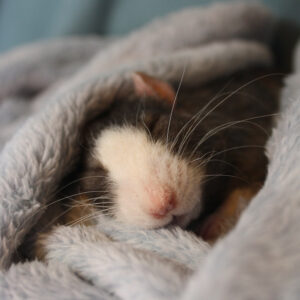
Is there anything cuter than a snoozing rat? There’s something so precious and innocent about a rat curled up or intertwined in a pile with friends and sleeping the day way. But what is there to know about rats and their slumber? Well, a lot actually!
Sleep Patterns And Naps

I’m sure it’s not a surprise that rats are nocturnal. That’s because they are prey animals and nighttime is usually a safer time for smaller, weaker creatures to be out and about. But like cats and dogs, rats are also considered polyphasic sleepers, which means they have more than two sleep cycles in a single day. This allows them to adjust easily to their owner’s schedule. And they can be awake at random hours.
Because rats don’t have to stick to a strict bedtime, they are able to catch up on their beauty sleep through naps. And man do rats love their naps! According to the University of Washington, rats sleep on average 12.6 hours a day, or 52% of the day. Unfortunately, the study doesn’t give any ages, but I’m going to assume those statistics are about younger adult rats and that this percentage increases over time. One thing you learn as an owner is that rats sleep even more as they age.
Sleep And Aging

Baby rats sleep a great deal. When awake, they are little balls of energy that are always go, go, go. This couldn’t be clearer than when you have both young and senior rats at the same time. To get an idea of what I mean, read my article Rat Life Lessons from Older Rats from February of 2022. I “interviewed” my then-group of seniors and young boys.
Today, only two of those rats are still with me; the seniors have all passed on and I lost Kelton, one of the “young boys” last month. The two remaining boys are just over 2 years old now and are very quickly approaching their own senior status.
At the time of the Life Lessons article, Brinley and Moffett were hyper and always on the move. And while they never quite had the same intense level of energy as Kelton, it’s been fascinating to watch them become lazier and lazier like my seniors from 2022. Actually, Moffett is currently napping on the couch as I write this.
Usually, male rats slow down more than female rats do as they age, but even girls lose their stamina over time. So longer, more frequent naps in older rats are completely normal and expected. Don’t confuse this with lethargy.
Rats are usually able to adjust quickly after being woken by their owners. For the most part anyway. Sometimes when I call my boys in the middle of the day, they don’t always come. I know that they heard me, because there is instant movement within their hammock. It’s not unusual for me to see one of their faces poke out from said hammock only to disappear again if I’m not offering a treat. A treat might be worth the effort, but lack of treat means those lazy butts aren’t budging. That’s when I have to manually extract them from their bed. But by then, they are wide awake and happily willing to hang out.
If your rat is listless or not waking up, then it’s time to be concerned and see a vet.
Light And Darkness
All creatures function better when exposed to the typical cycles of light and dark throughout the day. Too much light can have a significant effect on our circadian rhythm, which guides our internal sleep clocks. Regardless of being nocturnal, rats are no different and shouldn’t be left in a lit room all night long. You should also provide them plenty of dark places to sleep within their cage during the day.
Dreaming

Did you know that rats can dream? A study done at MIT and published in Neuron in January 2001 found that rats dreamed about the mazes they had run through earlier that day. And another study at University College London published in Neuroscience in June 2015 discovered that while a rat is sleeping, their brains simulate journeys to a desired moment, like eating. Maybe this means that our pet rats are dreaming about a play session they just had or their next snack?
Based on my own observations, I think they have both pleasant dreams and nightmares. Witnessing it is similar to dreaming dogs, minus any whimpering or barking. You are likely to see a change in their breathing and all of their whiskers may flutter and rapidly twitch together. The muscles in their face or eyelids may flinch, and their front paws may close into tight balls and then relax, while their back legs jerk or kick. They may even start bruxing in their sleep! I’ve witnessed a few of my rats startle themselves awake, only to look around confused immediately after. Whatever they dreamt, it must have been vivid.
Snoring
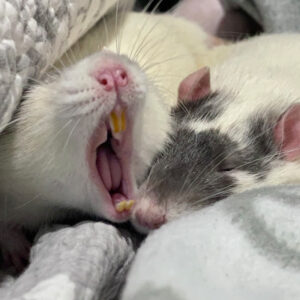
Ever wonder if rats snore? Well as far as I understand, they can, but never without cause. Anytime I’ve heard “snores” coming from my rats, the cause was an upper respiratory infection. Every video I’ve seen online showing a pet rat “snoring” has the sound of a respiratory illness.
While I do not have any hard scientific data that says rats can snore without an underlining health, genetic, or congenital issue, I think any noise a rat makes while sleeping should be considered a possible health issue. It would be wise to talk to a vet.
Sleep Positions

Rats sleep in all sorts of crazy and often hilarious positions! One of the more commonly seen is a rat with their head adorably curled and tucked under toward their belly. They almost resemble an egg or a potato. Some people believe they do this to block out any bright light exposure.
A room being cool can be another factor for sleeping in this position or in a ball on their side, because tucking into themselves keeps their body heat in. A warmer room temperature and a darker sleeping space may encourage a more open or stretched out body position. Rats regularly stretch out inside their hammocks where it’s dark and cozy.

But comfort level can also play a part in how rats lay. Rats that feel vulnerable or nervous are much less likely to sprawl out, but a happy content rat is known to “pancake” or lie flat on their stomach as if they are trying to be one with the surface they are on. They may do this if they are getting overheated as well, but there’s usually accompanying behaviors they exhibit if overheating is the cause.
Much less common, but absolutely adorable is the belly up, on their back, with feet in the air position. Most rats do not readily sleep like this, as it leaves them feeling defenseless. I often read that rats who do sleep on their back feel especially safe in their environment.
My two boys Moffett and Brinley are back sleepers. I’d love to pat myself on the back for providing them that level of peacefulness, but I honestly can’t take credit for it. They’ve always slept like this. A photo of them asleep on their backs made me instantly want to adopt them. They were in a foster home with people they didn’t know and surrounded by numerous other rats. I had had only a couple other back sleepers in the past, and because I found it to be so rare, I felt an immediate love for them the second I saw the picture.
As the boys have gotten older though, they only sleep on their backs when inside a hut instead of out in the open as they did in the past. So, feeling safe is a component I’m sure, but I think it’s also about preference. I believe that, just like people, rats can have a favorite sleeping position.
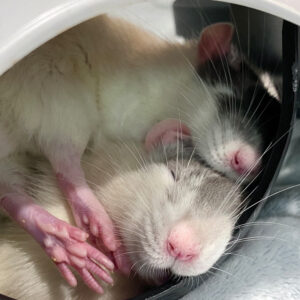
You can’t have a mischief (a group of rats) without seeing a rat pile at some point. Rats love to snuggle with one another and absolutely use each other as pillows. They don’t mind having another rat’s foot, tail, bum, face, or entire body, in or on their own face — or squashing them from above. It’s just the amusing way rats roll.
So the next time you find your rats napping, capture the moment and take lots and lots of photos. My phone is absolutely full of sleeping rat pictures!