


Contents

Being a rat owner comes with an inevitable barrage of rude comments that you might not expect. Not everyone’s reaction to learning you share your home with pet rats will be negative; some are rather pleasant and supportive. But the topic of pet rats often attracts a lot of unsolicited, negative opinions.
“Ew, I hate their tails!” probably tops the list of insulting comments I get. This comment is usually followed with a grimace or shudder. The most common reason rat-phobic people give for not liking the tail is that it resembles a snake. I guess it has some resemblance to snakes, but I just see a tail when I look at them. And I actually love those adorable, long, rattie tails! I have always surmised that if rats had bushy, squirrel-like tails instead, they would be much more popular with the general public.
Have you ever wondered, though, why rats have tails in the first place? Or why they look as they do? Well, like everything in nature, there are important reasons for this.
Tail Appearance

A rat’s tail is long and cylindrical, starting off fatter at the base and then tapering down to the tip. It grows to be 6 to 8 inches long by adulthood. The majority of tails are peachy-pink in color like the rat’s ears and feet, but some tails may be brown, gray, or multicolored. This depends on the variety of rat. They are also covered in tiny, smooth scales that can darken or change with age, from dry weather, or from debris (such as urine).
Way too many resources online claim that rat tails are hairless, but they aren’t. They are, in fact, sparsely covered in fine, short hairs. These hairs are colored white, black, brown, or even a mix of these on the same tail.
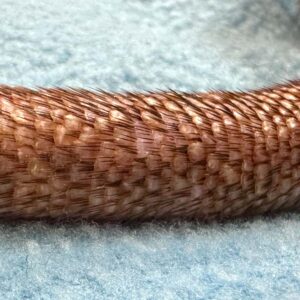
I cannot find detailed information about these tail hairs, but from years of observation I believe they are similar to whiskers. They are clearly sensitive to the touch and cause discomfort to the rat if rubbed against the direction of growth. If you gently touch to tail hairs moving against the direction of growth, the hairs feel coarse or bristly. However, if you gently touch the tail hairs moving with the direction of growth, the hairs are quite soft.
Tailless Rats

Before I get into the functionality of the tail, let us discuss the Manx rat. In 1915 and 1917 The Anatomical Record, a peer-reviewed, scientific journal published since 1906 from The American Association For Anatomy, published two scientific reports of naturally occurring “taillessness” in rats. By the late 1980s tailless rats, i.e., the Manx rat, started to pop up within domestic breeding circles in Europe and the United States. While this may have started as a natural mutation, some breeders eventually began specializing in this unfortunate trait. The reason I say “unfortunate” is because the absence of a tail means that the rat is missing half of his or her spine!
The rat’s tail is literally a part of their vertebrae. It also contains a necessary layer of tendons, muscle, and blood vessels (that we’ll discuss in the next section). Predictably, Manx rats end up having more abnormalities and serious health issues than rats with tails. A few of the problems they face include malformed skeletons, fused leg bones, bladder or bowel problems, urinary tract infections, and body temperature regulation issues.
This type of gene selection ends up being far less about appearance and much more about needlessly removing a vital part of the body. This is why I wholeheartedly believe that breeding for this trait is absolutely illogical and selfish. We should not be breeding animals to make them more palatable for the squeamish.
Tail Functions
Besides being an extension of the spine, a rat’s tail also provides thermoregulation, balance, communication, and sensory input.
Thermoregulation:
Rats have a limited ability to regulate their body temperature and do not sweat or pant. Instead, it is their tail’s job to serve as a thermoregulation system. A rat’s temperature is controlled by dilating or constricting blood vessels in the tail. When a rat gets too warm, the vessels swell, drawing warm blood from the body and cooling it through the surface of the tail’s skin. The blood then returns to the body at a cooler temperature. This means that rats would actually overheat if they had a furry tail.
When a rat gets too cold, the vessels in the tail constrict, which limits the warm blood from flowing into it. This allows their body to maintain that heat instead.
Tailless rats are at major disadvantage without this thermoregulation system.
Balance:

Rats are amazing climbers and explorers, thanks in part to their long tails. While rats cannot grasp an object or hold onto something with their tails the way monkeys can, they do use them as a counterbalance. A rat’s center of gravity is already low, but they can change it by specific placement, angle, or movement of the tail. Essentially, their tails provide them extra time to make subtle, needed muscle adjustments as they walk or climb.
When a rat stands on its hind legs, the tail is usually straight out behind it to provide three points of contact. If a rat feels unsteady when you pick it up, it often rotates the tail like a propeller (an action called helicopter tail) to gain balance. Spend time watching what your rats’ tails do when climbing the bars of their cage or sitting perched on the edge of a food dish. It is really fascinating to witness all the remarkable ways that tails help out your rats.
Communication:
A couple different tail movements help rats express emotion. Tail slapping (hitting another rat with their tail) is probably more common with wild rats, but it can be witnessed in domestic ones as well. It is used as a warning when a rat is upset or getting annoyed.
Tail flicking or wagging on the other hand can mean fear, anger, or happiness. This movement look very snakelike, because it resembles slithering rather than the tail wagging of a dog. I have only had a few tail-wagging rats. And even those rats only did it once or twice in their lifetime.
Because tail flicking or wagging can mean different emotions, I was able to figure out what my rats were feeling based on what else was happening. I could tell one rat was afraid, because he had spotted our cat. His entire body stiffened and his whiskers were fiercely twitching as his tail wagged. I have also seen tail wagging while two rats were bickering with each other. That was clearly a wag from anger. But the happy wags have come from rats whose bodies were extremely relaxed with their eyes shut, while getting a back rub. Those wags were communicating pure bliss.
Sensory:
I cannot find any specific role for the hairs on the tail, but because of their sensitivity when touched, I believe they act similarly to whiskers. I think these hairs help poor-sighted rats identify when objects or barriers are close. Or perhaps they allow the rat to analyze what type of surface they are on? Either way, I highly doubt they are there randomly.
Tail Care

Rat owners need to be mindful of this essential body part when handling their rats. NEVER pick up a rat or grab a rat by their tail! Also watch carefully for tails when closing cage doors. And be diligent about not stepping on one if your rats are free-ranging.
All of these actions can cause injury and pain, and possibly even damage to their spine. This is especially the case for elderly rats, or rats suffering from arthritis, and hind leg problems.
It’s not mandatory, but you should also consider keeping your rat’s tail clean.
Rat Tails Rule!

So now that you know what an important role a rat’s tail plays in their lives, why not drop some cool trivia on all those haters who make rude comments? I find that educating people does not necessarily change their mind, but it does catch them off guard. The more facts I provide when people are being rude, the less they have to say. And who knows, maybe you’ll even convert someone into being a rat lover!
baby rat tails are so soft and special! when they are super small i’ve lifted them by their tails when i’ve had to catch them in their cages or on the floor, but i do not continue to do this. i stop as it get older. i love to touch their tails while my rat is on my shoulder. they don’t mind at all.
Nothing better like the feeling of your rat’s tail in your mouth or nose when they stand on your shoulder! <3 I particulary enjoy too when they just pee on a platform and make a little of tail and you feel some "water" on your face xD Anyway I really love the tails, they are really amazing. Oh and the feeling when they roll up their tail around your hand <3