



If you’re considering getting rats for your child, I’m glad you’re here! Not only have I spent decades caring for these animals, but I also raised my own son around them. I even spent several years taking my rats to a summer camp class where kids got the opportunity to meet a different animal each day. I was known as the “Rat Lady” for “Rat Day.” By the end of class, every single one of the children left with a new appreciation for rats.
Additionally, I helped regularly with table events for Any Rat Rescue, where we got to educate both adults and children about the pet rats that needed homes.
Know What To Expect
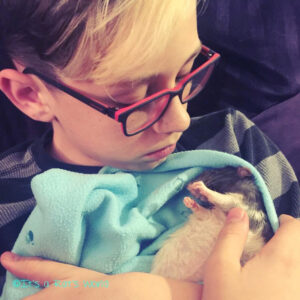
Over the years I’ve been asked countless times whether rats make good pets for children, and my answer is always a resounding YES! Their unique personalities, their sweetness, their playful nature, and their ability to form strong bonds with humans makes them a fantastic pet for children. Although, my response also comes with caveats.
Research rat care and what you need to provide. Anytime you bring an animal into your home it’s important that you do so by choosing the right one for your family and lifestyle, while also providing them with the best care. Luckily for you, I’ve written an article about the pros and cons of having rats to help with this decision.
Understand that rats are a commitment. I’ve also noticed that a lot of parents assume that all pocket pets are extremely easy to care for, are cheap, and require little commitment. Some people are shocked to learn that rats need vets just like dogs and cats do. I’ve had kids frantically email or message me asking for help when their parents refused to take their sick rats to the vet, which always broke my heart.
Accept that rats are not throwaway pets. Maybe it’s their small size or the fact that pet stores often have an abundance of rodents, even selling them as food, that gives off this impression. Whatever it is, I feel it’s my duty to change this myth. Not just for the parents’ or kids’ sake, but for any of the rats they bring into their homes. So, I beg any moms or dads reading this not to treat these animals as throwaway pets!
Reflect on you and your child’s ability to care for rats. Due to my experiences, I have some questions I regularly ask parents: How old is your child? What is their maturity level? Is your kid going to be the only caregiver, or do you plan on taking an active role, too? Are you willing to have two or more rats, plus buy all the needed supplies? How much time can be dedicated to the rats every day? Are you willing to spend money on vet care?
Age Guide For Rat Interactions
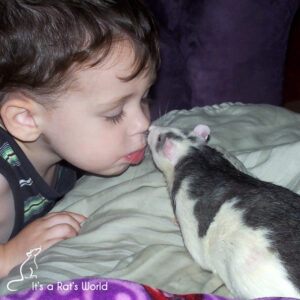
Your child’s ability to care for their rats is contingent on several factors. Age and maturity level being the main ones. The following age guidelines can help.
Babies and toddlers should be monitored and coached at all times when touching or holding rats.
Children younger than 8 can be given simple tasks to help, but parents should be the main caregivers.
Kids age 8 to 12 can be expected to take on shared responsibilities, while also being the ones who spend the most time with their rats. A parent should still continue checking in daily though, with reminders about feeding, making sure water bottles are filled, cages are getting cleaned, and that the rats are getting enough daily attention. Parents should also spend time getting to know the rats, that way they can help spot any changes in their health.
Even though my son Rory was raised with rats since birth, it wasn’t until he was 8 that I felt he was ready for his own. Even then, I oversaw all their care.

Kids older than 12 can be the main caregiver of their rats. Although, I still advise parents to check in every now and then, especially if the child is new to rats. There’s a lot to learn in the beginning and they can’t be expected to figure it out all on their own
Please keep in mind that every child matures at their own pace. Some may not be as adept with specific responsibilities of rat care that other kids are. They may need extra time before they are ready. That will be up to the parent to decide.
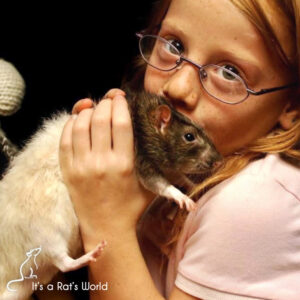
Another consideration is the child or children in question. Some are too aggressive around animals, and rats are small and delicate. Maybe skip rats as a pet if this is your child.
Not all children innately take to the responsibility of pet ownership either. There’s nothing wrong with a child who doesn’t, it just means a parent or guardian needs to be even more involved than expected. Some kids are forgetful and may require daily reminders. Additionally, the older a child gets, the busier their social life becomes. Check in and see if they are still providing adequate care for their rats, don’t just assume they are.
Even if your kid is all in, it’s important that you’re still hands-on and provide guidance when needed. They will not automatically know how to care for their rats, and they might not take the time needed to learn about them.
My Personal Experience

My first dabble into the world of rodents started at the age of 8 with a gerbil named Whiskers. That led to more gerbils, then a hamster, several mice, a guinea pig, and finally rats. I think I was just born to be a rodent lover.
No shade to my mom, it was the ’80s after all, but the only help I got was with the money to buy my pocket pets and their supplies. She also gets credit for paying for the vet during my high school years when my guinea pig got sick. Beyond that, I was on my own.
Looking back, I can confidently say that I should have been supervised at least into my preteen years. In the beginning I would get lazy about cage cleaning and didn’t fully understand the importance of removing the litter and scrubbing the cage. Sometimes I just piled clean litter onto the dirty stuff instead of removing the dirty litter. Then there was the whole gerbil breeding saga I went through when the friend I got for Whiskers was misgendered at the pet store.
I tried my best with all my rodents, but the lack of guidance and the terrible educational materials that were available at the time made it challenging. It’s honestly why I’ve spent all my adult years working to educate rat owners.
Teaching A Child How To Handle Rats

When showing a child, or an adult for that matter, how to hold rats for the first time, start with just one rat to keep the process simple.
If your child is still very young, do not let them pick up the rat themselves. Instead, bring the rat to them and place them in their lap inside something soft like scraps of fleece, a rat hammock, a bonding pouch, or a small towel or blanket. This protects the child from accidentally getting scratched. Plus, rats always feel safer when covered up. You should also repeatedly say something like “Gentle” or “Soft hands” as you show them how to gently pet the rat’s back. Quickly redirect them anytime they try to grab at fur or pinch the skin and repeat, “Gentle” to them. And never leave a small child unattended with a rat!
When teaching older kids to pick up and hold rats, stress the importance of supporting the rat’s entire body, including their hindquarters. This can be done by scooping the rat up with a cupped hand under their belly and then bringing them in toward your chest or setting them in your lap. A second hand can be used on the side of the body if the hands are tiny, or the rat is large. Keeping the rat against your body provides continual support. It should also be emphasized that rats should never ever be picked up or held by their tail!
Dealing With And Heading Off Fear

If your child is scared or especially young, there are two very specific things to be aware of: sharp nails and toilet issues. They are the quickest way to turn a child off of rats.
During a first introduction the rat is likely to be nervous, too, which means fear poops. Male rats are also particularly prone to urine marking, but some females do it as well. After a while, this does lessen and it’s not something that happens every time a rat is held, especially if you pay attention to their cues.
As for their nails, I won’t lie, they can hurt! They are especially noticeable if the rat is sitting on your shoulders or bare legs, digging in as the rat tries to keep their balance.
This is why I always put rats in a bonding pouch, hammock, or fleece, before handing them over to a child or adult to hold for the first time.
Being armed with a bag of these items and a container of antibacterial wipes (baby wipes can work, too) is how I won over apprehensive kids at the summer camp and families at the table events. Not only did having something for my rats to sit/hide in provide a barrier from their nails and urine, but it also provided the rats extra support. And I mean both mental and physical support. A rat feels safer when they aren’t exposed. And when they feel safer, they are calmer and much less squirmy. You’re definitely more likely to get scratched when a rat is squirming in your bare hands or arms. This, in turn, can cause the rat to be dropped and injured.
If it was a teen or adult, I felt comfortable enough letting them hold my rats while standing. Anyone younger I started off by having them sit and placing the rat-filled hammock or pouch in their laps. Once I could determine how comfortable they were, then I might let them stand or hold the rat without any fabric.
Giving rats kisses in front of kids and telling them funny stories about rats is also very helpful with scared youngsters. Their fear usually stems from uncertainty, rather than a negative experience. Once they get a chance to witness the sweetness of rats and touch them in a safe way, they usually let their guards down.
At the summer camp, there were always one or two kids who would tell me right away that they were absolutely not going to hold one of the rats. But after watching the other kids love on them, and hearing them giggle, and “awe” over my pets, they too were holding a rat by the end of the class.
So, are rats in your child’s future? Check out my article on choosing a rat if they are!

Brandi,
I’ve brought my first two gals into my life in 1/ 24, my third the following March, followed by my last the following May (all in 2024). I knew a day would eventually come when I would experience a loss , or soon to be loss, but frankly I didn’t expect it to happen with my first ” family” of little girls. Piper ( I bought her with Pipa) in that January, has been diagnosed with mammary tumor. As a retired RN, I realized it must be a tumor, I just didn’t know what kind. It was in March when I noticed it, out or nowhere, when she was playing with my hair and I noticed the bulge. At that time, it was about 2 inches. Now, it’s about the size of a golf ball, if not a tad larger. My vet said they grew rapidly, and he was correct!!
I’m crying now as I write this. I love these li’l gals immeasurably. And Lord knows Piper has bitten me her fair share of times, but I still wouldn’t trade it for anything.
I’m writing because I’m not sure what people do with their beloved ratties once they cross over. I suppose cremation is not done. I don’t even know if a humane society creates rats? Perhaps they are deemed not of the same class as that of a canine. and not worthy of a cremation. I don’t know. Then there’s burial in the limited backyard space I have , its not even a yard, just a
strip of land. But what if I move from these apartments? I cant take her with me. My only other thought was to get something used for planting flowers/ veggies , ie., a raised flower bed, and use that as a ” rat cemetery”. That way, it’s small enough to be mobile , and I can decorate it miniature headstones. An idea…Dr. Chad said it could be 3,6,9 months before we have to think about anything. I understand about the potential for skin infection as it becomes even more difficult for her to move about. It surprises me how well she has done thus far. Her appetite appears the same, as does her mood/ behavior/ interactions with her” siblings”. One would never know there’s anything the matter with her, except for noticing the large tumor.
So, anything you have to offer on this matter would be greatly appreciated. I so wished I’d discovered these wonderful, precious critters when I was growing up. However, growing up in Baltimore, I don’t think my Mom would have allowed me to have a rat in the house…🤭 Certainly better late than never!
Hi Denise, I’m deeply sorry you’re dealing with this. Finding a tumor is always a gut punch! Plus facing the loss of a rat is an agonizing feeling, especially if it’s your first one or a heart rat (this is a soulmate pet). I appreciate your questions and understand everything running through your mind right now.
First, I wanted to let you know that many tumors can be removed if your rat is a good candidate for surgery. I’ve gone through this more times than I’d like to think about with my rats over the years. It is safest to remove the tumor when they are still small, but even many large ones can be removed as well. Please note that starting a rat on an antibiotic several days before the surgery and continuing after until the incision has healed, can help prevent respiratory issues from flaring up. The health and age of the rat, along with the placement and the type of tumor, are all things that needed to be considered when making this choice, however. If this is financially feasible for you and something you want to consider, discuss these details with your vet soon, as it sounds like the tumor is growing rather rapidly. But do ask your vet how much experience they have with tumor removal and what their success rate is too, that’s an important factor when considering rat surgery.
I should warn though, that’s it’s not uncommon for another tumor to pop up, especially when it comes to mammary tumors, or the rat is female. Hormone-related tumors and diseases are unfortunately extremely common for the girls. For future ratties, spaying them between 3-4 month is the most effective way to lessen this problem.
Another option is to talk to your vet about the medication Tamoxifen (I don’t have personal experience with it, however), which is used in humans to treat breast cancer. It can be used with rats as well. It won’t get rid of Piper’s tumor, but it could slow the growth rate down. It might be worth looking into. Here’s more about it: https://ratguide.com/meds/chemotherapy/antineoplastic_agents/tamoxifen.php
As for your concerns about Piper after she’s passed, yes you can absolutely have rats cremated! That’s what I’ve done with all mine since the mid 2000s. Some vet clinics have contracts with pet crematoriums and can help you with this process. Or you can look for one independently in your city by searching “pet cemetery” or “pet cremation.” If cremation isn’t an option, you can look into the cost of burial at a pet cemetery, or as you mentioned bury her in planter. Many owners have done just that when they lacked a yard. Plus many cities prohibit animals from being buried in backyards anyway.
I’m really sorry you’re facing these tough decisions, but I applauded you for thinking about it now and trying to be proactive. I have another article that I think might be helpful to you right now and after you have to say your final goodbyes: https://lafeber.com/mammals/dealing-with-a-beloved-pet-rat-death/ Good luck!! ~Brandi