



You just came home with your first pair of rats.
CongRATS!
Let’s assume you spent time researching rat care (hopefully by reading my articles), which is why you knew to get a pair of rats (or more) and not just one. You did get more than one, right? Let’s also assume you’ve already bought a proper cage, all the needed supplies that go inside, and you have a proper rat diet and snacks ready to go. If you don’t, peruse through all my past articles for guidance.
So now, here you are, filled with anticipation as you look at your two (or more) brand new cuties and — and now what?
Oh no, you’re suddenly full of all sorts of questions.
Questions like: Is it normal that my new rats are really scared? Should I give them space and put them in their cage, or do I interact with them right away? How do rats typically behave on the first day, first week, or even first month into having them? When do I feed them and how often? How often should I clean their cage? Do they need to see a vet? What if my new rats don’t like me?
First off, breathe.
It’s absolutely normal to be both excited and apprehensive when bringing a new kind of animal home. I’ve recently been contemplating what other types of pets I might want in the future and even I’m overwhelmed by all there is to learn about something new.
Luckily for you, though, I’m here to be your rat guru.
First Homecoming
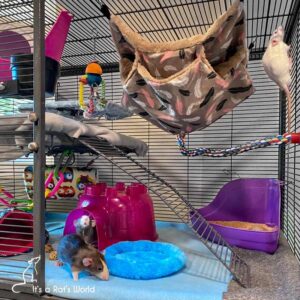
Let’s start at the very beginning. You’ve just walked into your home with your brand new ratties. What now?
This is somewhat dependent on the rats themselves and what the process of acquiring them was like. For instance, was there a lot of travel time involved? Are the rats skittish and hiding, or do they seem comfortable and confident? The answers to these questions help gauge your next move.
No matter how excited you are to cuddle and snuggle your new rats, pace yourself so as not to overstimulate them. Your rats do not yet understand that they now live with you. All they know is that they were taken from their cage/home and any friends that were left behind, and are in a brand-new place with unfamiliar sounds and smells, all while being held by a stranger.
Start off by showing them their cage first, which should have already been set up, and let them explore it. This does not mean that you have to leave. In fact, I encourage you to stick around for a bit, maybe offer them a snack, which they may or may not take. Talk to them and show them around like any good host would do: “… and these are your hammocks, this is your food dish, this is your litter box …”
Speaking of the litter box, nervous tummies often need a bathroom, which is another reason why making the cage your first stop is a good idea.
After The Cage Introduction
OK, so you’ve given your rats the full tour of the cage, they’ve had snacks, and they are either thoroughly inspecting everything or they are hiding. What’s next?
I’m sure you’re eager to start bonding with your rats immediately, but I suggest assessing how much time was involved getting them home.
If you picked them up locally and travel time was short, I think it would be fine to bring them out.
If they endured a long travel time, however, I’d give them 30 to 60 minutes to decompress. This isn’t mandatory, as some rats are eager to get out of their cage right away, but skittish rats may need a moment. Follow their lead.
What To Expect
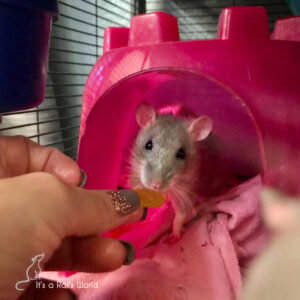
Every rat is different, so it’s impossible to predict exactly how each one will act on the first day, during the first week, or even during the first month. Some are bold from the start and are ready to know their owners. Some are a mixture of cautious and brave. Outgoing rats usually feel at home quickly, thus making their humans feel more at ease.
But it’s common for rats to be nervous and jumpy, or downright frightened at the beginning. This can be intimidating when you lack experience with them, causing many new owners to believe they should take a hands-off approach. I’ve even been asked how many days they should wait before holding their new rats. Days? Never wait days!
Scared rats will not magically stop being scared all on their own. From their perspective, hiding and running away is what has kept them alive. So, it’s up to you to change that perspective. Rats only learn to trust their owners through consistent quality time and effort, and this needs to start on Day 1! And it needs to continue every day after, whether they are scared or not. Rats should come out of their cage and be held and shown affection daily.
If your new rats are frightened, hiding in the corner of their cage, running from you, or squirm every time you try to hold them, don’t fret! I have lots of tips in my articles Helping A Scared Pet Rat and Honoring Your Rat’s Personal Space.
If your rats’ panic suddenly causes you to fear they will bite, know you’re not alone. I have found this to be a common reaction and misunderstanding with brand new owners. Sadly, this trepidation has led to rats being neglected. You need to avoid this cycle from the start, because the longer you go without interacting with your rats, the more terrified they will become. Please read my article Do Pet Rats Bite? for insight on this subject and for a boost of confidence.
A Common Rat Trait
While we’re on the topic of behavior, there’s something I’d like to warn new owners about. It’s something I completely misunderstood with my very first rat.
Rats are not notorious for biting, which you’ll learn about in my article. But they can have one somewhat obnoxious and bizarre quirk: many LOVE to nip socked feet! Not bare feet mind you, socked feet. I have written about this goofy quirk of theirs, but I completely forgot to mention it in the biting article. If this happens to you, which isn’t an everyday occurrence, please know that your rat is NOT vicious, they are not attacking you, and you are not in danger. I’d be shocked if they even break your skin doing this, mine NEVER did. But it can be startling, and it caused me to be scared of my first rat after he nipped my socked toes.
I will also warn that some rats might go after your toes or fingers if you’re using nail polish remover around them. My belief is that the smell or fumes really disturb them and they aren’t even aware that you’re on the other end of it (rats have terrible vision). Just avoid using it when they are near.
Basic Care Tips

While the rats are still checking out their new digs, let’s go over some of your burning questions.
1. How often should you be cleaning the cage?
Probably more often than you’re hoping, but it’s a necessary part of rat ownership. The best way to keep smell and waste build up down is to do a spot cleaning every day or at the very least, several times a week. The frequency of a complete cage cleaning is dependent on how many rats you have, whether they are good at using a litter box, how lazy they are, and sometimes even their sex is a factor (boys are more likely to pee on the bars and in hammocks). For a comprehensive cleaning schedule check out my article Resolve To Keep Your Rat’s Habitat Cleaner.
And if you don’t know where to keep the cage, look over my Home Environment articles Rats And Home Ambience and Rats And The Air to help you figure it out.
2. When and how often do I feed my rats?
I suggest splitting up the daily allotment of their main staple diet into breakfast and dinner. Rats have fast metabolisms and usually like to graze throughout the day. But many are also overeaters, so splitting it up helps them pace themselves. Their fruit and veggie allotment for the day can be a part of those meals and/or given with small-portioned snacks throughout the day.
An example: I gave my rats things like yogurt, fruit, or scrambled eggs with their breakfast. In the middle of the day, they might get carrots and grapes. At dinner they might get cooked veggies, a cooked noodle, or something else from my dinner. For more in-depth guidance, check out the rat diet article and the daily menu example that I co-wrote for the Rat Guide.
3. Do my rats need to see a vet right away?
If you went through a reputable rat rescue that has a quarantine protocol in place and gets medical care for sick rats before adopting them out, seeing a vet immediately shouldn’t be necessary. On the other hand, if your rats came from a pet store (which I don’t recommend), an unknown “rescue” that cannot afford veterinarian care, a backyard breeder, or from someone who was poorly taking care of the rats, then it might be necessary. Stress can weaken the immune system and cause a respiratory flare-up.
If your rats start showing symptoms of sneezing, loud breathing, wheezing, or crackling sounds within the first couple of weeks, then absolutely get them looked at. If they did come from a reputable rescue, you can try contacting them first to see if they provide medication after adoption. I also recommend that you start putting money away now for future vet needs, because it will be needed at some point.
Getting To Know Each Other

Finally, cage time is over and you’re absolutely dying to hold your new friends.
But wait! Suddenly you realize how small and fragile they are. Not to mention they are wriggle monsters that won’t sit still. And man, do they have sharp nails! You instantly find yourself unsure of how to interact with your rats.
No worries! Hopefully by now you know that I have your back, because I’ve got more articles to the rescue!
My article How To Pet Your Rats gives tips for, well, petting your rats.
And since I know you’re hoping to be your rats’ bestie, you’ll want to read one of my latest articles, Forming A Bond With Your Rats.
My article Let Rat Play Rule In A Rat Playground will explain how to build play areas outside of the cage. The couch idea in particular is how I spent most of my time with my rats because it allowed me hours of cherished moments with them.
And lastly Rat Communication: How Your Rat “Talks” To You explains the different ways rats communicate with their owners. Although, you may need to know your rats a bit longer to benefit from this one.
My final bit of advice is to be patient, to be consistently present, to make sure you spoil your new rats rotten, and to enjoy this truly awesome adventure. Hopefully in a couple of months, you’ll feel like an old pro.