


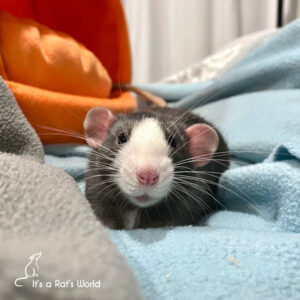
Wild rats will likely be synonymous with filth and disease until the end of time, but domesticated rats don’t deserve this label. They are different than their wild cousins and are actually very clean animals who don’t carry or spread diseases. Sadly, the general population doesn’t seem to distinguish this difference. Many people assume that anything negative about wild rats must also be true of our pets.
Misunderstandings like this leave rat lovers having to debunk a lot of myths. It also leads to a lot of questions about pet rats and their hygiene. Such as, does being clean and disease-free actually equal smell-free? Well, no, not exactly. I mean, they are still animals, so of course they’re capable of smelling bad sometimes. Heck, we humans even stink up our own habitats. In reality, the answer to this question is much more nuanced, and I have a fair amount to share about rats and their odor.
Know The Main Odor Sources
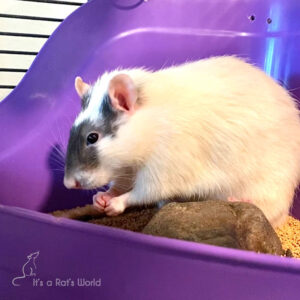
If your rats are stinking up your home, that’s the sign that it’s past time to clean their cage. The cage is always going to be the main culprit when it comes to odors because it also serves as your rats’ toilet. But this is definitely manageable. You just need to set up a system that works for you and stick to a cleaning schedule. In my article, “Resolve To Keep Your Rats’ Habitat Cleaner,” I give timetables for different levels of cleaning, along with tips for making the process easier and less taxing.
There are other factors that can worsen the cage’s aroma as well. For instance, the number of rats you have. Two rats stink it up far less quickly than say, five or eight of them (the latter being my highest amount at once). Living in a particularly small home or apartment can make odors seem more pungent, as can overly humid environments. I live in a dry state that sees little rain, but whenever it does rain, scents from all of our pets instantly become much more noticeable.
Your rats’ gender may also have an effect. Boys are notoriously less discriminating than females when it comes to marking their living space. In my experience, boys also are less disciplined at using a litter box. Some males also enjoy “marinating” in their own urine, which is gross. This does not mean that all male rats smell worse or that females are guaranteed to be cleaner, because it really depends on the individual rats. But what it does mean is that some rats may create a little more work for you than others.
How Pet Rats “Deodorize”
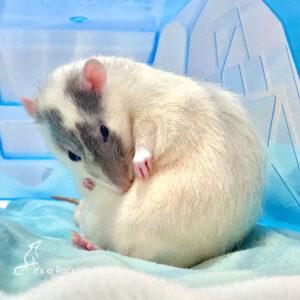
Sure, rats may mark you or objects in their vicinity, and yes some of them do enjoy “marinating”, but they are quite the meticulous little groomers. They will spend hours, collectively, each day cleaning every one of their nooks and crannies. It’s even common for them to immediately groom themselves after being touched by their owners, as if we made them dirty. Their constant cleaning means they rarely need a bath and can usually get by with just a wipe down from a damp paper towel or unscented baby wipes. Their tails may need some extra attention, however, they are truly terrible about keeping those clean.
Their obsessive grooming works as a natural deodorizer. In fact, it allows their natural smell to shine through. The intact males are known for smelling like warm corn tortillas or tortilla chips, and females and neutered males are usually scented like flowery grape soda. How can you not love that?
Be Alert For Warning Odors
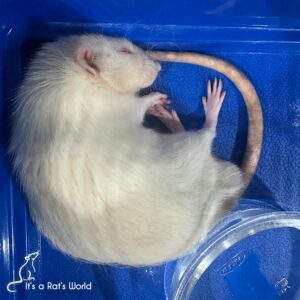
There are some body odors that aren’t pleasant, however, and if your rat has one or suddenly develops one, it’s time to get your rat to the vet. The specific smell and where on the body it’s coming from are clues to an underlying health issue that has yet to fully announce itself.
Here are the warning smells I’m most familiar with:
A foul, almost rotting odor can be an indication of a bacterial infection, a yeast infection, an abscess, or even cancer. The minute I noticed a rotting scent like this coming from my boy Brinley’s ear, I panicked. I had hoped it would be a treatable infection, but it turned out to be my worst fear, a Zymbal’s gland tumor, which is an invasive carcinoma. It was causing an abscess to form and leak into Brinley’s ear canal.
A sickly, sweet-smelling urine can be a sign of diabetes, especially if there’s a white, calcium-looking residue left after the urine dries. Noticing this smell on my boy Kelton is how I learned rats can get diabetes in the first place.
Strong or mildly unpleasant odors coming from your rat’s genitals can indicate a urinary tract infection, kidney stones, or a vesical proteinaceous plug (also known as a penis plug), which can cause a UTI and other serious problems. Age isn’t always a factor, but these problems tend to arise more in elderly rats, especially if they have hind leg degeneration. When my boys turned 2, I always started doing sniff tests on them to check for penis plugs. They have a very specific scent, which I don’t know how to describe, but once you smell it, you’ll always spot it.
Tracking A Mysterious, Hideous Odor

One warning odor deserves a section all its own. I’ve come across it a few times in different pairs of rats that I adopted. The only way I can think of to describe it is as a sort of rancid poop smell, I guess. It is not a normal poop smell at all, but rather, an otherworldly one. Frankly, it’s terrible.
And this stench doesn’t come from just their feces, it comes from their entire body! It’s almost like it oozes out of their pores. I could never find anything explaining what I was smelling or what was causing it, even my vet was stumped.
I was suddenly forced to play detective, and I decided to analyze what each of these rats had in common: They were all adopted with cagemates and each one of them smelled like this. Each one arrived at my home with the smell, it didn’t develop later. Each group had been rescued from poor living conditions, some had even been abandoned outdoors. They all had soft, mushy poos. And a bath did absolutely nothing to improve the stink because their fur wasn’t actually dirty.
I finally surmised that these rats were suffering from gut problems due to malnutrition and neglect. What they needed was a proper diet and something to help heal their gut flora. On top of a good feeding routine, I put them all on Bene-Bac Plus, which is a probiotic and prebiotic supplement designed to help with digestion in pets.
Within a month or two, every one of these odiferous rats began smelling like their natural aroma of corn tortillas or flowery grape soda, just as they should. Thank goodness, too, because, wow, it was difficult to be around them.
If you come across an odor like this and your rat has come from some difficult situation, I feel pretty confident it’s a gut issue. But definitely talk to your vet as well to rule out intestinal parasites. Two of my stinkies had those, too, and needed to be on medication to get rid of those. But it wasn’t until they were given the Bene-Bac that their nasty funk went away.
Comparing Rat Odor And Odors Of Some Other Pets

If you’re curious whether rats are less stinky than other pet choices, I think the answer is subjective and, subsequently, depends on the individual asking.
For instance, I have hyperosmia, which means I’m overly sensitive to smells and keenly aware of the bad ones. I’m what you’d call a “super smeller.” My husband, who has a terrible sense of smell, says it’s my superpower. I, however, consider it a curse. And there isn’t a pet out there that I don’t find malodorous at times. My deep love for animals and the need to have them in my life is the only reason I’m able to tolerate bringing their unpleasant odors into my home.
Being able to smell everything makes it difficult for me to judge how others might perceive rat odors compared to those of other pets. So, I’m just going to explain how I’d rank the different animals we’ve had.
I find cats to be one of the least smelly animals. My son’s cat, Vertigo, has the loveliest scent, despite never being bathed. She just naturally has a clean and fragrant aroma. But when you add her litter box to the equation, then my opinion of cats changes completely. The ammonia in cat urine is utterly overwhelming for me. It causes me excruciating sinus pain and headaches as it builds up in their litter box. For as much as I enjoy cats, I’m not sure I would get another one in the future.
Aside from being a rat person through and through, I also love dogs. To me, every house should have one. I also appreciate that their toilet area is outside and not in my house. Since our dog, Juno, never has accidents indoors, this gives her an advantage in the “which pet smells better” category. But, and this is a huge one for me, I think dog fur generally smells awful. And because I’m not physically up to giving Juno baths regularly, she’s not allowed on the couch or any of my blankets. Plus, I feel an immediate need to wash my hands after petting her. Otherwise, all I smell is “dog.” I’ve never felt this way about rats; their fur doesn’t leave behind a funk.
I’ve also never recoiled from the smell of rat breath on my face the way I do with dogs. Bad rat breath is just not a thing, which is great since they like to be up in your face a lot. Thankfully, Juno spends 70% of her day chewing on one of her many, many toys, which keeps her teeth and gums in great condition. She is the first dog we’ve ever had whose breath doesn’t smell like death, so she personally gets a pass on this one. But other dogs don’t!
The most pungent of all our pets was the ferrets. But they’re related to skunks, so being odiferous is just something you have to accept if you want a pet like that. Oddly enough, I became fairly nose blind to their musky odor. Although, anyone visiting our house did not.
I would love it if there was an animal who was completely odor-free, but who are we kidding? So, if I had to choose, my preference would be for whatever odor rats come with. And that says a lot when you’re forced to go through life being tortured by your nose.