




Contents
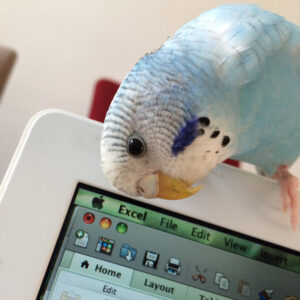
Last month I wrote a blog on how technology could be used to improve the lives of our companion parrots. I assessed the ability of birds to “ZOOM” with one another as a mostly positive achievement, although I did mention possible negative issues (e.g., overuse of the same behavioral patterns as happens with humans who become “addicted” to online games). Technology, however, has many faces, and this month I want to discuss another form of technology that is mostly being used for humans but that has implications for nonhumans as well, again pointing out the pros and cons.
What is Artificial Intelligence (AI)?
So…Most of you have already heard of the advent of GPT-4: a form of artificial intelligence (AI) that mimics human communication skills. It is “trained” on what are called Large Language Modules (LLMs). What that means is that it is exposed to huge data sets made of all sorts of human communication materials—anything that can be considered public access; it then learns the most common combinations of words that exist for a particular topic so that it can generate long strings of relevant text. An extremely simple example is what happens when you use some email programs and you start to write a phrase like, “I’ll get back to you…” and the machine suggests “shortly” as the next word.
Because GPT-4’s trainers use every imaginable data source, it can not only answer simple questions and complete simple phrases, but can also be asked to write poems, songs (e.g., output akin to Shakespearean sonnets or something that sounds like your favorite pop artist) and essays in a requested style, can take a complicated scientific abstract and ‘translate’ it into terms understandable by someone outside of the specific field, etc. It’s pretty obvious to see both the pros and the cons: Pros are things like the ease of obtaining answers to questions or playing with the system to entertain oneself; cons are things like students using it to write their papers for class instead of figuring out the assignment themselves. (And, no I am NOT using GPT-4 to write this blog entry!)
AI & Animal-Human Communication
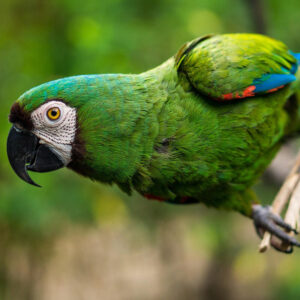
One can also see how it could be used to train “bots” to disseminate huge quantities of both true and false information. My colleagues who have been working on these projects even report how GPT-4 has invented fake references to support its not-always-entirely-accurate claims when it was asked to write a scientific report on a given project. (Remember, it is trained on huge data sets, meaning that it is exposed to whatever is public access, and the content may not always be factually correct.) Many of these colleagues are extremely concerned about how quickly systems like GPT-4 are developing and some have asked that a voluntary hold be placed on such development by its designers.
So, what does this have to do with animal-human communication? I recently took part in a fascinating ZOOM meeting, where members of a group called the Earth Species Project described their latest work: How they were beginning to use AI to develop ways to understand nonhuman communication systems by collecting tons of data on what types of actions individual subjects may perform and correlating such data with their various vocal productions—thus pairing actions with meaning.
The researchers record this information by placing very small tags on their animal subjects. The researchers discussed all sorts of extremely interesting ways in which this information could be used—not only to “crack” the code that the nonhuman was using (i.e., to get a handle on the symbolic representations of the animals’ vocalizations) but also possibly to use it as a way of directly communicating with the species in question.
How AI Can Help & How It Can Hurt Animals
Imagine really being able to understand what your parrot is saying with all its squawks and whistles, and to ‘talk’ back in that mode! Could we then directly ask our companion animals what they want or need? Or ask those in the wild how we could help them survive? Could we more effectively study their intelligence? I’d no longer have to spend years training my parrots to communicate in English but could converse with them in their own “language” to understand how they interpreted our world.
However, the downside of this research was also immediately apparent. Imagine a poacher, trying to trap an endangered species: All that person would have to do would be to broadcast information that could lure subjects to a given spot—for example, the vocalizations of a flock member calling out that a great food source was just a few kilometers away—but the poacher would be waiting with nets to entangle the birds. Poachers can already use playbacks of simple vocalizations—for example, the call of a stranger that was invading a mated pair’s territory so that the pair would want to investigate and defend their space—but this new technique would be a lot more complex, and thus potentially be a lot more attractive to a larger number of individuals. You can see my concerns.
When asked about such issues, the organizers were quick to state that they planned to put controls in place to prohibit “bad actors” from accessing their system. And I’m sure they will. However, we already know that dedicated hackers can break through such controls. Again, I’m sure you can appreciate my concerns.
I don’t have any answers and, despite my colleagues’ many suggestions of how controls could be put in place for the comparable system for human AI, none of those who are working on these issues have come up with any fail-proof method of safeguarding the results from agents who would use these systems for nefarious purposes. Sadly, I don’t see how those who are working with animals can come up with anything either.
So…although I do try to keep these blog entries upbeat and even sometimes funny, I also try to keep them informative. Thus, I felt that sharing my concerns on this topic was both worthwhile and necessary. If nothing else, I hope I’ve provided some food for thought…
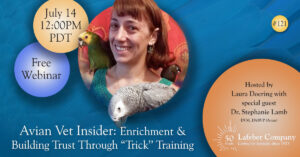 Join us for a FREE, live, interactive webinar hosted by Laura Doering, former editor of Bird Talk magazine and Birds USA magazine. Our special guest, Dr. Stephanie Lamb, DVM, DABVP (Avian Practice), will discuss what behavior modification and trick training is and how they can offer enrichment for pet birds, as well as build trust between you and your parrot. Dr. Lamb will explain how teaching your bird simple behaviors or tricks can encourage exercise or serve as a distraction from unwanted & hormonal behavior. Find out the connection between trick training and trust in this insider’s view of a parrot’s life with an Avian Vet.
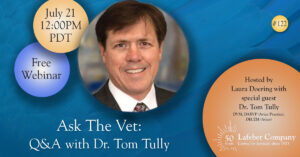 Join us for a FREE, live, interactive webinar hosted by Laura Doering, former editor of Bird Talk magazine and Birds USA magazine. Our special guest Tom Tully, DVM, DABVP (Avian Practice), DECZM (Avian), will answer your questions about pet bird health, nutrition, & care. Dr. Tully, a decorated Professor & practicing Vet at Louisiana State University School of Veterinary Medicine, is an internationally known Veterinarian who has earned specialties in Avian medicine in the United States as well as in Europe. Having this type of access to a Veterinarian of his status is rare, but Dr. Tully believes in the educated bird owner as being the best bird steward. Dr. Tully answers each question in detail and shares his vast knowledge of birds, particularly parrots. Is your bird’s problem health-related or behavioral? Are you offering the right foods to your pet bird? Ask the Vet!
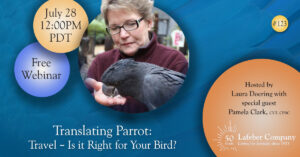 Join us for a FREE, live, interactive webinar hosted by Laura Doering, former editor of Bird Talk magazine and Birds USA magazine. Our special guest, Pamela Clark, is a well-known author, speaker, IAABC Certified Parrot Behavior Consultant & retired CVT. Pamela will present the first episode of a brand new series – Translating Parrot, a Lafeber Pet Birds Webinar Series focusing on Parrot Behavior & Wellness, based on Pamela’s years of experience with a wide range of parrot species. Pamela will discuss the best strategies for traveling with parrots and explain that this is not only possible but can be a valuable experience for our companion parrots. Even fearful parrots can learn through positive reinforcement to first enter a carrier on cue and then ride in the car in comfort or travel in a plane. Have a summer trip planned and aren’t sure about bringing your parrot? Pamela’s advice will help you translate what your parrot wants in this informative new series!

 Join us for a FREE, live, interactive webinar hosted by Laura Doering, former editor of Bird Talk magazine and Birds USA magazine. Our special guest, Lisa Bono, CPBC, owner and operator of The Platinum Parrot and a certified parrot behavior consultant specializing in African grey parrots, presents Episode 20 of The Grey Way, a Lafeber Pet Birds Webinar Series focusing on Congo & Timneh African grey parrots as pets. In this episode, Lisa will discuss pet bird products and foods that aren’t in the best interest of your bird, no matter how much your bird, or you, might like it. From sleeping to caging, snacks & toys, Lisa helps you as a good bird steward make the distinction between harmless indulgence versus something that may require some tough love to remove or keep out of your pet bird’s life. While Lisa will focus on Grey-centric concerns, her advice will apply to any parrot species.
 Join us for a FREE, live, interactive webinar hosted by Laura Doering, former editor of Bird Talk magazine and Birds USA magazine. Our special guest Tom Tully, DVM, DABVP (Avian Practice), DECZM (Avian), will answer your questions about pet bird health, nutrition, & care. Dr. Tully, a decorated Professor & practicing Vet at Louisiana State University School of Veterinary Medicine, is an internationally known Veterinarian who has earned specialties in Avian medicine in the United States as well as in Europe. Having this type of access to a Veterinarian of his status is rare, but Dr. Tully believes in the educated bird owner as being the best bird steward. Dr. Tully answers each question in detail and shares his vast knowledge of birds, particularly parrots. Is your bird’s problem health-related or behavioral? Are you offering the right foods to your pet bird? Ask the Vet!
 Join us for a FREE, live, interactive webinar hosted by Laura Doering, former editor of Bird Talk magazine and Birds USA magazine. Our special guest, Dr. Stephanie Lamb, DVM, DABVP (Avian Practice), will discuss why a vet visit is in order whenever your bird exhibits any type of symptom, or change in behavior, appetite, or appearance. While it might seem like it would be easy to know what is wrong based on a symptom, in most cases, there is a long list of possibilities. Some examples of “What is wrong with my bird” begin with “My bird is limping”, “My bird stopped eating”, “My bird suddenly can’t fly”, “My bird’s eye won’t open” or “My bird only wants to sleep”. The Clinic staff’s challenge is to help a bird owner understand that the Vet must see the bird & tests must be run in order to know how to help the bird. Dr. Lamb will go over some seemingly simple symptoms and some of the possible causes to help you understand the complexities of diagnosing a bird in this insider’s view of the daily happenings at your Avian Vet’s clinic.
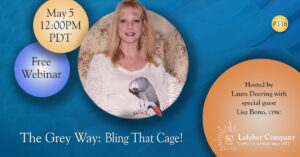 Join us for a FREE, live, interactive webinar hosted by Laura Doering, former editor of Bird Talk magazine and Birds USA magazine. Our special guest, Lisa Bono, CPBC, owner and operator of The Platinum Parrot and a certified parrot behavior consultant specializing in African grey parrots, presents Episode 19 of The Grey Way, a Lafeber Pet Birds Webinar Series focusing on Congo & Timneh African grey parrots as pets. In this episode, Lisa will discuss how to make the most out of your bird’s cage & play areas. She will show the best way to arrange food, foraging, toys & perches to encourage healthy feeding, play & exercise for all parrots, including those with mobility issues. While Lisa will focus on Grey-centric concerns, her advice will apply to any parrot species.
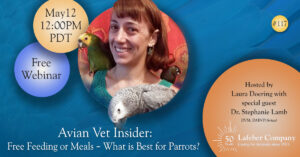 Join us for a FREE, live, interactive webinar hosted by Laura Doering, former editor of Bird Talk magazine and Birds USA magazine. Our special guest, Dr. Stephanie Lamb, DVM, DABVP (Avian Practice), will discuss a new trend of feeding meals to parrots, where they only have access to food for each meal rather than free feeding – having food available at all times. Dr. Lamb will explain the major benefits of free feeding and why it fits more with their physiology in this insider’s view of the daily happenings at your Avian Vet’s clinic.
 Webinar: Ask The Vet: Q&A With Tom Tully, DVM, DABVP (Avian Practice), DECZM (Avian)
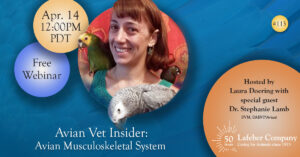 Join us for a FREE, live, interactive webinar hosted by Laura Doering, former editor of Bird Talk magazine and Birds USA magazine. Our special guest, Dr. Stephanie Lamb, DVM, DABVP (Avian Practice), will discuss the musculoskeletal system of birds and its vital role for normal flight, perching, and movement. She will discuss how this system works including a description of the mechanics of flight and common problems she encounters in pet birds. She will cover fractures and how to deal with them, nutritional disorders that affect the bones, hormone-related problems, and joint disorders in this insider’s view of the daily happenings at your Avian Vet’s clinic.
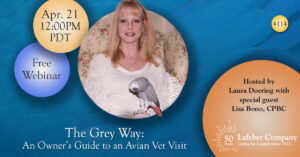 Join us for a FREE, live, interactive webinar hosted by Laura Doering, former editor of Bird Talk magazine and Birds USA magazine. Our special guest, Lisa Bono, CPBC, owner and operator of The Platinum Parrot and a certified parrot behavior consultant specializing in African grey parrots, presents Episode 18 of The Grey Way, a Lafeber Pet Birds Webinar Series focusing on Congo & Timneh African grey parrots as pets. In this episode, Lisa will discuss how to prepare your bird for a trip to the Avian Vet. Her talk will include how to reduce stress, what to bring, what to tell and ask your Vet, what to expect when you get there, and what to do if you have to administer medication. While Lisa will focus on Grey-centric concerns, her information will apply to any pet bird species.
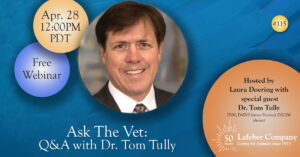 Join us for a FREE, live, interactive webinar hosted by Laura Doering, former editor of Bird Talk magazine and Birds USA magazine. Our special guest Tom Tully, DVM, DABVP (Avian Practice), DECZM (Avian), will answer your questions about pet bird health, nutrition, & care. Dr. Tully, a decorated Professor & practicing Vet at Louisiana State University School of Veterinary Medicine, is an internationally known Veterinarian who has earned specialties in Avian medicine in the United States as well as in Europe. Having this type of access to a Veterinarian of his status is rare, but Dr. Tully believes in the educated bird owner as being the best bird steward. Dr. Tully answers each question in detail and shares his vast knowledge of birds, particularly parrots. Is your bird’s problem health-related or behavioral? Are you offering the right foods to your pet bird? Ask the Vet!
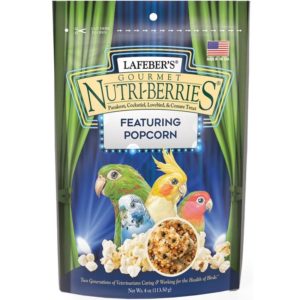 Popcorn Lover’s Day is celebrated on the second Thursday in March. Not only can you partake by popping your favorite kernels, but your feathered companion can also enjoy their own bird-friendly popcorn to snack along with you—break out a bag of
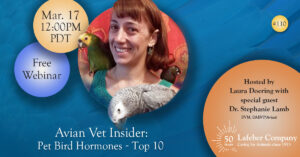 Join us for a FREE, live, interactive webinar hosted by Laura Doering, former editor of Bird Talk magazine and Birds USA magazine. Our special guest, Dr. Stephanie Lamb, DVM, DABVP (Avian Practice), will revisit our annual March topic – hormones! Most behavior issues & many health issues for pet birds actually begin due to hormones. Dr. Lamb will discuss the Top 10 hormone-related questions and concerns of bird owners in this insider’s view of the daily happenings at your Avian Vet’s clinic.
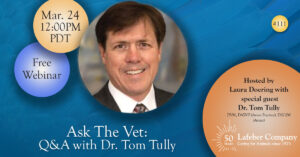 Join us for a FREE, live, interactive webinar hosted by Laura Doering, former editor of Bird Talk magazine and Birds USA magazine. Our special guest Tom Tully, DVM, DABVP (Avian Practice), DECZM (Avian), joins us once again to answer your questions about pet bird health, nutrition, & care.
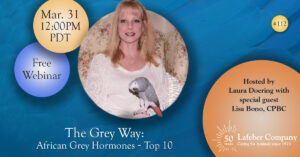 Join us for a FREE, live, interactive webinar hosted by Laura Doering, former editor of Bird Talk magazine and Birds USA magazine. Our special guest, Lisa Bono, CPBC, owner and operator of The Platinum Parrot and a certified parrot behavior consultant specializing in African grey parrots, presents Episode 17 of The Grey Way, a Lafeber Pet Birds Webinar Series focusing on Congo & Timneh African grey parrots as pets. In this episode, Lisa will revisit our annual March topic – Hormones – but of course focusing on Africa Greys. Lisa will discuss the top 10 hormone-related questions or complaints from African Grey owners. Lisa will focus on Grey-centric concerns in this very important episode of The Grey Way.


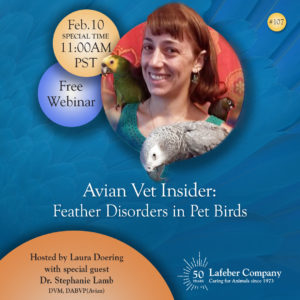 Join us for a FREE, live, interactive webinar hosted by Laura Doering, former editor of Bird Talk magazine and Birds USA magazine. Our special guest, Dr. Stephanie Lamb, DVM, DABVP (Avian Practice), will continue her series on the different Avian systems by discussing feather disorders in pet birds. Some may think the only feather problem pet birds deal with is behavioral plucking but that is not the case! In this webinar, Dr. Lamb will first explore the various problems that can occur with feathers. She will discuss infectious diseases, nutritional problems, odd disorders, and yes, even that pesky topic-Feather Destructive Behavior(FDB). Learn about some of the things to watch for in your bird’s feathers, and view some fascinating cases, in this insider’s view of the daily happenings at your Avian Vet’s clinic.
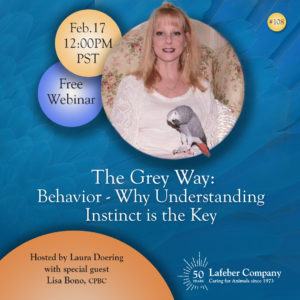 Join us for a FREE, live, interactive webinar hosted by Laura Doering, former editor of Bird Talk magazine and Birds USA magazine. Our special guest, Lisa Bono, CPBC, owner and operator of The Platinum Parrot and a certified parrot behavior consultant specializing in African grey parrots, presents Episode 16 of The Grey Way, a Lafeber Pet Birds Webinar Series focusing on Congo & Timneh African grey parrots as pets. In this episode, Lisa will help owners unravel the mysteries of parrot behavior. Owners forget or simply do not realize that all pet parrots – from budgies to macaws – are exotic species, even when domestically bred. In order to successfully tame or train a bird, one must understand the difference between a domesticated pet versus a domestically raised exotic pet. Lisa will help even the most frustrated bird owner gain a better understanding of why their bird does something, and how the owner can work to change or minimize a behavior through patience, positive reinforcement and being consistent. While Lisa will cover some Grey-centric behaviors, her information can also be applied to any species.
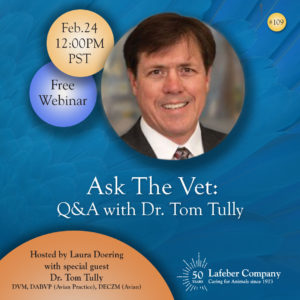 Join us for a FREE, live, interactive webinar hosted by Laura Doering, former editor of Bird Talk magazine and Birds USA magazine. Our special guest Tom Tully, DVM, DABVP (Avian Practice), DECZM (Avian), joins us once again to answer your questions about pet bird health, nutrition, & care.


 Join us for a FREE, live, interactive webinar hosted by Laura Doering, former editor of Bird Talk magazine and Birds USA magazine. Our special guest, Dr. Stephanie Lamb, DVM, DABVP (Avian Practice), will discuss common infectious diseases including aspergillosis and chlamydia that are known to classically affect the respiratory system. She will also cover allergic airway disease to bring more awareness to this disorder. And she will talk about coelomic diseases that can present as respiratory disease, stressing the importance of full diagnostics to treat your bird effectively. Don’t miss this free webinar to get another fascinating insider’s view of the daily happenings at your Avian Vet’s clinic.
 Join us for a FREE, live, interactive webinar hosted by Laura Doering, former editor of Bird Talk magazine and Birds USA magazine. Our special guest Tom Tully, DVM, DABVP (Avian Practice), DECZM (Avian), joins us once again to answer your questions about pet bird health, nutrition, & care.
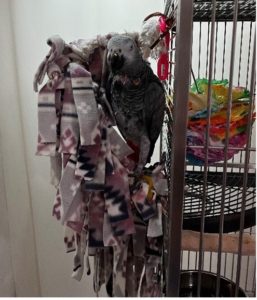
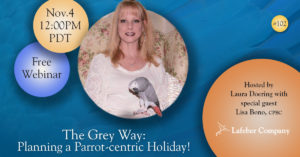 Join us for a FREE, live, interactive webinar hosted by Laura Doering, former editor of Bird Talk magazine and Birds USA magazine. Our special guest, Lisa Bono, CPBC, owner and operator of The Platinum Parrot and a certified parrot behavior consultant specializing in African grey parrots, presents Episode 15 of The Grey Way, a Lafeber Pet Birds Webinar Series focusing on Congo & Timneh African grey parrots as pets. In this fun holiday episode, Lisa will discuss different ways to cater to your pet birds and give them their own holiday fun & feasting! This is about what they CAN have, and not about what they can’t. She will give the viewers ideas for holiday-themed activities and toys as well as seasonal foods your birds can enjoy. Get ready to plan your own special holiday fun for your birds this season!

.jpg)

.jpg)
_-_Weltvogelpark_Walsrode_2010-10.jpg)