




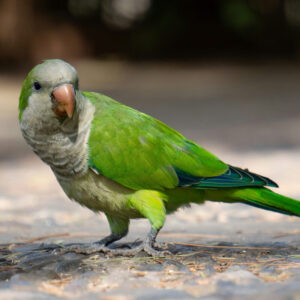
Science has studied almost every aspect of the lives of birds. In their studies, they attempt to discover how birds interact with the flocks they are a part of, how they work together to achieve a goal, and how they individually act to stay a vital part of the community that they’re affiliated with. Many species have unique approaches to their own existence, often passed down to others within the flock.
What science discovers is that birds, like other creatures, have commonalities with the human race in the way that binds us together as living beings. One of those is the social standing of birds within their own flock. A recent study by the University of Cincinnati, published in the Behavioral Ecology journal at Phys.org, details the interesting social aspects of the monk parakeet (commonly referred to as the quaker parrot or quaker parakeet).
Monk Parakeet Pecking Order
For a year’s period, the study, led by Annemarie van der Marel, sought to discover the social standing imperative of the monk parakeets by working with three groups of birds. The standing of each bird in each group was determined by their interactions within the group. The more well-placed the bird, the more aggressive they were with the others. Once the standings were determined, the tests to discover how those standings remained were put into play. The standings were noticed by how aggressive the bird was to another, and how each bird reacted to the aggression. If a bird was able to intimidate others, then it was on a higher level of acceptance. If a bird chose to move away from a pecking neighbor, it was determined to be lower on the social spectrum.
The researchers extracted several birds of varying degrees of social standing within each group. The birds were removed for a period of eight days to see how they would reintegrate into the flock. Would the bird retain its standing? Or lose it? As it turned out, the removed birds had lost a lot of social ground and needed to regain, if they could. As birds attain a top-tier standing within the flock, they must continually assert their dominance as others attempt to gain higher standing. By removal, the upper-echelon birds lost much of their rank. After reintroduction, the once “top bird” was found to be bullied by those who took over the position of rank.
A Hierarchy Re-Shuffling
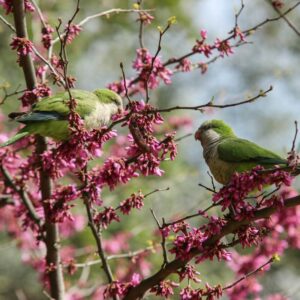
When lower and mid-level ranked birds were reintroduced, they were not as bullied as the previous top-ranked birds were. It is assumed that the upper-ranked birds did not feel threatened by the lower-tiered birds and, as such, didn’t pay them much mind upon their return. But the new power elite simply refused to give up their new high ranks by letting the once highly ranked bird regain a position of standing.
The primary purpose of the study was to find ways to improve the health and well-being of all birds within captive environments. With birds being their natural selves, the structures must be evaluated to maintain a sense of safety. Interestingly, the monk parakeets are highly observant. They watch the fights among their flockmates to follow and to remember outcomes. They are aware of their places within the flock.
High rank within a flock allows for better access to food, and other good things meant for survival. While the temperaments of the monk parakeet do not necessarily extend to other species and their modes of social standing, this study does offer insight as to how we might be able to work with other species in captivity to help ensure their safety. It is also a mirror of sorts to the human species, interesting in that we find that we share many traits. We’re all much closer to other species in the animal kingdom than we realize.
GREAT AND INFORMATIVE ARTICLE!!!
Thanks so very much for this study! I have one monk parrot and he’s a love bug talker but can also get too aggressive at times. He’s only two but when he gets totes out of hand we send him to the vets ‘bird camp’ and he always returns with a new more friendly perspective. Please keep me up to date on any new reports. Our little guy is so smart. He uses his words in appropriate situations. He so smart it baffles us. Thanks so much! Best viv
I too have a monk parrot. she has been with me for 14 years. she owns me not the other way around. she has moods, but as long as I am active with her she is happy with me with the exception oof cleaning her cage. she gets a little bother when I reach in and out. she loves her nest. she talks in my voice. she says at least 50 words and dpeaks to her nest as though there were babies in it. she grooms me and I scratch her head. i love her to death.