




In the world that we live in, there are day people and night people. Typically, certain personalities and inclinations exhibit better in one or the other of the two settings. The reasonings are widely varied when it pertains to humans. And it may very well be that same kind of partial inclination settings for the birds of the world as well.
The Darkest Black

(A) Edwin Scholes / (B) Tim Laman, CC BY 4.0, via Wikimedia Commons
Some years ago, a new kind of bird was discovered with an amazing display of jet-black feathers. The male bird is categorized as the Greater Superb Bird of Paradise and is only found in the western region of New Guinea known as Vogelkop, or more interestingly, Bird’s Head. The bird has plumage so black that it is almost considered to be the super dark color of Vanta Black. Vanta black coloring absorbs 99.96% of light, creating an interesting look. The plumage of the Greater Superb Bird of Paradise is discovered to absorb 99.95% of light. Close enough to refer to the feathers as that of a natural vanta black coloring. Fondly, nature is doing its thing.
What makes this bird even more stunning is its male mating dance that calls for a “smiley face” display. It is achieved by fluffing out its beautiful blue chest feathers and creating a crescent-shaped spread of feathers. It’s an eerie but gorgeous display that can only be appreciated fully by seeing it. Watch this Cornell Lab of Ornithology video to see how the bird does this dance, along with other bits of interesting information about this amazing bird.
The Brightest White
But what about the brightest bird in existence? Yes, we have one of those, too.
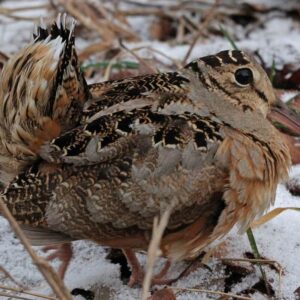
The Brown Woodcock – also known as the Eurasian Woodcock – is found mostly in the regions of Russia. They are night birds and prefer the dark to avoid detection by predators. As such, they remain rested until night when they emerge to feed and communicate with each other. However, being brown, they can be nearly impossible to detect in the dark. This is solved by the underside of their tail feathers, which are bright white. How white, you may ask? Well, white enough to be considered the whitest feathers on any bird alive. In fact, it has been scientifically determined that the white tail feathers reflect 30% more light than any other known bird.
What the woodcock uses these feathers for is to communicate in the dark among their kind in the field. The undersides of the tail feathers are thick and flat to allow for the feathers to create an increase of area for the light to reflect and scatter thereby getting the attention of the right thing that moves about in the nighttime with them, namely their pals. Even more interesting is that the bird can adjust its tail feathers in such a spread to get the most effective use out of them, reflectively. Like the ultra-black Greater Superb Bird of Paradise, the Brown Woodcock knows what it has and uses it to its best advantage. That’s an interesting case of awareness and instinct use.
Nature supplies the needs of individual birds (and the rest of us, too) by providing those which are necessary to survive in the world that we all live in. You can learn more by reading the official studies: for the Eurasian Woodcock, read here; and for the Greater Superb Bird of Paradise, explore here.


Interesting facts about some wonderful birds. I love ❤️ birds!
Where do Green Cheek Conurs fit in the scale