




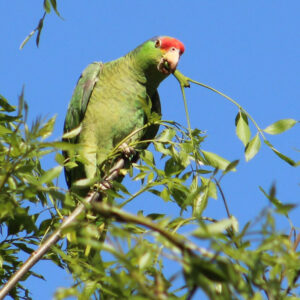
We have a long list of parrots that are threatened by several reasons, including illegal poaching for the pet trade, climate instability, habitat invasion by deadly predators, and catastrophic occurrences like the fires that decimated populations of wildlife and plants in Australia. While some of these are unavoidable, and others completely avoidable, the fact remains that many species are threatened, and some are near extinction. These are ongoing issues that need intervention in whatever ways that can be discovered. Researchers in colleges and universities team up to look for answers. However, sometimes we get pleasant surprises. In this case, the surprise comes from a species that was threatened with an estimated population of less than 2,000 individual parrots. But the red-crowned Amazon parrot had another idea, one that could be their saving grace.
A Move To The Texas Suburbs?
The red-crowned Amazon parrot is indigenous to Northeastern Mexico. The mostly green-feathered parrot sports a vibrant red coloring above the beak. The main reason for its declining numbers is primarily attributed to the illegal capture and trade of the beautiful bird. But the red-crowned Amazon’s natural habitat is being changed as well, as the forests that make up their home are being systematically reduced.
A recent research study by Texas A&M, headed by Dr. David J. Brightsmith, and assisted by Simon Kiacz, and Hsiao-Hsuan Wang, discovered that around 675 red-fronted Amazon parrots have relocated to Southern Texas, with two main counties of occupation. Those include Hildago County, and Cameron County. Within those counties are several cities that the birds have taken a liking to. This study comes on the heels of the realization that parrots are found to be thriving in urban cities, a location that seems odd but nonetheless conducive for birds and other forest-dwellers that have left their places of origin.
The study went on to recognize that urbanization of parrots could quite well be their saving grace. The birds seem to adapt to cities with a wide range of plants that contribute favorably to their continued well-being and sustenance. It is believed that the birds now in cities were brought in the ’80s, when such birds were legal to purchase. They are thought to be escaped pet parrots that have found each other to flock with.
Right Temperature, Right Habitat
The researchers are also aware of two other favorable urban habitats for red-crowned Amazon parrots. One is in Southern California, where an estimated number of birds that live there is around 3,700. Another adopted location is Florida, where there are an unknown number of these birds. The study took around 4 years to complete using adjustable models of habitat acceptance that were “high-quality habitats”, “medium-quality habitats”, and “low-quality habitats.” What was an important equilibrium element was temperature. The red-crowned Amazon parrot has a low tolerance for temperatures that are too low. As they are non-migratory, it is essential that temperatures remain at consistent levels for them to thrive. As temperatures rise in the southern states, it is believed that exotic birds will find suitable norms for them to establish new habitats.
It is further believed that “medium-quality habitats” with currently smaller spans will soon develop into “high-quality habitats” as the maturation of vegetation takes place in the rapid urbanization of many Texas locations. These models are in a constant state of flux as we predictably change in temperature and plant adaptability and growth.
There is a more in-depth look at this occurrence in a published study at the MDPI Science Journal For now, it’s a strong dose of hope as the birds relocate and find ways to thrive more than they were doing so in their original locations. And it seems that the growing urban centers are pleasant places for parrots. Who would have thought?!


I desperately want a parrot of any kind. I have had several over the years (79) but now live in Colorado. I so enjoy reading about them but can’t afford to buy one due to retirement and very limited discretionary income.
Wonderful article and information, as are ALL of the ones on Lafeber!
People need to understand that between climate change and human alterations to animal habitats, many species are forced to find new areas in which to live. The invasive title no longer applies because of this, and the adaptation of many species can often be a positive development and not a problem.
I live in San Diego and was amazed 30 years ago when we relocated from Michigan. On the coast the tree were and still are filled with these parrots. All sizes so we knew they breeding here and not just passing through… Up around Fresno there is a huge flock of wild parakeets …….Love your vary informative articles.