




Temple Grandin (2006) was one of the first to write extensively for the public on the topic of seeing the world through the eyes of nonhumans. Grandin wrote, for example, about cows that would not walk over shadows or that spooked at a coat hanging from a fence post. She understood that nonhumans process information in different ways — the coat’s position might trigger distant memories of something negative that occurred at the same time that they had seen this same situation, and thus signal danger forevermore. Many people who study animal behavior have used similar knowledge to explain why nonhumans do things that, to humans, fail to make sense.
My colleague and friend Chris Davis was once called to consult about a parrot that had, for no apparent reason, started plucking and acting fearful — the owner could not figure out why her bird had changed behavior so dramatically and suddenly. After asking a number of questions and taking down the history of the bird, Chris was somewhat perplexed herself — until she heard the loud chiming of a grandfather clock in the room. Her next question was, “And when did you install the clock?” Not surprisingly, the parrot’s new stress-related behaviors coincided with the arrival of the bonging “monster.”
What’s Behind African Grey Griffin’s Poor Performance?
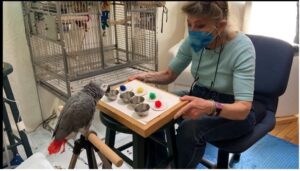
In a similar vein, we were recently faced with some unexpected and unacceptable behavior from Griffin — which had a relatively simple solution, once we figured out the issue! The background was that Griffin had succeeded on a very difficult new task, achieving 91% accuracy. However, because his arthritis sometimes made movement on the testing perch painful, we had been repositioning the tray on which the stimuli sat during the trials, so he didn’t have to change his position as he performed the task.
Although the direction of the reposition was not consistent, an argument could be made that he had used the movement of the tray as a cue to direct his behavior and that he wasn’t actually solving the problem we had presented. We thus needed to redo the entire experiment, now without any repositioning — and hope that the various remedies for his arthritic pain were working sufficiently well that he could easily move on his own.
Of course, life is never all that simple. Between the original set and the repeat set of trials, we had to move the lab to a different apartment. We tried to replicate the position of the various pieces of equipment and the cages in the new space so that the birds would adjust to the move quickly and with as little stress as possible. Given the placement of windows and heating vents, that wasn’t exactly possible.
Different Bird’s Eye View, Different Results
Nevertheless, we thought we had done an OK job and started the trial repeats. Griffin, however, would not work. He was now failing miserably, clearly not attending to the stimuli. We thought it was his arthritis, but when we did some much simpler control trials requiring larger physical movements, he had no issues. We tried arranging the stimuli for the difficult task on the tray a bit differently, to no avail. My students were beginning to question my competence, thinking that I had indeed been cuing him on the first set of trials. But when I looked back at the videos taken in the earlier apartment, that did not make any sense; sometimes he needed no repositioning, and he worked perfectly.
However, looking back at the videos made me realize something totally different that just might have been important. On the second set of trials, Griffin was situated so that his back was toward his fellow African grey Athena’s cage — he couldn’t comfortably keep track of her and of the stimuli at the same time — whereas in the first set of trials, Griffin faced to the side of her cage — so he could keep one eye on her and one eye on the stimuli. Could that be an issue?
During times when neither bird was working, he always seemed to be very aware of where she was. I seemed to remember, too, that sometimes when we were starting a trial on the second set, if Athena was squawking at the top of her lungs and I had a student take Athena off her cage and sit with her to the side to quiet her down, that Griffin was more likely to work in those cases. I hadn’t written all that down on the experimental log because I didn’t consider it important, but the recollection — fuzzy as it was — suggested that we should look into the possibility that the position of the two birds was critical.
So, the next time I was in lab, we rotated the experimental set-up 90 degrees. Griffin performed flawlessly. Duh. We had spent months trying to figure out why Griffin could not replicate his initial accuracy, testing out all sorts of small experimental design changes, to no avail. However, looking at the larger picture — and seeing the world from Griffin’s point of view and taking into account his comfort zone and vision — made all the difference!
Most every day I bring my Congo and Timneh to perches in front of a “picture window” to the side of my desk while I work from home. I have noticed that Smokey, the Congo, prefers to walk around his cage on the floor before I pick him up and bring him to the window. Then I bring T-bird to his perch next to Smokey. Despite how much Smokey enjoys his window view, if I bring T-bird to the window first then Smokey will go back inside his cage and stay there.
Your situation with Griffin leads me to believe that Smokey has a need to perch first. Likewise T-bird’s behavior also changed. Normally, they would stay at the window for long periods. Without Smokey there, T-bird was intent on getting back to his cage.. They both prefer the original “order of operation” or they will have none of it.
What do you make of it? Is it a perceived need of their process in order to cooperate as usual?
Love the line, “My students were beginning to question my competence!” That’s wild! And, more seriously, it is heartening to know that even a valued expert in the field can be stumped. Gives the rest of us hope that we can figure out our issues.
Thank you for the education. Even though it took time you were successful and shared that success and we benefited from that insight. We are all connected. I don’t think I would perform well in a test if I were concerned about my family members.
So helpful! The little things that matter!
I love reading and learning about the Pepperberg lab birds ❤️ . I have 3 African greys (2 CAG and 1 TAG) . Every night they come out on their individual perches while I clean their cages. I routinely place them on the same perch by habit. One night I was in a bit of a hurry and placed one of my CAGs on the other CAGs perch. I swear he had a total look of confusion on his face. He kept staring at the perch he is usually on. He bent down closer to look at his assigned perch and then looked over at me as to say, hey this isn’t right, this isn’t my perch! He was so confounded that I broke from routine. It was priceless to see. He is a very smart grey and i can read him well. i guess we are all creatures of habit, but when you can literally see what your bird is thinking, its very special.