




We all enjoy memories of places we’ve been, things we’ve done, and people we’ve met. Science likes to call the more explicit memory events “episodic memory” as it more easily encapsulates specific information that we access more deeply for various reasons. It turns out that some birds do the same thing. This discovery gives us greater insight into the brains of birds and how they recall specific instances that are important to them.
Episodic memory is the term used to describe a vivid remembrance of details that allow for explicit recall. An example would be if you recalled a memory from, say, 10 years ago. In that recall, you may be able to suddenly remember the color of a wall, the smell of a flower, or several minute details that seemed unimportant at the time. That recall might become important as such detail revealed helps fully expand that memory.
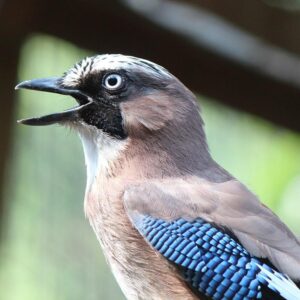
A recent study was conducted at the University of Cambridge (UK) by lead researcher, James R. Davies, along with Nicola S. Clayton (also with the University of Cambridge), and Elias Garcia-Pelegrin of the National University of Singapore on Eurasian jays, which belong to the Corvid family, a group of birds already known to be extremely smart. A Eurasian Jay can store food and remember exactly where it was hidden. They are already known to have other useful traits, which encouraged the researchers to further explore whether the Eurasian jay could go back to a memory to see if they remembered all details, even those which seemed unimportant at the time.
It’s All In The Details!
Seven jays were studied—three females and four males who were raised at an on-site open aviary. They were given a chance to remember cups with different colors, shapes, and patterns that were applied to the cups. The birds watched the researcher place food under some cups. The purpose was to discover if the jays could remember enough seemingly unimportant details about these cups to recall and find the food.
The birds were then removed for 10 minutes to disrupt the line of sight. At first, the birds watched as researchers placed food under similar cups and the bird needed only to remember the cup position. Afterward, the birds were given the same test but with cups that each had different details. As the experiment continued, it was discovered that the birds could remember distinct details about the one cup that they never thought they’d need. But the jays surprised researchers by getting it right far above what is referred to as “chance level.”
However, the tests are primarily focused on food caching scenarios. But that time is coming soon enough as researchers delve deeper into understanding the generality of episodic-like memory across various types of information and contexts. You can read the entire content of the highly fascinating study write-up by the researchers here.
.jpg)
i learn from my sun conure all the time. He knows just how long my boxer should stay outside. if time exceeds. he calls her name and remarkably she comes right in. tonight he was squaking and i asked him what he was talking about. ftjen i told him my daughters name and that shr was cominh to dee him tomorrow and he calmed down i also told him she would give him a treat and he did his little chirp. i know he unferstamds English. i love him amd ive had him since 6 months old. ive had him 7 years.