




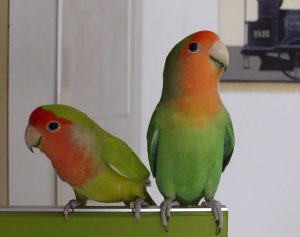
“Beakiation” is a newly coined word to describe how birds in the wild use their beaks to move from tree to tree — similar to how monkeys do with their limbs.
A recent study was launched by the New York Institute of Technology (NYIT), with work done by Edwin Dickinson, Melody W. Young, and Michael C. Granatosky. The study involved four rosy-faced lovebirds. A runway was set up to give the birds a space to move about as they pleased. The purpose was to watch how the birds used their beaks to facilitate movement. The birds performed admirably by often using their beaks to grasp a tree limb while releasing their feet from support surfaces. They moved across spaces by grasping with their beak and “swinging” to the next location.
Faster Movement In Dense Spaces
The reasoning behind this behavioral pattern is that it enables faster movement in tree-dense areas. Flight involves a set of motor movements that require more energy than swinging requires. It also helps birds move faster than ground-based predators, much like monkeys do to evade their predators.
Birds’ beaks are amazingly strong, with a grip that can hold many times the bird’s weight. The upper beak has a hinge between the bill and the skull that allows the bird to amply flex that region. This becomes helpful — much like an extra hand — when grasping a branch to allow the bird to pull itself up. The upper beak is used as a propelling force to give the bird extra power in movement and lift. Taking nothing away from the power of the lower beak, it is clear that each part operates independently of the other to achieve great physical feats.
In the wild, using their beaks to travel more effectively helps parrots avoid ground travel, where predators might lurk. They can do as the monkeys do to get from place to place.
If you have further interest, read the original study and observation of parrot movement. Also, watch this YouTube video showing lovebirds in action.
My tiel loves to travel with his beak on his cage and perches. The top of his cage slants down, and sometimes he’ll slide down the top of it with his feet like a little ninja. It makes me smile every time.
Ive noticed that my birds use their beaks to help to boost themselves up or gain a little stability before stepping up. I think a lot of people see them reach out with their beaks before they step up, and they become a little frightened thinking the bird is about to bite them (sometimes they are :), but often they are establishing stableness or feeling out the matter before they make their move to step up.
also one of my african greys ALWAYS slaps the side of his water bowl muliple times with his beak, prior to taking a drink of water. Ive always been curious as to why he does it. I thought maybe sensing the temperature of the water? but I don’t think he can gain that much sensitivity from the taps. Curious if anyone elses bird does the same thing?
Cockatiels with arthritis have little to no muscle strength to grip. Mine at age 25 years can no longer grip things anymore. She, named Spex, uses her beak to pull herself forward by tugging on what is near. When she can not, she calls to me for help to move to where she wants to go. I do it lovingly, and she is always by my side for 25 yrs.. She sleeps at night in her cage and has been free flying all her life.
Do you have suggestions on exercise for her feet? Or being Spex is 25 years old, should I just keep making her as comfortable as possible for the time she has left?