




From candlelit dinners and heartfelt love letters to awkward dance moves at weddings and over-the-top gestures (remember when flash-mob proposals were a thing?!), some people go all out to impress the apple of their eye. But we’re not the only ones pulling out all the stops for love. Some birds take courtship to the next level and beyond. Here’s a look at some of the more dazzling displays of bird bachelors doing all they can to stand out from the crowd.
Birds-of-Paradise
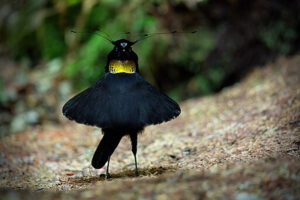
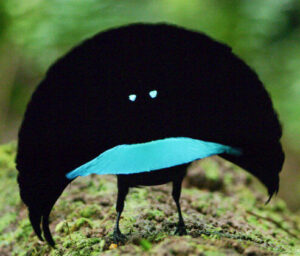
Native to Papua New Guinea, Australia, and Indonesia, male Birds-of-Paradise take dancing quite seriously. There are more than 40 species of Birds-of-Paradise, and each variety has unique plumage to show off, and they seem to know exactly the right moves to showcase their vibrant, look-at-me feathers. They give themselves a stage by clearing twigs and leaves until they have an impeccable dance floor, or meticulously clean a branch to dance along. Their dance moves can include hopping, hanging upside down, or flaring out their feathered “skirts” or “capes.” The Superb Bird of Paradise is known for its unique optical illusion display in which it appears to be a floating black oval with entrancing blue eyes and a wide blue smile.
Bowerbird

JJ Harrison, CC BY-SA 4.0, via Wikimedia Commons
The word “bower” means an attractive dwelling or retreat, so you can probably imagine what the Bowerbird’s love potion is. These birds look to impress with their architectural wonders and interior design. They don’t have flashy feathers or silly dances; instead, they use their flare for home design to send a signal to the ladybirds that this is the place to be. Male Bowerbirds build a twig structure and then furnish it with attractive items like berries, shells, flowers, and human items, such as bottle caps and bits of plastic. They also like to color-coordinate their interior design. The satin bowerbird, for example, will seek out all shades of blue, even going so far as to “paint” the walls with berries to perfect the look.
Bowerbirds strive to outdo their neighbors by creating fantastical arrangements. They are also not above stealing items from neighbors to incorporate into their design. Check out this video of a male Vogelkop Bowerbird adding a final touch of colorful flowers to his design to stand out from the crowd. Females know a good home when they see it; the more elaborate and meticulously curated the display, the more likely she is to say, “Honey, I’m home!” Ironically, after building such a cozy home, male bowerbirds don’t stick around to help raise the chicks.
Manakin
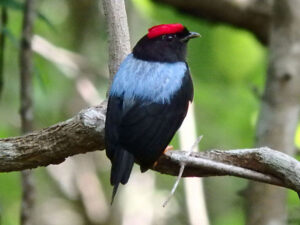
Another bird with a dance card is the Manakin. Found in Central and South America, Manakins show off their amazing, high-speed dance skills—the faster, the better. Males grab females’ attention by zipping along branches and performing mid-air acrobatics. What makes their dance even more exciting is that it is performed as part of “lek” (imagine a Chippendales’ show, with multiple males vying for a single female!) Their lekking ritual allows a visiting female to survey which partner to choose to mate with.
Dance isn’t their only love potion. Male Manakins have evolved to create sounds with the rapid beating of their wings, with each species having its own unique sounds. Red-capped Manakins snap their wing feathers to make a zipping sound, while the Club-winged Manakin produces a high-pitched buzz by vibrating their wings an impressive 100 times per second. Other species are said to make a pop, pop, pop firecracker sound, still others take to air to make a whooshing sound all in the name of love. Check out these two male Lance-Tailed Manakins getting their groove on for a curious female.
Laysan Albatross
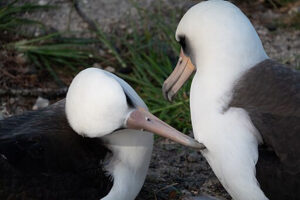
Yet another aspiring Lord of the Dance is the Laysan Albatross, native to the Hawaiian Islands and the Pacific Ocean. Instead of the male busting his best dance moves, these birds assess their compatibility based on how they pair up as dance partners. The Albatross’s elaborate dance includes plenty of head bobbing, beak-to-beak movements, and a synchronicity reminiscent of experienced ballroom dancers. The better they dance together, the stronger their bond. Albatrosses know the importance of finding the right dance partner, as they mate for life. Perhaps that is why they often practice their dance in groups before taking to the main dance stage.
Great-Crested Grebe
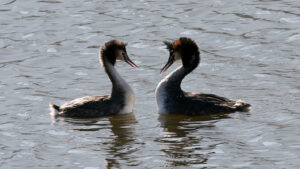
When we think of ballet, Swan Lake might come to mind, but the real bird ballet dancer is the Great-Crested Grebe, found in Europe, Asia, and Africa. These birds pair up and perform a “mirror dance,” matching each other’s movements with perfection. They also throw in synchronized swimming dancing, where they dive in unison underwater and come to the surface with aquatic plants as an offering to one another. Their ballet-like movements serve to strengthen pair bonding.
These displays highlight not just beauty and skill, but also intelligence and social bonding—proving that, in the bird world, love is truly an art form! If you were a female bird, which of these birds would you fall for?!


.jpg)
.jpg)
_(1).jpg)