




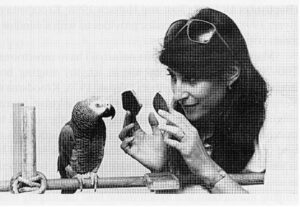
Image courtesy Dr. Pepperberg
Recently, there has been a resurgence in interest in animal-human communication. After a considerable hiatus, I’ve been getting a lot of calls and emails for interviews. The focus of interest has changed a bit (more on that below), but humans’ desire to communicate with other species is long-standing. It is part of many stories (think of the Doctor Dolittle books) as well as legends in many cultures…even as far (if not further) than King Solomon, who purportedly had a ring that allowed him to communicate with all the birds and beasts in his realm.
However, the scientific history of successful research goes back only about 55 or so years. (I’m not going to give references for all this work, or this blog will become a scientific review paper. Dear reader, you can Google all the info for summaries!)
The first real breakthrough was when Trixie and Allen Gardner taught some aspects of American Sign Language (ASL) to a chimpanzee, Washoe. They were quickly followed by ASL studies by Penny Patterson and the gorilla, Koko, and Lyn Miles’ work with the orangutan, Chantek. And soon after, Ann and David Premack worked with the chimpanzee, Sarah, using plastic chips as words, and Duane Rumbaugh and colleagues set up a computer-based system using “lexigrams” for the chimpanzee, Lana.
Louis Herman began working on hand signals with dolphins; Diana Reiss had a keyboard for dolphins, and Ron Schusterman used various symbols with sea lions. What all these studies had in common, however, was they worked with animals that had either a close evolutionary history with humans —I .e., the great apes — or large brains — the marine mammals.
So it wasn’t all that surprising that when I suggested doing the same work with an African grey parrot — an animal separated from humans by over 300 million years of evolution and with a brain the size of a shelled walnut — my first grant proposal came back asking me what I was smoking! As you all know, however, I persisted, and my subject, Alex, became quite famous. Unlike the other subjects, he could literally talk with humans and did so meaningfully.
Despite all the excitement it initially engendered, the field of animal-human communication did not last very long. In 1980, at a conference at the New York Academy of Sciences, many researchers argued that we had made grave errors in our work and that our studies were flawed, if not outright fraudulent. Such claims were even made by some of the scientists doing these studies, basically trashing their colleagues’ work.
I was at that conference — not as a speaker, but as an observer — and was horrified (Pepperberg, 2017). None of us were deliberately faking our data; the issues were that we were all pioneers, trying to figure out the best way to forge ahead in a brand new area…but the amount of research funding was small, and the competition fierce. So, yes, our protocols were not perfect, but instead of using the conference to work together and figure out the best ways to proceed, the conference proceeding were used as a reason to stop funding for the studies and close them down. Those of us who managed to survive shifted the focus of our work: We no longer talked about “animal language,” but rather referred to a communication code that could be used as a tool to investigate the intelligence — the cognitive processes — of our subjects.
And that is the realm where most of us have remained to this day. Some exceptions exist. Some folks are claiming that dogs are using keyboards in sophisticated ways, but they are making the same errors as the early researchers who hadn’t yet figured out the appropriate controls to ensure that they weren’t overinterpreting their results. (And, FYI, I’m sure that dogs can use keyboards to let owners know about basic needs and wants, but I draw the line at their talking about sharing their dreams.)
From Alex to AI: The Shift in Animal Communication
However, now, some new players have entered the field, and their approach, in some ways, makes lots of sense. To whit…humans believe they are the apex creatures in terms of cognitive abilities but have expected the (presumably less intelligent) nonhumans to learn a human language; yet humans, for all our intelligence, have never been able to fully crack the codes of any nonhuman communication systems used in the wild. Now humans are trying again…but with the help of artificial intelligence (AI).
These researchers are using computers to try to analyze huge amounts of data in which they track what animals are doing in certain situations. Most of the work is on vocalizations in particular contexts, but some researchers are looking at body signals as well. The idea is that by making correlations between certain signals and certain contexts, the researchers might be able to infer the meanings of these signals.
The work is intriguing but may have some problems. Quine called it the “Gavagai problem.” Suppose you are an anthropologist trying to understand the language of a hunter-gatherer tribe you are studying. You and your guide are walking along, and a small furry creature briefly runs in front of you, and your guide says “gavagai.” You might decide that “gavagai” is the name of the species (e.g., like “rabbit”). However, it could just as well mean “lunch,” “vermin,” or “my child’s pet”…you get the picture.
Still, there are now some big prizes (e.g., the Jeremy Coller Foundation’s “Coller-Dolittle Prize”) in the offing for whoever makes significant progress in this realm. Which is why I’ve been doing a lot of interviews lately. We still are intrigued by the possibility of talking with nonhumans, whatever the code that is being used!
References
Pepperberg, I.M. (2017g). Animal language studies: what happened? Special issue, Psychological Bulletin & Review, 24, 181-185. W.T. Fitch (Ed.), DOI 10.3758/s13423-016-1101-y
so glad to see Dr. Pepperberg is back in the public eye with her research. having been following her for decades, I eagerly await her results!
I’m very excited by LaFebers commitment to relate to the latest information on parrots! Thank you for contacting and publishing Dr. Pepperbergs’ work!