




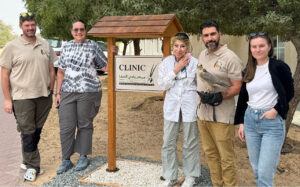
Photo courtesy of Dr. Irene Pepperberg
So, why am I writing about non-parrots? Well, as it turns out, on an evolutionary scale, falcons are very closely related to parrots—even more so than they are to hawks. And I was recently given the opportunity to work with these birds in Dubai….
The story starts many months ago, at a veterinary conference in Norway, where I was presenting a talk on contrafreeloading—working for food that could simultaneously be obtained for free. The point of my talk, based on studies designed by my students, was that if the “work” was actually something the bird regarded as play, the combination of the activity and the food would be preferable to the food alone (Carroll & Pepperberg, 2024; Smith et al., 2021; 2022). The talk caught the attention of a veterinarian from Dubai who helps care for several falcons owned by a shaykha (a female sheik). As it turns out, summers in Dubai are far too hot to fly the birds, and they just sit—and eat. The veterinarian wondered if the birds might enjoy doing some cognitive tasks to get fed, to relieve their boredom.
So, we began to talk. A veterinary conference was being held in Dubai in February; might I be interested in presenting the same talk, and seeing how falcons might react when given some tasks other than those involved in their standard hunting? I was intrigued, and had never been to Dubai; he said he would talk with both the organizers of the conference and the owner of the falcons to see what was possible.
Learning How Falcon’s Problem-Solve
I started doing a bit of research on my own. Falcons are known for their hunting abilities, but not much has been written about their cognitive capacities (at least compared to that known about parrots or corvids). A review paper (Biondi, 2022) had described a few such studies in several different falcons. Most occurred with M. chimango, also known as the caracara. In one study, researchers trained the birds to associate one of two colored boxes with a food reward, then examined reversal learning—how quickly they would learn to change to the other color, which now had the reward.
Much like pigeons, they learned to avoid the first box rather than to actively choose the second. Researchers also studied these falcons’ abilities to innovate in order to obtain rewards from various puzzle boxes. Here, the birds performed exceptionally well. In a further study, birds that had never done the tasks also quickly acquired these behavior patterns from birds that had, providing good evidence of social observational learning. And, in a later study, Harrington et al. (2024) presented wild caracara with a complex problem-solving arena that had been previously given to cockatoos…and the falcons performed at the same level as the parrots.
I was definitely primed to work with the peregrine and peregrine-gyrfalcon hybrids that would be available in Dubai. Their trainers were eager to cooperate, although they warned me not to expect too much…these birds had never done anything other than learn to hunt, and the trainers wondered whether their birds would even pay attention to the tasks I was proposing. So, I tried to temper my expectations and was prepared as much for failure as for success.
I can’t provide the details of what we did in this blog, because we hope to publish the results when we complete the studies, and describing our current findings now would prevent that from happening. I can state, however, that the all the birds eventually understood the tasks, and that some advanced very quickly: I spent a few evenings staying up late to write up new data sheets to keep up with the falcons’ progress. And I hope to return later this year to continue the work…
So…stay tuned!
References
Biondi, L.M. (2022). Falconiformes cognition. In J. Vonk & T. K. Shackelford (Eds.), Encyclopedia of Animal Cognition and Behavior, pp. 2650-2613.
Carroll, A., & Pepperberg, I.M. (2024). Contrafreeloading in umbrella cockatoos (Cacatua alba): Further evaluation of the play hypothesis, Journal of Comparative Psychology, https://dx.doi.org/10.1037/com0000395
Harrington, K.J., Folkertsma, R., Auersperg, A.M.I., Bondi, L., & Lambert, M.L. (2024). Innovative problem solving by wild falcons. Current Biology, 34, 190–195
Smith, G.E., Greene, D., Hartsfield, L.A., & Pepperberg, I.M. (2021). Initial evidence for contrafreeloading in Grey parrots via the opportunity for playful foraging. Journal of Comparative Psychology, 135(4):516-533.
Smith, G.E., Bastos, A.P.M., Taylor, A.H., & Pepperberg, I.M., (2022). Contrafreeloading in kea (Nestor notabilis) in comparison to Grey parrots (Psittacus erithacus). Scientific Reports. 12:17415 doi:10.1038/s41598-022-21370-6.
As a Raptor rehabber, educator, curator and master falconer, I find enrichment a real challenge. Fortunately I have never had a falcon that self mutilates or practices perseverate behavior but I really look forward to having new arrows in our quiver in terms of keeping these friends happy and engaged- thank you
Indiana Raptor Center-
Not surprised. I suspect Dr P’s techniques could apply to most birds!
Very interesting indeed. I have flown peregrines but not to hunt, merely spot flying but was not aware they had been cross bred with Gyrs. Still, I don’t have the wealth to move in those circles. I.can only train and rehome cockatoos. A rewarding task since my first Lesser Sulphur Crested some 70 years ago Added to the various types over the years, along with my 2 own birds but I never even saw a black one and never thought of peregrines and parrots as being remotely alike. Just shows, a life spent learning and still learning yet. A good lesson and I look forward to seeing you publish. Don’t take too long though, I might be gone. Good article/blog. Can I have its link address please. Or is it just the Grey Way? I ‘ve just finished training a sadly abused DuCorps rescued from a bush fire threat as a fledgling. He gave his abuser pneumonia so justice is partly served but the fact that the abuse was through ignorance and convenience holds no water with me. I got him at 6 going on 7 so very anti human but mainly human females so a part win at the least. He left to join a mixed bunch with an experienced female in charge and a female DuCorps who happily accepted him made my heart sing Only saw it on video as I was in hospital myself but it lifted my spirit no end to see him reacting in a civil way to her. He was very quiet when he first arrived in his Lufthanser puzzle box which took me an hour to open, it being not like other, secure travel boxes, hence the name puzzle box. But he’s vocalising fine now after 6 years of patience 2 hours a day, 6 days a week. And left to a near perfect home and happy. What more could I ask, it makes my heart sing.
….