




I’ve written about this aspect of research from time to time and figured it was appropriate to revisit the subject, given our recent experiences in the lab. This time centered around a study that is dependent upon the birds choosing between two stimuli to obtain what appears to be more juice. This isn’t much of a hardship, because juice is something they really, really like (and which we limit, as juice provides an intense sugar infusion, even more so than eating fruit. With fruit, they at least have to work to extract the juice!)
The desire to maximize their intake of juice was also the basis for two previous studies on Piagetian liquid conservation (Cornero et al., 2020; Pepperberg et al., 2017). And as much as they like juice, they were quite fussy about what kind we used. Athena would work only for freshly squeezed organic grape juice. Needless to say, the process of obtaining liquid that way was not simple, even after we figured out how to use a garlic press to speed up production. So, we wanted to look for an alternative juice this time.
We knew that other African grey parrots owned by friends would drink a commercial mix of cranberry-blueberry juice and figured we could try it. Of course, our local store was out of that particular flavor, so we purchased pure cranberry juice, thinking it wouldn’t be all that different. We poured some into the small tattoo cup that we were going to use in our study and offered it to Griffin. He happily sucked it down! We were thrilled—less sugar and a healthy choice.
Next came Athena. She watched Griffin happily drink and figured it was probably fine. She took a big gulp. Uh….her eyes pinned…she pulled back…and spewed the entire beakful all over us! If she had the words to convey her feelings, I’m sure she would have said something like “Are you trying to poison me!?!?” We wish we had been filming so we could have captured the expression on her face…and we know that a replay isn’t likely as she’s too smart to make that mistake again. And, for the sake of consistency, we wanted to use the same juice for both birds; thus, we were going to have to go back to hand-squeezing grapes.
Griffin’s Sneaky Way of Getting More Juice
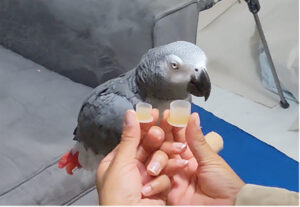
We are still collecting data on this study, so I won’t go into it in detail at the moment, other than to note that we start a session of two or three trials with a pre-test to ensure that Griffin and Athena want to work that day. In the pre-test, we gave them a choice between two differently-sized cups that are both half-full of juice (see Figure).
If they pick the bigger cup, they get to drink the juice and proceed to the regular trials. If they pick the smaller cup, they get to drink what is in it, but we assume they don’t care about the juice and thus aren’t eager to work, so they get a time-out while we either do trials with the other bird, or we just pause for several minutes. They then get a second try. Choosing the smaller cup at this point ends the session for the day, as we assume they aren’t really interested in doing trials.
Over the course of the study, we began to notice that Griffin consistently chose the smaller cup on his first pre-test and the larger cup on the second. It took us a few days to realize that he was gaming the system. He realized that by making those choices, he could maximize his juice intake! We couldn’t change the protocol at this point, so we let him get away with it (he was getting only a few milliliters extra juice, so it wasn’t very much), and, well, we felt he deserved it for being so smart!
References
Cornero, F.M., Hartsfield, LA., & Pepperberg, I.M. (2020). Piagetian liquid overconservation in Grey parrots (Psittacus erithacus). Journal of Comparative Psychology, 143, 197-210.
Pepperberg, I.M., Gray, S., Lesser, J.S., & Hartsfield, L.A. (2017). Piagetian liquid conservation in Grey parrots (Psittacus erithacus). Journal of Comparative Psychology, 131, 370-383.
Never underestimate the Gray’s .
I’ve not laughed this hard in weeks, thanks
We have a Gray and a Scarlet Macaw and together both are very smart and know how to get what they want when they are hungry. I have found that sometimes even the way I cut up vegetables or certain foods affects if they will eat it or throw it out of their cage. Your research is interesting and enlightening.
We laugh all the time at some of the antics.