




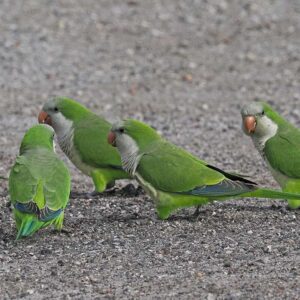
Social media has a significant impact on the thought process. In the past, human socialization often occurred in small settings. People would find groups of like-minded individuals, and they would inevitably learn new ways of thinking and speaking. Today, the extensive reach of social media has created entire networks of ideas that merge and propagate pathways with one another, both positively and negatively. Why would we think that parrots are any different?
In a recently published research paper in The Royal Society Open Science journal, a team of researchers that included Simeon Q. Smeele, Lucy, M. Aplin, and Mary Brooke McElreath, all working with the Max Planck Institute of Animal Behavior (German), and Juan Carlos Senar with Museu Ciencies Naturals (Barcelona), spent two years in observation of monk parakeet social networks. They hoped to determine how social networking influenced the individual parrot.
Using methods of data collection, study, and intense analyses, this group paid close attention to 337 monk parakeets, commonly referred to as quaker parakeets. They recorded the parrots’ community interactions, both socially and vocally. With 5,599 recorded vocalizations from 229 individual birds, the team discovered several amazing realizations.
A Parrot’s Social Circle Shapes How They Talk
The team discovered that the larger the groupings, the more vocalizations the birds acquired versus smaller groups. The more social the individual bird was, the greater their vocabulary of calls and screeches was. Interestingly, females were the more social of the monk parakeets.
This study does not say that larger groups of parakeets attracted the smarter birds, but rather the large groupings influenced a wider intake and use of newly learned “language.” With a larger vocabulary, the larger groups had more ways to communicate with each other. The more intimate the relationship, the more unique the calls are.
More than ever, we are realizing that, as we gather socially, however we do so, our unique expressions within the groups we identify with open up various new communicative avenues. With the conclusion of this study, it now appears that this is also true for birds, particularly the monk parakeets.
Monk parakeets who joined a “clique” were deeply influenced by how that group communicated with one another, much like us. If a bird was more central to the group, it was certain that their vocal repertoire was larger than that of the others. Interestingly, other studies have found that species with declining populations also experience a significant reduction in song and vocalization variations.
The next step is to attempt to discover exactly what these birds’ vocalizations mean to the group and how they actively influence decision-making and outcomes.
The depth of this study is far deeper and complex than the few words committed to this article. For further investigation of your own, visit this link for the published paper.
Great science in possibly learning how other animals interact and communicate together, Think about it: all life evolved on earth. Nature never reinvents things unless it can’t find a way around a problem. So social interactions in groups of birds sounds exactly like those in humans. The human animal is the result of evolution. Nature is a beautiful machine!