




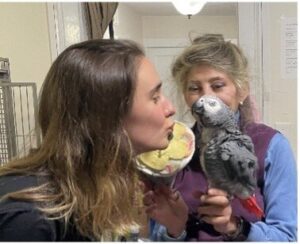
Image courtesy of Dr. Irene Pepperberg
As I’ve previously mentioned, my parrots do not like change. They want to be able to predict what is going to happen, and when it will happen, and with whom it will happen. They sometimes will respond somewhat negatively to just a normal shift change in personnel, simply because it is a “change.” Griffin even seems to have some kind of internal clock, requesting specific actions at roughly the same time each day. Thus, the end of a semester is a difficult time for our birds.
Our research assistants’ (RA) schedules are pretty much upended thanks to final exams and then intersession breaks. People are coming and going at all sorts of unexpected times, and RAs are likely to exchange shifts to accommodate each other’s changing schedules. Griffin and Athena inevitably respond by being a bit cranky and very needy and clingy toward those of us who remain. We try to be understanding, giving them extra attention and maybe even a few extra treats. One would think that our parrots would habituate to all these comings and goings over the years, but such is not the case. And they are not simply “playing us” for attention and treats, as their behavior is closely associated with these changes.
Not surprisingly, the end of spring semester is particularly problematic, as we usually have quite a number of graduating seniors, RAs who have been with us for long periods — often three or four years — during which time they and the parrots have become quite attached to one another. Of course, we are very proud of these students, but the goodbyes are not easy!
Feathers, Feelings & Final Exams
This year, we had four graduating RAs, including our assistant lab manager. A few RAs who will be back in the fall are cutting their hours for the summer because of other internships. (Lena, pictured, saying farewell to Griffin, will be starting a Rhodes Scholarship in Oxford in the fall, after a summer internship in Nevada.) For the birds’ sakes, we try not to make too big a production out of all these departures (e.g., we stopped having end-of-year pizza parties, as the birds clued in on that celebration as something that heralded upheaval), but the birds do pick up on all the emotions.
And, of course, the departure of a number of RAs means that we have to hire replacements. We try to interview all the applicants in person to see how they will respond to and interact with the parrots. We sometimes joke that the parrots make the final decisions!
So, another stress is that the birds have to deal with a string of newcomers, all within a short period of time, some of whom, although extremely interested in the research and eager to work, nevertheless often have little experience handling African grey parrot-sized birds. Many people don’t expect how heavy the birds are (about a pound) and how loud they can be (particularly when Athena squawks right in one’s ear). And we have to tell all potential RAs that, yes, you will get bitten and it will hurt, but that these birds can’t remove a digit! And those bites need to be disinfected promptly with the materials we provide…
Thankfully, that information has never dissuaded a potential RA. However, there is quite a learning curve: New RAs need to learn how to clean cages and perches quickly and efficiently, how to prepare the birds’ meals, make and replace toys, how to recognize problems (odd poop, other evidence of possible illness), what to do in case of emergencies — all while trying to gain the birds’ trust, something not all that easy given that the birds were recently “abandoned” by those whom they had trusted. And we also have to make it very clear to new RAs that until they have gained that trust, the birds are unlikely to perform any experiments with them, which means that an RA who is in the lab for just the summer or one semester probably isn’t to have their name on a publication.
We do think that we are going about everything appropriately; however, most of our new RAs are folks who were recommended by those already working in the lab or are also graduating. Griffin and Athena settle down quite a bit as soon as we have a new schedule. And everyone realizes that something very special occurs when the birds finally do give someone their trust and ask for “TICKLE!” or look at them intently and state, “Wanna nut” (the cue to do an experimental trial).
Interesting, I can see the patterns and behaviors described in in my African grey. Over the past 28 years, he has become very sensitive to the cycles of our lives. He becomes cranky and needy when there’s even the smallest change in our household.
I live with a 25 year old Amazon who lives her life between two cages, the one in her bird room with her TV (so she can see Sesame Street – she’s an Elmo fan) and a small cage in the dressing room so we can keep track of her at night. My job is to move her back and forth between the two cages, scratch her head, and play peek-a-boo with her. She clearly has expectations of certain things happening at certain times. If I’m off schedule with something, she is clearly not happy.
I’ve been following Pepperberg’s research for some years going back to Alex. Used to assign her book to be read and discussed by college sophomores in a developmental psychology course in connection with the topic of language. Usually got a good response from the students.
In her lab, Pepperberg observed that parrots could display emotional responses.