




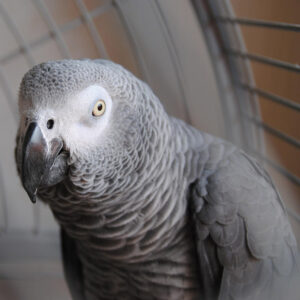
So, this blog is going to be a bit of a rant, because I’m extremely tired of the AI (artificial intelligence) folks using the term “stochastic parrot” as a derogatory term to describe some of the programs that exist today. The term was first used by Bender et al. (2021), claiming that the output of these programs was simply mindless, meaningless, statistically likely but not necessarily precise sequences: “stochastic” from its definition of “randomly generated” and “parrot” in the (wrong!) sense of a “mindless mimic.” Whatever one thinks of artificial intelligence programs, there is no reason to use the term “parrot” in a derogatory manner.
I’ll start by providing a bit of background about the artificial intelligence programs I’m discussing. All of you probably have some experience with them, whether or not you actively decide to do so, if you use any kind of word processing or email program. For example, I’m getting prompts constantly while I write these sentences! About half the time I agree with those prompts and am fine with using them…and about half the time they are totally useless.
Let me explain a bit about how these prompts originate. These programs are based on what are called LLMs, or “Large Language Models.” Basically, they scan and store in memory just about anything (“Large”) written (“Language”) that they can access. They then use statistical programs (“Models”) to determine the most likely next word in a sentence, based on the number of times these patterns exist in their memory. So, certain patterns are more common than others, and the program decides that, therefore, you’ll really like them.
The finding that they are often useless (and sometimes discriminatory, deceptive, and/or incorrect) triggered Bender et al.’s argument. Of course, by actively choosing to use such programs and providing carefully designed prompts, you can get decent results. (For example, if I ask, “What should I do to cool down on a hot day?” I’ll be told to go to an air-conditioned space, drink cool liquids, go swimming, etc.) But the Bender et al. argument was that even when the responses are sensible, the programs have no understanding of the material and simply provide the most likely responses, solely based on the material in memory, and if there is a problem with the material in memory…well, you get the idea.
Reclaiming “Birdbrain” As A Badge Of Intelligence
I’m not going to defend artificial intelligence programs (some of which are extremely helpful, others not so much, and a few maybe even seriously problematic); what I AM going to defend is the “other” AI: that of avian intelligence—I have spent an almost 50-year career trying to convince people to appreciate the cognitive abilities of our feathered compatriots and NOT to use their names in a derogatory manner. (Of course, not all parrots use speech in meaningful ways, and their abilities depend on how they are trained and the extent and types of their exposure to human interactions—but even those birds that have not undergone rigorous training often make meaningful associations between particular speech patterns and real-world activities…)
Notably, it is not just parrots who have been taught English speech like Alex, or tested on the same types of task as young children as Griffin (and Athena, Pepper, and Franco—other birds that I have studied) that are certifiably intelligent—you can do a literature search and find all the amazing research on tool use in cockatoos and corvids, episodic memory in scrub jays, ravens cooperating to solve problems, concept formation in pigeons…the list is huge.
Scientific research also exists showing that (at least) parrot and corvid brains have cortical areas (those parts of the brain responsible for intelligence) that are (relative to body size) as great and as densely packed with neurons at levels comparable to great apes. I’m not about to do a major review of avian intelligence here; reviews of the material are publicly available even if the specific journal articles are not. My point is simply that to call something—be it a living being or a computer program—a “birdbrain” should be a compliment and not a slur!
References
Bender, Emily M.; Gebru, Timnit; McMillan-Major, Angelina; Mitchell, Margaret (2021). On the dangers of stochastic parrots: can language models be too big? Proceedings of the 2021 ACM Conference on Fairness, Accountability, and Transparency. doi:10.1145/3442188.3445922
I read this while watching the Rachel Maddow show where she was saying exactly the same thing in reference to A1. You’re right on target!
Totally agree. After I commented once on a YouTube video, someone called me a “birdbrain”. I thanked them profusely for the compliment and mentioned how birds are super intelligent. This of course angered them further lol.
Why does the author object to the use of the term “stochastic parrot” by AI critics, and how is the term considered both inaccurate and derogatory? Regard
Hello, Dr Pepperberg, l can’t say l had noticed this comparison between parrot language and large language models, but l agree that avian intelligence is underated. Living with our Congo African Grey has taught us to appreciate how nuanced his learning and output are, even to sarcasm! A large language model can replicate heran speech to a degree, but it cannot pick up on our moods, that is, interact with us as our parrot does. Thank you for sharing your research,
After having being privileged to be let into the secret life of Sun Conures for +22 years, I vouch 100% to the truth of Dr Pepperbergs above statements.
Artificial intelligence is just that…artificial. Avian intelligence is anything but. The local corvids are smarter than most people I know, and definitely more sociable.