



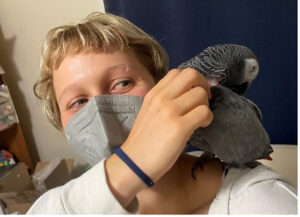
Athena, who is happily sitting on
her shoulder.
Image courtesy of Dr. Irene Pepperberg
As I mentioned in a previous blog, we generally have to engage in a round of new hires at the end/beginning of semesters. Students graduate, or those who have been with us for a gap year or so are now ready to move on, so we need to find replacements.
We usually start by sending adverts to my colleagues at the various nearby universities and ask the current research associates if they have any friends who might be interested, or friends of friends. Sometimes I’ll mention our search to colleagues at more distant places, on the chance that they might know a student who is planning to relocate or who is interested in relocating to the Boston area. When I was still teaching, I’d recruit a top student in my class. We’ve had really good success using these methods. Usually, we get a number of resumes, and we carefully go through them to determine which applicants will be a good fit for the lab, and thus which we should call for an interview.
Beyond Bird Wrangling Skills
People sometimes think that we might favor applicants with a lot of experience in handling birds, but that is rarely a possibility. Most of our students are interested in learning about working with birds, particularly pre-vet students, who generally have previously volunteered at places that afforded them many chances to work with dogs and cats, but not birds. And we get lots of students who are interested in animal cognition who have read about our work in their courses and want to be involved in the research. We do favor applicants who have some experience working with animals (even as pets), as some basics about care clearly apply to all animals (fresh food, fresh water, clean cages…).
Sometimes, depending on where the potential hire is currently living, we start with a ZOOM interview. ZOOM, obviously, isn’t perfect, but we don’t want someone to travel a long distance for an in-person interview if we feel that they wouldn’t be a good fit for the lab. We ask the obvious questions: why they want to work with us; what they hope to learn; how long they might be able to stay; and what hours they might be able to work.
One of the critical issues is often finding folks who can work particular shifts based on the schedules of the people who are already in lab, so someone might be terrific, but if they can work only at a time that we already have covered, we tell them to check back the next semester. We also tell every potential hire that, yes, the birds bite and that every human in the lab will eventually get bitten — but that the birds cannot remove a digit. If the students adhere to our rules, the birds will not cause serious injury. Griffin, for example, will warn you by giving a gentle nip, which, if you don’t stop what you are doing to cause that behavior, will result in something that needs to be cleaned and bandaged! Athena, however, will first ignore you and then strike with a small but quick puncture.
Can You Pass The Parrot Interview?
The next step is the personal interview. Obviously, we can’t hire anyone afraid of the birds, so that is a prime check. And, as you might guess from the title of the blog, it is Griffin’s and Athena’s reactions to the person that is the basis for our final decision. We don’t expect an interviewee to immediately be able to handle the birds, but we do see how they approach the birds and whether the birds are intrigued or not. If the birds completely ignore the human, it is unlikely that the person will be hired.
Athena, who is much more outgoing than Griffin, will very often be willing to climb from the hand of a current research assistant to that of the interviewee. Griffin very rarely will do that, but if he does we know we have a winner! Very rarely, the birds will “choose” someone who doesn’t work out well for other reasons (i.e., failure to follow rules or directions), but on the whole, the system has worked quite well for decades. The birds do seem to have a good sense of who will fit into our laboratory. And, depending on the shifts the research assistants work, they often spend more time with the birds than with the humans in our lab, so our birds better be happy with their choices!