



One of the big issues in psychology these days is “replication”… being able to reproduce the results of a given experiment at a later date. Most experiments replicate quite well, but a few do not, and, of course, those are the ones that attract lots of attention. Sometimes my work has been criticized because it involves only a single parrot (first Alex, now often Griffin), with the argument that these are very special avian “Einsteins” and thus that the research is not replicable.
Well, Alex was chosen at random from a group of eight parrots in a pet store; what was the chance that he was particularly gifted? And Griffin chose me. The breeder sat me on the floor with a bunch of baby African greys, and one toddled up to me; well, maybe that did show something special, but…? In any case, the replication issue still arises, and thus, we try to address it when possible.
Replicate To Substantiate
The important issue here is that, to be scientifically sound, replication requires that all the experimental conditions be the same the second time around. And that just isn’t always possible. For example, Alex was a single bird for the first 15 years of his life, interacting only with humans. He adopted us as his flock. Such was not the case for Griffin, and Alex dominated him mercilessly, yelling at him to “Talk clearly!” or “Say better!”; or if I asked about colors, Alex would shout, “Tell me what shape?” Griffin became very timid, and his attitude was “just clearly show me what to do, and I’ll do it…but don’t make me try to figure out something new on my own!” Most of the time, this has, indeed, been a very successful strategy for him.
My point is that we are often challenged to replicate what Alex and Griffin have done with other birds. And, again, replicating all the experimental conditions is almost impossible. But sometimes we can come close; not by replicating the conditions exactly, but in very similar ways. Such has been the case with some of our work on inference by exclusion; seeing if our parrots can find treats after being given information that tells them where the treats cannot be. The ability is extremely interesting because multiple sequential studies must be conducted to demonstrate this capacity, each one building on the prior task.
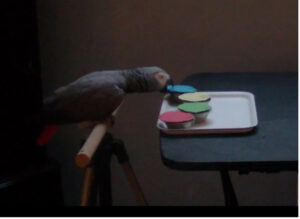
The first task is quite simple, and includes only two choices (i.e., involves 2 cups, A or B; originally developed by Premack & Premack, 1994); that is, we fill two covered cups in front of the subject, place a barrier in front of the cups, remove one treat, remove the barrier and show that one cup, either A or B, is empty. The inference is, for example, “A or B; not A, therefore B,” where A and B are evaluated as a pair. An equally plausible description of this task, however, is “Maybe A, maybe B; not A, maybe B,” where B is another likely, independent alternative (maybe the experimenter cheated and removed the other treat surreptitiously, too!); the inference is not fully based on being certain of where the treat is, only of where is it likely (Mody & Carey, 2016)…and a simple strategy is just to avoid the empty cup, which doesn’t require any inference.
Nevertheless, the task is a crucial step to show that the subjects are motivated and can at least track the hidings. We gave this task to four African grey parrots (Griffin and Arthur in my lab, plus Pepper and Franco who are companion animals but are often tested in the same way as our birds), and they all succeeded (Pepperberg et al., 2013).
To provide a better experiment to determine if subjects really could solve an inferential problem, Mody and Carey (2016) created two additional tasks…one, a 3-cup task, that acted as a pre-test and then a 4-cup task that got closer to demonstrating inferential reasoning. In the 3-cup task, one cup (A) is on one side, and two cups (B,C), are on the other. A barrier is placed in front of the cups, and a treat is hidden in each of the two sides (one in A, one in either B or C), the barrier is removed, and the subject is asked to choose among all three cups.
Clearly, the best chance of reward is to go for A, as only one treat is hidden on that side, and it must be there. Success demonstrates that a subject is able to follow two hiding events, is motivated to get a reward on the first choice, and has the ability to distinguish certainty from probability. The researchers showed that 2½ year old children, who all succeed on the 2-cup task, also succeed here. The 4-cup task, however, is a totally different story!
Can They All Pass The 4-Cup Challenge?
There, the subjects see 4 cups, two on one side and two on the other. A barrier is placed between the cups and the subject, and a reward is hidden in one cup of each pair—e.g., B,C; then the barrier is removed and one cup, e.g., A, is shown to be empty. If subjects are indeed reasoning by a form of exclusion, they should conclude that the reward is 100% likely in B, only 50% likely in C or D, and will choose B. If they are avoiding the empty cup and using the “maybe” alternative, however, they are likely to choose equally among B, C, and D. Children 2½ years of age that pass the 2- and 3-cup task fail this 4-cup task. But when we gave the two tasks to Griffin, he not only succeeded on Mody and Carey’s 3- and 4-cup task but also outperformed even 5-year-old children (Pepperberg et al., 2019).
So, was Griffin some kind of “Einstein” bird? Or might the other birds that passed the 2-cup study do as well as he did, outperforming the children as well? Unfortunately, Arthur, who had passed the 2-cup task, had passed away, but our Athena succeeded on that task. So we now had three birds we could test. Their overall backgrounds weren’t exactly the same (e.g., Pepper and Franco had been given several tests that Griffin had been given, but Athena had not experienced), but they all had done well on the 2-cup task. As it turns out, they all successfully completed the 3- and 4-cup tasks as well if not better than 5-year-old children, and Pepper did even a bit better than Griffin on the 3-cup task (Pepperberg & Hartsfield, 2025). So, we were able to replicate the study and show that these birds are just as smart as Griffin!
References
Mody, S., & Carey, S. (2016). The emergence of reasoning by the disjunctive syllogism in early childhood. Cognition, 154, 40-48.
Pepperberg, I.M., Gray, S.L., Cornero, F.M., Mody, S., & Carey, S. (2019). Logical reasoning by a Grey parrot (Psittacus erithacus)? A case study of the disjunctive syllogism. Behaviour, 156(5/8), 409-445.
Pepperberg, I. M., & Hartsfield, L. A. (2025). A test of inference by exclusion in Grey parrots (Psittacus erithacus): Replication of a parrot–child comparative study using additional avian subjects. Journal of Comparative Psychology. Advance online publication. https://dx.doi.org/10.1037/com0000427
Pepperberg, I.M., Koepke, A., Livingston, P., Girard, M., & Hartsfield, L.A. (2013). Reasoning by inference: Further studies on exclusion in Grey parrots (Psittacus erithacus). Journal of Comparative Psychology, 127(3), 272-281.
Premack, D., & Premack, A.J. (1994). Levels of causal understanding in chimpanzees and children. Cognition, 50, 347–362.