




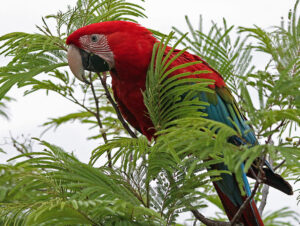
Phoenix Landing sponsors ecotours to support conservation, and I have just returned from another amazing trip to Brazil. Green-winged macaws, or red and greens as they are referred to in South America, are my favorite species. So, one of my most treasured places on the planet is Buraco das Araras.
Buracos das Araras is a circular sandstone crater that was created by a collapse of boulders. It is in the municipality of Jardim, in the State of Mato Grosso do Sul, just south of the Pantanal. Roughly 127 meters deep and 500 meters wide, it is one of the largest sinkholes in the world.
Throughout the twentieth century, this once-beautiful gathering place of macaws was turned into a dumping ground for garbage, and the birds became a target for vandals with guns. Sampaio Modesto purchased the property as a cattle ranch in 1986 and saw the potential in what was then a hole in the ground full of trash. He decided to bring the macaws back.
Dumpsite Transforms Back Into A Macaw Paradise
In 1997, he released a pair of green-winged macaws near the hole, and the birds survived. In that same year, the Sampaio family, along with the army, the State University of Mato Grosso do Sul, and the fire brigade of Jardim, removed truckloads of garbage from the sinkhole. The sinkhole is a testimony to the fact that one person can make a big difference. Modesto, and his sons, Bergson and Rooswelt, continue to manage and preserve this spectacular property.
As the population of macaws has grown over the years, so have the number of visitors. In 2007, it was officially declared a Private Reserve of the Natural Patrimony, ensuring permanent protection for the 29 hectares (71.6 acres) surrounding the sinkhole.
169 species of birds have been recorded at Buraco das Araras, including peach-fronted conures and aracari toucans; but the red and greens rule. When I was first there in 2012, there were about 30 pairs. That number has grown exponentially; this year there are an estimated 60 pairs. One blue-and-gold macaw has been accepted into the group because she pair-bonded with a green-winged macaw, but all other macaw species have been made unwelcome, including a pair of blue-and-gold macaws we saw last year. Here is a photo of hyacinth macaws trying to relocate in 2018, and the green-winged macaws said NO! It was an unsuccessful attempt at “invasion.”
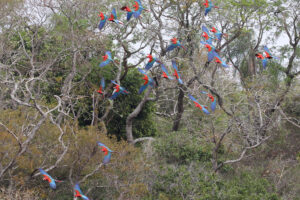
Buracos das Araras has a nursery where trees are propagated for additional food and nesting sources, and this year they are adding a new tree to the mix, the Pindó palm tree. In addition, a neighboring cattle ranch has given Buraco das Araras the rights to plant trees on their property, about 10 meters wide. This provides additional food and nesting sites, and also provides some protection from cattle ranching activities.
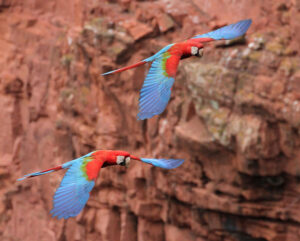
There are double-decker platforms along 2 sides of the sinkhole’s edge, which look down on the cliff walls. Several bird species, including the macaws, nest in holes in the arid cliff walls. To look down upon these stunning birds in flight is an amazing (and tearful!) experience.
To learn more about the Buraco das Araras go to www.buracodasararas.org. This month’s Lafeber donation goes to support the continued planting of new vegetation and trees needed to sustain the growing population of the magnificent green-winged macaw.

I loved that story its good to hear that something is working
It sounds a like a thrilling place to visit! And I appreciate Ann Brooks’s commitment to parrot conservation and rescue.