




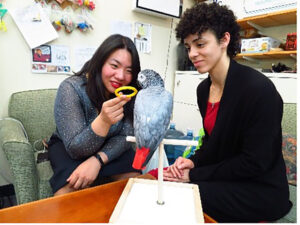
I’m often asked why we have to engage in so much fundraising to support our lab…why is it so expensive when we have so few experimental subjects? The answer is that it really does take “a village.” Specifically, we try (though it is not exactly possible) to give our birds an environment as close as can be to that of a toddler.
So, think of that environment…the toddler is never left alone during the day! Yes, a caretaker will put a toddler down for a nap, or maybe put the child in a playpen (the equivalent of a cage, if one is being honest) for some parts of the day, but for the most part, the child has constant companionship. A good caretaker will be talking to the child pretty constantly, too—talking about what is being fed for meals, about the colors, shapes, and number of toys. And, although the toddler will have many other experiences that a companion bird lacks (e.g., only a few birds get to go out on walks or have playdates; see Pepperberg, 2024 for others), you get the picture.
So, for those reasons, our parrots have human companionship all of their waking hours…and, given that African greys originate in equatorial Africa, that is basically 12 hours each day. [For various reasons, our birds’ days are technically 11 hours, but, like many toddlers, they often resist going to “bed” (back in their cages), so often our research assistants (RAs) stay late and the days are closer to 12.]
Lab Runs on Teamwork
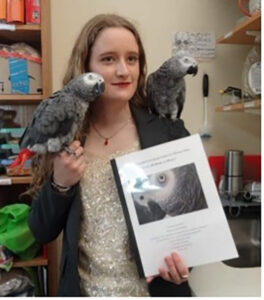
Almost all of our RAs are students with heavy class schedules, so they work in shifts. During their shifts, they clean cages, make meals, and give Griffin physical therapy for his arthritis, as well as engage in our various studies. And one person per shift is just a minimum. If we are doing any training, that means a minimum of two RAs—one as the model/rival and one as the trainer. Usually, we have a third RA to take notes. The same situation is true whenever we do testing. One person is doing the questioning, another is making sure all the stimuli and other equipment are working properly, and a third is note-taking and/or carefully watching the birds to ensure that they are paying full attention. If they aren’t, we have to declare a mistrial, and because of the way the experiments are designed, that third observer is often critical.
And even if we aren’t doing any scheduled training or testing, parrots need attention. They ask for “tickles”—for us to preen areas on their head that they can’t fully reach, or tell us they “wanna go back” to their cage where they can nap or snack. Alex would ask for a “showah” (a Bostonian shower), and Griffin tells us he wants additional training by saying “wanna nut!”, or asks to “go sink” (to the kitchen area, where he gets to play with spoons). Oftentimes, several RAs and I use avian nap time to discuss how we would design a new experiment or analyze the data from a current one, or to troubleshoot a design that isn’t working properly. These mini-meetings are critical to the smooth operation of the lab.
Although no one is in the lab overnight, we have monitors that alert the RA on call if anything unusual happens. A video camera is in place to identify the cause of an unexpected sound, and monitors send an alarm if the temperature goes too high or too low. (And, yes, we have had such emergencies. One time, the building’s power blacked out overnight, and the heat went off. The RA on call rushed in to find—unbelievably!—that the ONLY room in the entire huge building that still had electricity was the birds’ room, so we could plug in our emergency space heaters until the issue was resolved. And for that, of course, the RA got overtime pay.) When we were in basement labs at various universities, we also had a flood sensor, and we always have possible evacuation plans.
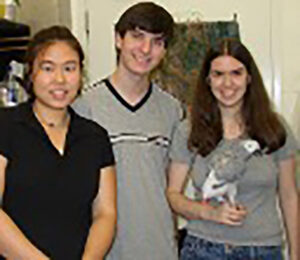
The RAs have various levels of expertise and are paid accordingly. The positions range from a post-doctoral fellow who spends half her time in lab working on new studies and half of her time at home, analyzing data and writing up papers based on completed experiments; to lab managers who are responsible for things like scheduling all the other RAs, ordering supplies and buying groceries as well as helping with bird care and experiments; to students who can work only a limited number of hours a week but who want experience in lab work and animal care. (Just FYI—I get no reimbursement for my time in lab or for running The Alex Foundation…And we get no federal or university financial support—we rent the apartment that maintains the lab, pay for utilities, food, veterinary care, supplies for experiments, etc. It all adds up…)
So, when you see our requests for assistance, understand that absolutely every penny goes to support the welfare of our parrots! For now, that is just Griffin, but other than veterinary bills, nothing really changes in terms of expenses and the number of our subjects.
Be Part of the “Village”
You can help Dr. Pepperberg continue the groundbreaking parrot research she began 40 years ago with Alex, the African grey parrot who won admirers from around the world with his cognitive abilities. If you shop online through sites such as Amazon.com, you can designate the Alex Foundation to receive a percentage of your final sales, or register with the Alex Foundation at iGive.com and a percentage of sales from companies associated with iGive will go to the foundation. The Alex Foundation also has a “Donate” button linked to PayPal. Visit the Alex Foundation’s “Support Us” link for more information.
I just love her work and appreciate all the RAs who are involved with this important research. I have two rescued greys and they are a delight to be around!