




The ability to plan for the future involves complex levels of intelligence, particularly if such spontaneous planning involves future motivational states. Even in children, it is a behavior that develops over time. For example, if young children are told they will be given a salty snack and then asked about how much they think they would like water or pretzels the next day, they rarely respond appropriately even up to seven years old; they may respond correctly at somewhat earlier ages for less complicated tasks, but still rarely before 3-4 years old (Mahy et al., 2013; see also Suddendorf & Busby, 2005).
Studies with most nonhumans show that this behavior seems mostly limited to the primate line (Cleveland et al., 2004); outside of primates, some nonhumans exhibit planning for the future, but only when the future is not very far away and not with respect to motivational states (e.g., pigeons and rats, Cook et al., 1985; Zentall et al., 1990). The one exception is an elegant study on scrub jays (Aphelocoma californica; Raby et al., 2007), which shows that, in the evening, they selectively cache food that will not be available to them the next morning in a particular room. The interesting point is that the jays are natural cachers, whereas the other nonhumans studied are not. So, we never thought about the possibility of studying something even remotely like this behavior in African grey parrots; as far as we know, they have never been observed caching either in the wild or in captivity.
One Saved Snack Offers Hint To Future Planning
Thus, we were extremely intrigued to see evidence of what seemed to be a simple form of future planning by Griffin. First of all, you have to understand his feeding situation. We keep a small paper towel on top of his cage with his pellets, shredded wheat, and raw pasta so that some food is always available. His water dish is also always there, along with his food bowl. However, the contents of the food bowl varies over the course of the day. He gets fed breakfast (cooked veggies with supplements) in the kitchen and then goes back to the cage for a bit. He is also taken off the cage for various physical therapies and maybe some data collection until lunchtime.
At lunch, he gets fed on top of his cage: a warmed mash made of ground pellets and water (slightly heated because he likes warm food) and fruit—a quartered grape, some diced apple (which we call “banerry,” in memory of Alex), and a few thin banana slices. What fruit he doesn’t eat is removed and refrigerated, to be saved for a mid-afternoon snack. In mid-afternoon, he gets some bird bread in the kitchen and then returns to his cage for the rest of his fruit.
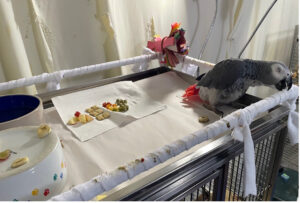
Griffin generally eats every last bit of grape, usually leaving some banerry and banana. We then do several rounds of training and/or testing before dinner. The fruit is completely removed when he is fed dinner (~5pm), which is, again, some warmed mash. We’ve noticed that on some days, Griffin carefully moves several pieces of banerry from his bowl to his pellets/pasta towel (see photo below) in the afternoon, before a research assistant (RA) can take them away; he then eats them not too long before bedtime…which is a few hours after he’s moved them.
Now, we aren’t anywhere near arguing that Griffin is seriously or consistently planning for his future banerry consumption. Again, he doesn’t do this every day, and we’ve only begun to think about keeping track of which days this happens, to see if there is any interesting correlation with something in his environment. Is it on days when a particular RA is present, one who is very conscientious about removing the fruit before making dinner? Is it related to how much banerry he has already eaten? We can imagine several scenarios, and only after examining them all might we try to figure out what kind of experiments might be possible to test our assumptions. Nevertheless, we were pretty surprised to see Griffin exhibit this behavior several times and thought it was interesting to document. It will be even more interesting to see what happens!
References
Cook, R.C., Brown, M.F. & Riley, D.A. (1985). Flexible memory processing by rats: use of prospective and retrospective information in the radial maze. Journal of Experimental Psycholology: Animal Behavior Processes, 11, 453–469.
Cleveland, A., Rocca, A.M., Wendt, E.L., & Westergaard, G.C. (2004). Transport of tools to food sitesin tufted capuchin monkeys (Cebus apella). Animal Cognition, 7,193–198.
Mahy, C.E.V., Grass, J., Wagner, S;, & Kliegel, M. (2013). These pretzels are going to make me thirsty tomorrow: Differential development of hot and cool episodic foresight in early childhood? British Journal of Developmental Psychology, 32, 65-77.
Raby, C.R., Alexis, D.M., Dickinson, A., & Clayton, N.S. (2007). Planning for the future by western scrub-jays. Nature, 445, 919-921.
Suddendorf, T. & Busby, J.(2005). Making decisions with the future in mind: developmental and comparative identification of mental time travel. Learning & Motivation, 36, 110–125.
Zentall, T.R., Steirn, J.N. & Jackson-Smith, P. (1990). Memory strategies in pigeons’performance of a radial-arm-maze analog task. Journal of Experimental Psycholology: Animal Behavior Processes, 16, 358–371.
Amazing planning on Griffins part 🙂 .
I have two congos, and a timneh grey. My timneh moves her food around to several cups in her cage. One cup is her toy box where I put a variety of toys each day. Often I will find food in her toy box and it makes me laugh. I wonder if she might be hoarding some of her food for a later time, in her toy box? It is usually her mix of cooked pasta, fresh veggies, nuts and fruits that she moves to the toy box, not her pellets which are kept in a separate bowl. I take her mix of pasta etc out of her cage at dinner time. I clean her cage and her toy box out in the evening. I hope I am not messing up her plans for a late night snack. Afraid to leave the food in the toy box because it might spoil.
They are extraordinary creatures that do and say surprising things. Looking forward to your follow-up result.