



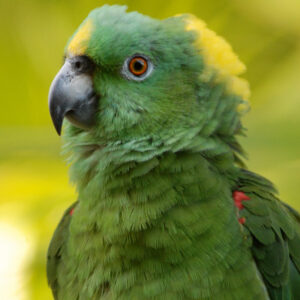
Parrots have long amazed us with their ability to mimic human words and accents, and new research suggests their own vocal exchanges are just as impressive. A recent study of yellow-naped Amazon parrots found that mated pairs perform intricate “warble” duets composed of 36 distinct call types. These calls are arranged in patterned, rule-governed sequences, which adds to growing evidence that parrots use highly structured communication systems.
Dr. Christine R. Dahlin, professor of biology at the University of Pittsburgh, along with five colleagues, recently published a study suggesting that yellow-naped Amazon parrots communicate using their own learned system of vocalizations, one that may function much like language.
How do they come to this belief? Dr. Dahlin and her fellow scientists found that the parrots’ duets contain clear structural patterns that follow recognizable “rules,” similar to those seen in complex human speech. They also discovered that many calls are sex-biased, with 75–99% used primarily by either males or females. Even more striking, some calls are entirely sex-specific, produced exclusively by one sex.
Distinct Calls, Distinct Meaning
Animals with highly social behavior, such as yellow-naped Amazon parrots, often display more complex call sets. These parrots are recognized to have regional dialects that span the entirety of their calls. The calls are divided into two groups: primary and warble. The primary calls are the most prevalent, while the warble call is seemingly used by pairs to alert and warn. They are distinct in that the warble call is expressed faster and in a more diverse range of notes. In all, 36 call types were identified, with another 11 calls that were heard only once.
This study is complex and revealing. Over the years, research shows that many of the planet’s animals may follow linguistic patterns remarkably similar to those humans learn and use. The study also aims to support the preservation of yellow-naped Amazons, which are considered critically endangered in the wild.
As Dr. Dahlin and her colleagues note, “If we hope to eventually break the code of their vocal communication system, it will likely take a sustained mix of conservation efforts, field observations, and playback experimentation. Ultimately, our work demonstrates the value of research into vocal complexity and syntactic organization in wild animal populations, as natural pressures shape communication in ways that cannot be replicated in captivity.”
For more, read the published February 12, 2026, study, Decoding Parrot Duets (here).