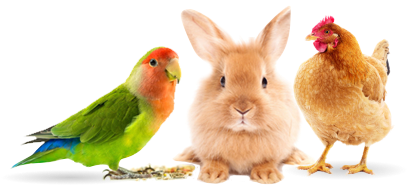




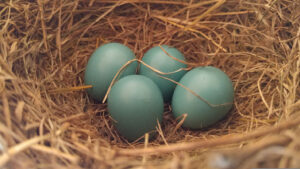
Every spring, we all go along with one very silly idea; that rabbits lay colorful eggs, and they hide those colorful eggs in gardens for children to find. Of course, they don’t. (Nice try, Easter Bunny!) Meanwhile, birds, the actual egg-laying experts, have been naturally producing beautiful-colored eggs for millions of years, probably wondering how rabbits ever stole their spotlight.
Let’s give credit where credit is due. Birds are the true artists of the egg world. Consider the impressive number of birds that lay blue eggs. Birdfly.com features 26 bird species that lay blue eggs, and it’s interesting to note that only a handful of the birds who lay blue eggs are themselves blue. And the Beauty and Biology of Egg Color blog, found on CornellLab All About Birds page, shows a dazzling variety of birds’ eggs, from deep blues to ones that look like they were drizzled with chocolate. In case you’re wondering, parrot eggs are almost exclusively matte white.
Bird eggs aren’t just beautiful; they’re functional masterpieces. Their colors serve multiple purposes, such as camouflage to hide from predators or to blend into the surrounding nesting material, and egg color can signal health and vitality. Egg shapes and patterns are as diverse as birds themselves. Unlike our holiday eggs, which we dye for fun, birds’ creations are biologically brilliant, crafted for survival and protection.
If you want to go past color and do a deep dive into bird eggs, check out this study on how eggs get their shapes covered by Harvard Magazine, which suggests bird egg shapes are influenced largely by flight: strong fliers tend to lay more elliptical eggs, while weaker fliers lay rounder ones. Moreover, a biophysical model shows eggshell membrane and pressure can create a full range of natural egg shapes. There’s also fascinating research highlighted in Science News that indicates that birds in colder regions produce eggs with darker pigmentation, a potential evolutionary strategy to increase thermal absorption and improve survival rates of embryos in low-temperature conditions.
We Have Germany to Thank for Egg-Laying Rabbits
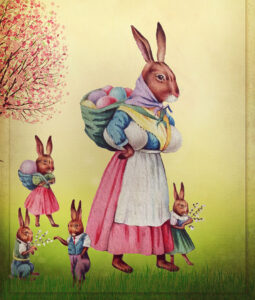
Photo by Dorothe Wouters/Pixabay
So where did this egg-laying rabbit lore come from? It traces back to old pagan springtime traditions celebrating fertility, something rabbits are famously good at because of their remarkable reproductive capabilities. In parts of Europe, especially Germany, stories popped up about a hare called Osterhase who would “lay” eggs for children to find in gardens. The tall tale dates all the way back to the 1600s, proof that this storied folklore has been spun for a long time.
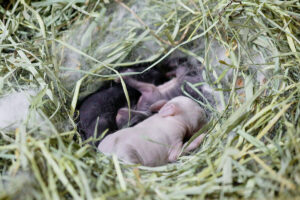
There is one thing rabbits and birds do have in common; they both build nests. Rabbit nests aren’t tucked into trees, however, and rabbits don’t sit on their nests. Instead, rabbit nests are simple, shallow dips in the ground. A mother rabbit lines the space with soft fur she pulls from her own body, then covers it with dried grass or leaves to keep it hidden. It’s cozy and warm for her kits (the official name for baby rabbits), but she doesn’t hang around. To avoid attracting predators, she quietly returns just once or twice a day, usually at dawn and dusk, for quick feeding visits.