



Grey Parrot Consciousness (Summarized from Pepperberg, 2026)
It has been 50 years since Donald Griffin (1976) wrote his seminal book proposing that nonhumans were conscious, that they had levels of self-awareness that could be compared to that of humans. At the time, the argument was completely revolutionary. Back then, the general consensus was that nonhumans were mostly instinctual beings or, at most, creatures that learned to respond to stimuli based on whether their actions were rewarded or punished (see review in Pepperberg, 1999). However, even now, the question of nonhuman consciousness — the extent to which it exists and how to evaluate its possible existence, particularly with respect to nonprimates such as birds— remains unsettled, although recently hundreds of scientists signed a declaration (Andrews et al., 2024), arguing that “strong scientific support” exists for nonhuman consciousness in mammals, birds, and possibly even all other vertebrates. However, actual proof of such consciousness is difficult to uncover in both humans and nonhumans.
Many studies focus on using sentience, the ability to experience emotions and sensations, as an indicator of consciousness. Of course, focusing on sentience as a marker for consciousness leads to further questions: How do we evaluate emotions and sensations in nonhumans? Given that humans often find it difficult to evaluate their own emotions (e.g., for a basic review, see Plutchik, 2001), it would seem that understanding nonhuman emotions would be exceptionally problematic.
A simple metric, then, might be deciding to examine only one sensation — sensitivity to pain, as that is somewhat more easily determined — but that would really be quite basic. It might be a necessary aspect, but is it a sufficient one to argue for human-like consciousness? The quest is ongoing.
Several researchers such as Birch et al. (2020) and Bayne et al. (2024) have developed complicated metrics that are extremely interesting but often too strongly biased toward human capacities. Several decades ago, a then-graduate student and I (Pepperberg & Lynn, 2000) argued that levels of consciousness existed and that these levels might be related to the levels of cognitive abilities that could be quantified in a given species. We also argued that levels of cognitive processing were likely a consequence of homologous or convergent brain evolution, perceptual structures, and learning mechanisms. Of course, we were then faced with issues of whether parallels existed between cognitive processes in nonhumans and nonhumans and whether there might be some kind of “neural correlate of consciousness (NCC)” in both humans and nonhumans. Interestingly, the search for an NCC in humans is still in process (Cognitive Consortium, 2025), so finding parallels in nonhumans is even more complicated!
Plus, the issue is confounded even further by the impressive levels of cognitive processing currently demonstrated by current AI systems … if only processing power were important, then AI systems would be likely candidates for consciousness, and — at least at present — we know that such systems lack self-awareness. So, does that pull us back to examining sentience rather than higher-order cognitive processing (note Block, 2025)?
The Scientific Debate Around Animal Consciousness
Well, not exactly. Full consciousness encompasses not only monitoring of sensory inputs and mental states but also executive control of decision making and voluntary action, and awareness of one’s own thoughts; specifically, being aware that one is aware. And it is this last bit, self-awareness, that is particularly tricky to examine in nonhumans, because even those nonhumans that have some level of referential communication do not have the kind of symbolic labels to discuss and report to us instances of self-awareness.
So, where does all this leave us? Another possibility is that we can examine various behavior patterns or successful task completion in nonhumans that, when observed in humans, provide evidence of such self-awareness. I give several examples in Pepperberg (2026). [It is an open-access paper, free for anyone to read.] Specifically, what is important in these tasks is that, in order to succeed, the subject must exhibit abilities that require self-awareness.
For example, in tasks of delayed gratification (discussed in a previous blog; forgoing a current treat so that one can obtain a better or much larger treat by waiting), the subject must recognize, understand, and suppress their immediate impulses, needs, and desires; must understand the potential conflict between immediate gratification and long-term goals; must keep the long-term goal active in memory; and, finally, devise a strategy that actively engages their thoughts in order to achieve that goal. Grey parrots are particularly adept at succeeding at this task (Koepke et al., 2015; Pepperberg & Hartsfield, 2023; Pepperberg & Rosenberger, 2022)! (However, I also note some general, potentially problematic issues with delayed gratification tasks in Peppeberg, 2026.)
Of course, the illustrative examples I provide in Pepperberg (2026) do not prove the existence of avian consciousness (or even Grey parrot consciousness) but do provide possible insights: evidence that must be evaluated in addition to that which would be collected in the kinds of consciousness tests proposed in the references cited above when trying to determine the levels and qualities of avian conscious behavior.
Whatever the difficulties, I do believe that we must collect the best possible evidence with respect to nonhuman consciousness, whether the evidence is positive, negative, or even contradictory, as well as appreciate the existence of alternative explanations to that of conscious behavior in what is observed. However, when deciding how best to coexist with nonhumans, prudence might dictate that the high levels of certainty that are considered necessary for scientific evidence of consciousness be lowered somewhat. In the spirit of “Do no harm” (as per Andrews et al., 2024), material that is merely indicative of consciousness should be considered integral to the design of protocols on welfare, humane treatment, and conservation.
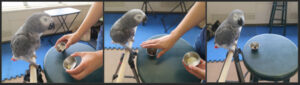
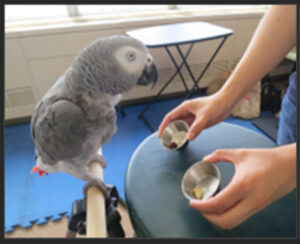
Griffin involved in delayed gratification: (a) being shown the two different sets of rewards; (b) one being taken away and the other being briefly covered while he is told to “wait”; (c) Griffin sitting with the first, less appealing—although still desired—reward during the delay. (From Koepke et al., 2015).
References
Andrews, K., Birch, J., Sebo, J., & Sims, T. (2024, April 19). Background to the New York Declaration on Animal Consciousness. nydeclaration.com
Bayne, T., Seth, A. K., Massimini, M., Shepherd, J., et al. (2024). Tests for consciousness in humans and beyond. Trends in Cognitive Science, 28(5), 454–466.
Birch, J., Schnell, A. K., & Clayton, N. S. (2020). Dimensions of animal consciousness. Trends in Cognitive Science, 24(10), 789–801.
Block, N. (2025). Can only meat machines be conscious?. Trends in Cognitive Sciences, 30(4), 298–308.
Cogitate Consortium. (2025). Adversarial testing of global neuronal workspace and integrated information theories of consciousness. Nature, 6422(8066), 133–142
Griffin, D.R. (1976). The question of animal awareness. Rockefeller University Press.
Koepke, A. E., Gray, S. L., & Pepperberg, I. M. (2015). Delayed gratification: A Grey parrot (Psittacus erithacus) will wait for a better reward. Journal of Comparative Psychology, 129(4), 339–346
Pepperberg, I.M. (1999) The Alex studies. Harvard University Press.Pepperberg, I.M. (2026). Comments on consciousness in Grey parrots. Comparative Cognition and Behavior Reviews. DOI:10.3819/CCBR.2026.210011
Pepperberg, I. M., & Hartsfield, L-A. (2023). A study of executive function in Grey parrots: Experience can affect delay of gratification. Journal of Comparative Psychology, 138(1), 8–19.
Pepperberg, I. M., & Lynn, S. K. (2000). Possible levels of animal consciousness with reference to Grey parrots (Psittacus erithacus). American Zoologist, 40(6), 893–901.
Pepperberg, I. M., & Rosenberger, V. A. (2022) Delayed gratification: A Grey parrot (Psittacus erithacus) will wait for more tokens. Journal of Comparative Psychology, 136(1), 79–89.
Plutchik, R. (2001). The nature of emotions: Human emotions have deep evolutionary roots, a fact that may explain their complexity and provide tools for clinical practice. American Scientist, 89(4), 344–350.