




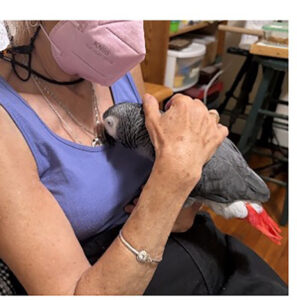
Image courtesy of Dr. Pepperberg.
As we approached the July 4th holiday, with all the accompanying fireworks, some of my newer Research Assistants (RAs) asked me how we were going to prepare for what they expected to be Griffin’s fear reactions to so many loud, unexpected noises. I reassured them that Griffin would not be bothered much at all. I can’t claim that all parrots, or even that all Grey parrots are unaffected, but we’ve never noticed any strong reactions from our birds. Importantly, we have cameras on them to observe their night-time behavior, so we know this is the case. In the Boston area, we also have fireworks on New Year’s Eve, and, again, have never noticed more than a brief awakening with a fairly quick return to rest.
We have no idea why they are so calm. One thought is that the fireworks might sound a bit like a somewhat far-away thunderstorm. Keep in mind, they are never all that close to the epicenter of the explosions, so it might simply be a recognition of the distance involved. If that were the case, they’ve learned that they are always safe in such situations, and not to be alarmed.
Why Fireworks Don’t Scare Griffin, But Lawn Mowers Do
However, they do respond intensely to other relatively rare but unpleasant sounds. In two of the apartments we’ve inhabited since leaving the lab at Harvard, we have been on the ground floor, which means the birds hear lawn mowers. Fortunately, the noises don’t persist for all that long, but Griffin really freaks out. Maybe it is because it is something he’s experienced only later in life, or maybe there is a particular “sound signature” to the motor that he finds particularly unpleasant, but he is definitely not a happy camper. We have to work hard to calm him down, sometimes actually holding him close to our chest, as we did when he was a chick (see Figure).
In contrast, other sounds barely register. Although he doesn’t much care for the nightly sound of our vacuum cleaner, that noise has been a constant in his life, and he doesn’t respond with anything near the level of fear saved for the lawn mower…he gives the vacuum what we call the “stink eye” and resumes whatever he is he had been doing. Street cleaning machines and garbage removal trucks don’t seem to be nearly as disturbing as a lawn mower—maybe because they are further away from the windows and are quickly gone? He might briefly startle at those sounds, but then shrugs them off. But even the sight of a now-quiet lawn mower sends him into a bit of a frenzy…
I discuss this topic because we really do need to be aware of the effects of sounds on our feathered companions. Although the peak of their hearing range overlaps ours, their hearing is much more sensitive at higher frequencies, and sounds we simply don’t hear could be annoying or downright disturbing to them. And sometimes we are totally oblivious, as was the case described to me by my close friend and colleague Chris Davis.
Chris had been called in by a parrot owner because her bird had suddenly started to pluck extensively. Chris interviewed the owner, who claimed that the bird’s diet had not changed, that there were no new people in the house, that the daily schedule was the same as ever, and that even the inter-personal relationship among the household members had not changed. Chris was quite perplexed, when all of a sudden she heard some extremely loud ‘bongs’ from a grandfather clock in the entryway. “And how long ago did you install the clock?” queried Chris. “And how long after did your bird start plucking?” “And does the clock chime all night?” I’m sure you can figure out the answers to these questions!
I’m also reminded of a case described by another colleague, who was trying to design appropriate ‘soundscapes’ for bird enclosures at a zoo. When she reviewed the literature, she found just how careful one would have to be: In one instance, the chosen material, which was supposed to be a completely naturalistic, calming, enrichment experience inadvertently contained alarm calls to which the birds never habituated (Kleinberger, 2020). Needless to say, the effects were not as positive as expected.
So, the bottom line is that we need to be conscious of all of the input received by the birds that inhabit spaces with us. It is quite possible that your particular bird really does share your love of heavy metal bands, but maybe you should pay some attention to their reactions before blaring your preferred music in an enclosed area!
References
Kleinberger, R. (2020). Vocal connection rethinking the voice as a medium for personal, interpersonal, and interspecies understanding (PhD dissertation). Massachusetts Institute of Technology.

My birds are cool with most sounds, but every once in awhile my cockatiels freak when they hear the sounds of gun shots. Everybody scatters for that! But not all TV shots. Probably a certain type of sound. And one of my tiels answers the microwave with alarm calls of the same sound.
My TAG tolerates the big vacuum cleaner, but when I bring the small hand held Dyson she goes wild, growling and screaming. Sometimes she will throw herself down off the perch onto the bottom of the cage. I don’t know if she dislikes the appearance of the hand held or the noise it makes, but she lets me know that she is not having it 🙂
My Amazon parrot is not threatened by most sounds. In fact, she loves to hear and see the fire engines racing down the road. Fireworks do not seem to bother her But, she hates to see and hear my hand-held vacuum cleaner. I have to use it when she is not around since she lunges toward that intrusive sucking machine. My parrot sometimes reacts to the buzz of a gate opening or the sound of the washer indicating the laundry is finished. She hates to see and hear the hum of drones overhead and starts growling. Whenever my bird is in a bad mood, all I have to do is sing to her, “Tomorrow” from the movie “Annie” or play her favorite “Lady Gaga” song to cheer her up.
My two senior Amazons have never been particularly bothered by fireworks, briefly startled perhaps if they are close by, but a word of reassurance calms them down. Same with lawn mowers – they might vocalize briefly but I just tell them calmly, “It’s just the mowers.” They do seem to be infleunced by my reaction to sudden unexpected sounds. Vacuum cleaner causes vocalizations of irritation but not overt fear reactions.