



I have just returned from our latest Phoenix Landing ecotour, this time to Guyana, a small country bordered by Venezuela, Brazil, and Suriname. It is the only English-speaking country in South America, and it holds some of the last remaining pristine forest. While there is some likely poaching of parrots, and trapping is still legal in Guyana, the problems there are not as desperate as in some other countries. Their biggest concern is how to protect their country in the future from some of the usual conservation problems like logging and mining. Recent discoveries of oil and gold are expected to pose some serious challenges for wildlife protection.
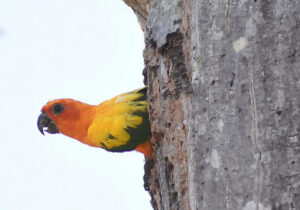
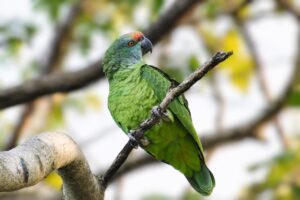
In spite of the bugs, high heat, humidity, no a/c, no hot showers, and the miles we walked through savannahs and forests, my fellow good-natured travelers remained adventurous and determined. The birds were also feeling the heat, giving us only small windows of opportunity to see them either early in the morning or just before dusk. However, we did manage to see several parrot species such as the Red-Fans (Hawk-headed); Festive, Yellow-crowned, and Orange-winged Parrots (Amazons); Black-headed Parrots (Caiques); Red and Green Macaws (Greenwings); Scarlet Macaws; Noble Macaws; Dusky and Blue- headed Parrots (Pionus); Golden-winged Parakeets; and one Sun Parakeet! (Conure).
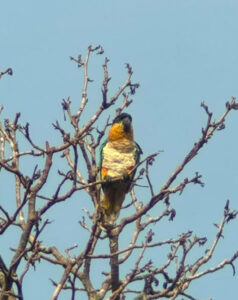
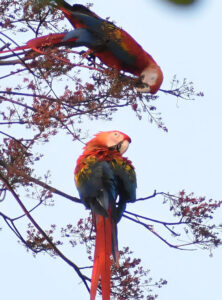
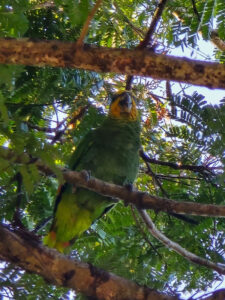
Because Guyana is only beginning to appreciate the value of ecotourism and has minimal facilities geared to it, most of birds could only be seen from a distance. But seeing wild parrots doing what nature built them to do is always magical, no matter how hard the effort to find them! Our guide, Ron Allicock, and his young protégé, Ravi Alfred, were true experts at hearing and seeing the birds. Ron comes from the indigenous Machusi lineage, and his grandfather was instrumental in establishing the country’s earliest conservation projects in the 1990s.
How Rewa Village is Leading the Way
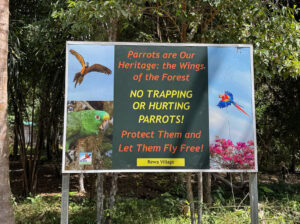
Deep in Guyana along the Rupiunni river, Rewa Village is proving a community-led conservation program can make a lasting difference. What began as a voluntary local initiative back in the 1990s has grown into an internationally recognized model for protecting wild parrots.
Although trapping parrots is legal in Guyana, Rewa Village chose to stop the practice in the 1990s. To measure the impact of this decision, they launched a formal monitoring project in 2018 in collaboration with the Rewa Ecolodge and One Earth Conservation.
Over six years of monthly counts across rivers, farms, and village areas, their efforts have yielded impressive milestones. Since there are few trails through the forest making it hard to count the parrots, Rewa utilizes a unique river-based counting methodology now considered a model and used in other countries. Early monitoring documented 20 of Guyana’s 29 parrot species—a number that has now expanded to 22 protected parrot species in Rewa this last year!
Rewa leaders will soon be visiting neighboring villages along with the local Wildlife Club to share their successes and encourage other surrounding communities to adopt similar “No Trapping” policies.
The village is also expanding its eco-friendly artisan items at the Rewa Ecolodge. There was nothing available at the lodge while we were there, so this will be a nice attraction for future ecotourists.
By combining local leadership, rigorous scientific research, and sustainable ecotourism, Rewa Village continues to set a powerful example for wildlife protection across South America.
This is the first time I’ve had an opportunity to spend time with an indigenous people. I have deep respect for their authentic alliance with nature, something many of us have lost with our many conveniences. A story as an example. Ken, our local guide, saw a caiman drown a peccary for its dinner. However, the otters had a den nearby and did not appreciate a caiman in their area, so they banded together and chased the caiman away. This left a dead peccary sitting in the river. Ken jumped in a boat and headed off to get it. When you don’t live near a grocery store, you don’t let good food go to waste!
One Earth Conservation is also officially launching a local chapter of its International Parrot Conservation Corps in Guyana, and is recruiting participants from Georgetown, Guyana’s largest city on the coast. An initial group of 15 participants is scheduled to complete targeted conservation mini-projects this next year. I hope Guyana will be able to stay ahead of destructive “development” in order to maintain its lovely forest and the beautiful culture of its indigenous people.
This month’s Lafeber donation goes to help One Earth Conservation extend its efforts in the village of Rewa, as well as support the Parrot Conservation Corps projects planned in Guyana next year.