




One of our natural attractions to parrots is their flawless ability to mimic sound. From the perfect replication of human words and phrases to the sounds of mechanized machinery, parrots amaze us with their vocalizations and reproductions. Interestingly, while we have learned a lot, we still have largely been unable to understand their ability to make these remarkable impressions.
The world of science is awash in continual studies on what makes the parrot tick. Their vocal abilities are a mystery, but science is getting closer to uncovering their abilities, even as we look much closer at their brain.
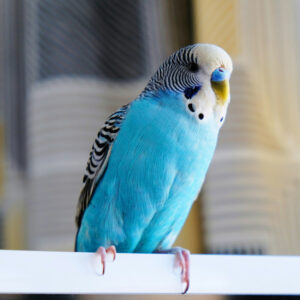
Researcher Dr. Michael Long and his colleague at NYU Langone Health, Zetian Lang, recently published a study in the science journal Nature that looks at the parrot’s ability to replicate speech. Specifically, the study focused on budgerigars. Thus far, budgies are the only animal documented with “language-producing centers” similar to those in humans. In their research, they watched nerve cells in the budgies’ brains as the budgies chirruped and discovered that the areas of the brain that are stimulated when the budgies “speak” are specific to the part of the vocalizations the bird creates.
Different Pitches Fire Up Different Neurons
Neural organization is a dedicated area of activity for these birds. It’s even theorized that their neurons are so specialized that they control the pitch of their chirrups. But there’s something even more amazing. They discovered that the way these budgerigars formulate their chatter is the same as humans doing the same task. The study found that when the birds chirp at varying pitches, certain neurons are fired up for that creation. A higher pitch fires up a specific neuron, and a lower pitch fires a different one.
For us, this study has amazing possibilities. Humans modify their speech in much the same way as budgies (or budgies the same way as humans) – with neurons firing to stimulate the areas of the cerebral cortex and traveling to the stem to control muscles of the throat and mouth to create words and tones via nerve endings.
This, and other forthcoming studies, can go a long, long way in helping science understand human speech better. With some people impacted by disorders that prevent speaking, these studies may help unlock the ability to correct human failings in the brain.
We are learning a wealth of new things about our feathered pals. And yet, there is still much more to uncover. It is thought that other parrots with the same vocal abilities may be able to do the same thing in their brains. But only time – and other, more advanced, studies – will uncover that reality.
What a great article! I have always had parakeets and some were great talkers. The sound of their little voices is so adorable! The little girl I have now imitates some of the sounds of my 22 year old Meyer’s parrot. He’s not a talker, but imitates her, my former cockatiel, squeaky windows, blue jays, Carolina wrens and the tea kettle among some of my favorites. :0)
Having lived with birds for 79 years, I’m
not surprised what your learning from them .
Especially when parrots can be taught names of objects y colors. Sometimes they understand a particular question y can answer correctly. Birds are amazing even Budgies