




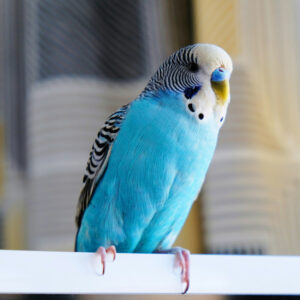
You may have seen a recent news article on this topic (Yang & Long, 2025)…and as I was asked to comment on the study, I thought it might be worth discussing the results here. The topic ties into a more general one involving vocal learning, so I’ll begin with that.
Vocal learning is the ability to acquire various utterances (songs, calls, words, etc.) after hearing them produced, as opposed to utterances that are considered innate, which, although they may change a bit with maturation, are defined as being species-specific and basically fixed throughout life. What is fascinating is that only a very small number of all the species on earth engage in vocal learning: just a few mammals (humans, bats, elephants, dolphins, whales, seals and sea lions) and a relatively large number of birds (but only when compared to mammals—parrots, songbirds, and hummingbirds). However, of all of these, even fewer have the ability to acquire and reproduce the sounds of human speech—only a very few mammals (humans, elephants, dolphins, killer whales, harbor seals)—and compared to the large number of vocal learning birds, few avian examples exist (some parrots, some corvids, mynahs, starlings).
Researchers are just beginning to understand what makes certain species’ brains uniquely capable of vocal learning. Interestingly, the avian brain is well-studied, and our knowledge has increased significantly over the past several decades (for reviews, see Jarvis, 2004; Jarvis et al., 2005). Knowledge has recently increased most with respect to the parrots, which, of all of the nonhuman species, are known to have the most extensive abilities to reproduce human speech. So, here’s a very brief and (because I am not a neurobiologist) superficial review of the avian brain (bear with me…it is the budgerigars’ brain that is crucial to their role as a model).
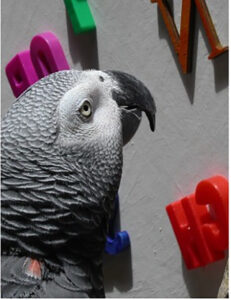
Budgie Vs. African Grey “Voices”
It turns out that the brains of humans and vocal learning birds have seven distinct loci (i.e., areas) responsible for this behavior. These areas are missing in species that do not engage in vocal learning. Interestingly, the areas in the birds and humans, although equal in number, do not look physically similar, nor are the connections among these areas all that similar. In fact, the areas and connectivity differ even among the parrots, hummingbirds, and songbirds (reviewed in Chakraborty et al. 2025). Nevertheless, these seven areas all seem to function in analogous ways in birds and humans to enable them to acquire their vocalizations via learning. But what about the acquisition of human speech?
Although we don’t yet know about the brains of all the birds that can acquire human speech (i.e., corvids haven’t yet been studied), we now know that for the parrots, specific brain areas are responsible for this behavior—areas missing in the nonparrots that were studied (primarily zebra finches).
Specifically, the parrot vocal learning system contains what researchers (Chakraborty et al., 2015) have termed “core” and “shell” region specializations, with the core system similar to the song system of songbirds and hummingbirds and the additional shell system unique (as far as we currently know!) to parrots. These researchers also found that the “shell” area varies in size across species, being thicker in birds like African grey parrots—known for their extreme accuracy in reproducing human speech—and thinnest in birds like the kea—known for learning their own vocalizations, but not for mimicry of human speech. But that isn’t the entire story….
We also know that different parrots produce human speech in slightly different ways. Grey parrots do so through what is known as frequency modulation, which is the same way that humans speak (Patterson & Pepperberg, 1994, 1998). So, for example, each human vowel is characterized by what is known as a “fundamental frequency” and (primarily) two other frequencies, called the first and second “formants”—so to produce the “ee” sound in “key” (technically referred to as /i/), humans modulate the frequencies of their speech in a different way than they do for the “ow” sound in “hoe” (technically referred to as /o/), using various parts of their vocal tract (larynx, glottis, mouth opening and closing, tongue position, etc.). Grey parrots perform similar actions, using their vocal tract (syrinx, larynx, glottis, beak opening and closing, tongue position, etc.; Warren et al., 1996), and the formant frequencies are rather similar (i.e., when we account for the difference in sizes of the vocal tract; Patterson & Pepperberg, 1994). That is why humans can mistake the vocalizations of a Grey parrot for another human.
Budgerigars, however, use a different technique, called amplitude modulation (see Banta Lavenex, 1999 for a complete description), which is probably why their productions of human speech, although completely understandable, could not be mistaken for those of a human. In another paper, Banta Lavenex (2000) described the particular bit of brain, termed the NLc, that controls the motor production of the budgerigars’ human speech.
So, where does this lead us with respect to the study on budgerigars that has made the news (Yang & Long, 2025)? These researchers, using far more sophisticated techniques than those that were available to Banta Lavenex (some twenty-five years ago!), studied a part of an area of the budgerigar brain, called the AAc, not present in the brain of a songbird (the zebra finch), finding that specific groups of neurons were used to produce vocal elements that have specific similarities in their species-specific utterances—a kind of map of the motor system used for production; the researchers describe it like a keyboard that makes particular sounds. They also argue that these bits of brain seem analogous to those used in the human cortex for speech production.
So, to tie all up, the bits of science I have introduced…First, from what I can understand, the part of the brain studied by Yang and Long is the “shell” part of the AAc, which would be in a budgerigar but not in a zebra finch (the “core” bit of the AAc would have an analog). Second, the “shell” bit of the NLc connects (the technical term is “projects” because of the direction) to the “shell” bit of the AAc (Chakraborty et al., 2015), which might explain how the findings of Banta Lavenex relate to those of Yang and Long. Third, the use of amplitude rather than frequency modulation in budgerigars’ production of human speech may mean that budgerigars might still be interesting, but (at least in my interpretation) less than perfect, models for the study of human speech production.
References
Banta Lavenex, P.A. (1999). Vocal production mechanisms in the budgerigar (Melopsittacus undulatus): The presence and implications of amplitude modulation. Journal of the Acoustical Society of America, 106, 491-505.
Banta Lavenex, P.A. (2000). Lesions in the budgerigar NLc affect production of, but not memory for, English words and natural vocalizations. Journal of Comparative Neurology, 421, 437-460.
Chakraborty, M., Walløe, S., Nedergaard, S., Fridel, E.E., Dabelsteen, T., Pakkenberg, B,, et al. (2015) Core and shell song systems unique to the parrot Brain. PLoS ONE 10(6): e0118496. doi:10.1371/journal.pone.0118496
Jarvis, E.D. (2004). Brains and birdsong. In P. Marler, H. Slabberkoom (Eds.) Nature’s music: The Science of Birdsong. New York: Elsevier- Academic Press.
Jarvis, E.D., Gunturkun, O., Bruce, L., Csillag, A., Karten, H., Kuenzel, W., et al. (2005). Avian brains and a new understanding of vertebrate brain evolution. Nature Reviews Neuroscience, 6, 151–159.
Patterson, D.K. & Pepperberg, I.M. (1994). A comparative study of human and parrot phonation: I. Acoustic and articulatory correlates of vowels. Journal of the Acoustical Society of America, 96, 634‑648.
Patterson, D.K. & Pepperberg, I.M. (1998). A comparative study of human and Grey parrot phonation: Acoustic and articulatory correlates of stop consonants. Journal of the Acoustical Society of America, 103, 2197-2213.
Warren, D.K., Patterson, D.K., & Pepperberg, I.M. (1996). Mechanisms of American English vowel production in a Grey Parrot (Psittacus erithacus). Auk, 113, 41-58.
Yang, Z., & Long, M.A. (2025). Convergent vocal representations in parrot and human forebrain networks. Nature,
https://doi.org/10.1038/s41586-025-08695-8.
I love this review, Irene. I believe that years ago you studied vocal learning in children and parrots at the various universities you have been at. I’m glad that some of the work that you did is being followed up.
I did not Budgies could talk. Keep sending your informative articles about birds. Thank you
Ms. Quinlan,
I have a 6yr old Conure. I have tried in vain to get her to talk. Do you know if they are capable?
Thanks for your advice,
Kim Stone
I think budgies or parakeets are amazing! My little guy is the most cheerful. He has a bell that he loves and constantly mimics the sound of it. Such a joy to!