




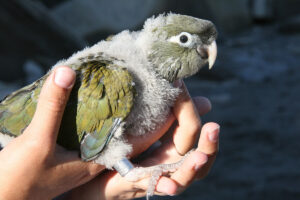
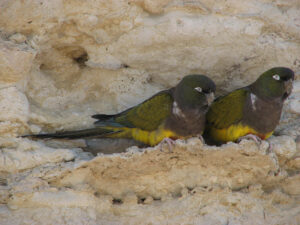
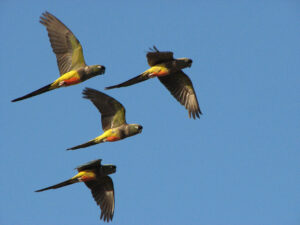
The Burrowing parrot or the Patagonian Conure (Cyanoliseus patagonus) is native to Argentina and Chile and lives in diverse habitats, from the arid deserts in the north to the frigid steppes of southern Patagonia. It is the only member of the genus Cyanoliseus. Patagonian conures are unique, with white eye rings and unusual olive-green, golden-yellow, and red feathering. They are the largest New World parakeet, which we commonly refer to as conures. Burrowing parrots are also slightly dimorphic to an expert eye, with the males being a bit weightier than females, and with larger and redder abdominal patches.
Life on the Cliffs of El Cóndor
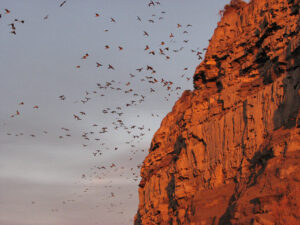
Patagonian conures are referred to as the burrowing parrot because they excavate nests high in sandstone and limestone cliffs. When spring arrives, which is October in Argentina, they flock from all over northeastern Patagonia to 11 miles of cliffs near the village of El Cóndor. This group is thought to be the largest parrot colony in the world! The cliffs provide predation protection. As the birds burrow into the cliffs, they create tunnels that end in a nesting chamber, and they often return to the same nest during the next breeding season. DNA studies have shown that mates are currently strictly monogamous. Patagonians usually lay 2 to 5 eggs, in the hope that 3 will ultimately fledge about 8-9 weeks after hatching; and juveniles typically stay with their parents for about 4 months.
Their natural diet is mostly fruit and berry-based in the summer. In other months, their diet shifts toward seeds, like thistles. A growing number of burrowing parrots are migrating to cities in winter due to loss of habitat or for other food sources, which has been a recent concern. Not only do some urban residents resist the intrusion, but many city food sources are ornamental plants and potentially harmful to their health and reproductive capacity.
From Cliffs to Classrooms
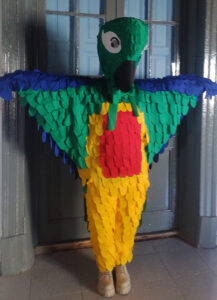
When it comes to conservation, lasting protection relies on local communities caring about and safeguarding their native species and habitats. For the Patagonian conures, that work is being led by biologist Mauricio Failla and his wife, Vero, both teachers in Viedma, near the cliffs of El Cóndor, where burrowing parrots gather to breed. Along with a dedicated and concerned team, Mauricio created Pirucha, a human-sized parrot suit comprised of 1,400 fabric feathers with cute eyelashes and a funny beak. Mauricio and Pirucha now visit schools and talk with the children about the parrots who live on the cliffs. Pirucha has visited with more than 3,000 students and teachers from 30 schools!
Pirucha now visits with her pichones, meaning “chicks.” These are small finger puppets made of plastic and leather that children hold and play with to spark their interest in parrots. Mauricio also wrote a children’s book to help children develop a love of nature in their earliest years.
Juan Masello, a research biologist at the University of Bielefeld (Germany) and the University of Venda (South Africa), has studied the El Cóndor colony during the breeding season for many years now. He says it has an average of 37,000 nests, representing 74,000 adults, extending over 18km of coastal cliffs. Unfortunately, in the 1970s, the largest colony of 45,000 nests near Bahía Blanca in the province of Buenos Aires was sprayed with pesticides and lost up to 90% of its population. In 1963, the burrowing parrot was unfortunately designated as a crop pest by the government of Argentina. However, thanks to the work of Juan, Mauricio, Vero, and others, the pest status was withdrawn in 2017, and the colony in El Cóndor received full legal protection in 2024.
Following two decades of research and outreach work, Juan and Mauricio have collaborated on over 20 documentary series produced by major international television networks, including the BBC, NatGeo, ZDF, TVE, and CNN. As a result, the world’s largest parrot colony has become known to millions of television viewers globally, raising awareness of its environmental uniqueness and tourism potential.
This month’s Lafeber donation goes to support conservation and education efforts for the exquisite burrowing parrots of Argentina.
My goodness! Thank you so very much for sharing this beautiful bird with us. I’m so happy to read they are no longer considered a pest. Pesticides sprayed that killed so many is an obscenity. Thank you for supporting conservation of these beautiful birds. I’d love to hold that baby☺️
My first two birds were Patagonians and that was in the early 80s. I would love to add one to my flock. They are wonderful birds. I am so happy to hear they are being protected from pest status